Sizzling Hot Deluxe
Sizzling Hot deluxe Review: The Five-Line Fruit Machine That Refuses to Cool Down
Sizzling Hot deluxe removes nearly every mechanic that modern slot menus use as a selling point. There are no Wild symbols, no Free Spins, no expanding reels, no cascading chain, no bonus purchase and no progressive jackpot. Five reels stand inside a purple cabinet. Fruit symbols, golden stars and flaming red Sevens fill three rows. Five fixed paylines settle the entire spin.
That stripped construction is not a limitation hidden behind elaborate artwork. It is the game's identity. Greentube and NOVOMATIC built Sizzling Hot deluxe as a direct digital fruit machine in which every important calculation remains visible on one screen.
The familiar online version is commonly dated to 13 November 2007. Greentube still names it among the studio's classic titles, and the game has remained in regulated-market integrations long after many releases from the same period disappeared.
An official NOVOMATIC specification records a 5-reel, 5-line format, fruit-and-fire theme, approximately 12 percent hit frequency when all five lines are played and a default 95.66 percent RTP profile. The same document lists seven other return settings, ranging from 88.14 to 97.04 percent. Checking the local help screen is therefore essential.
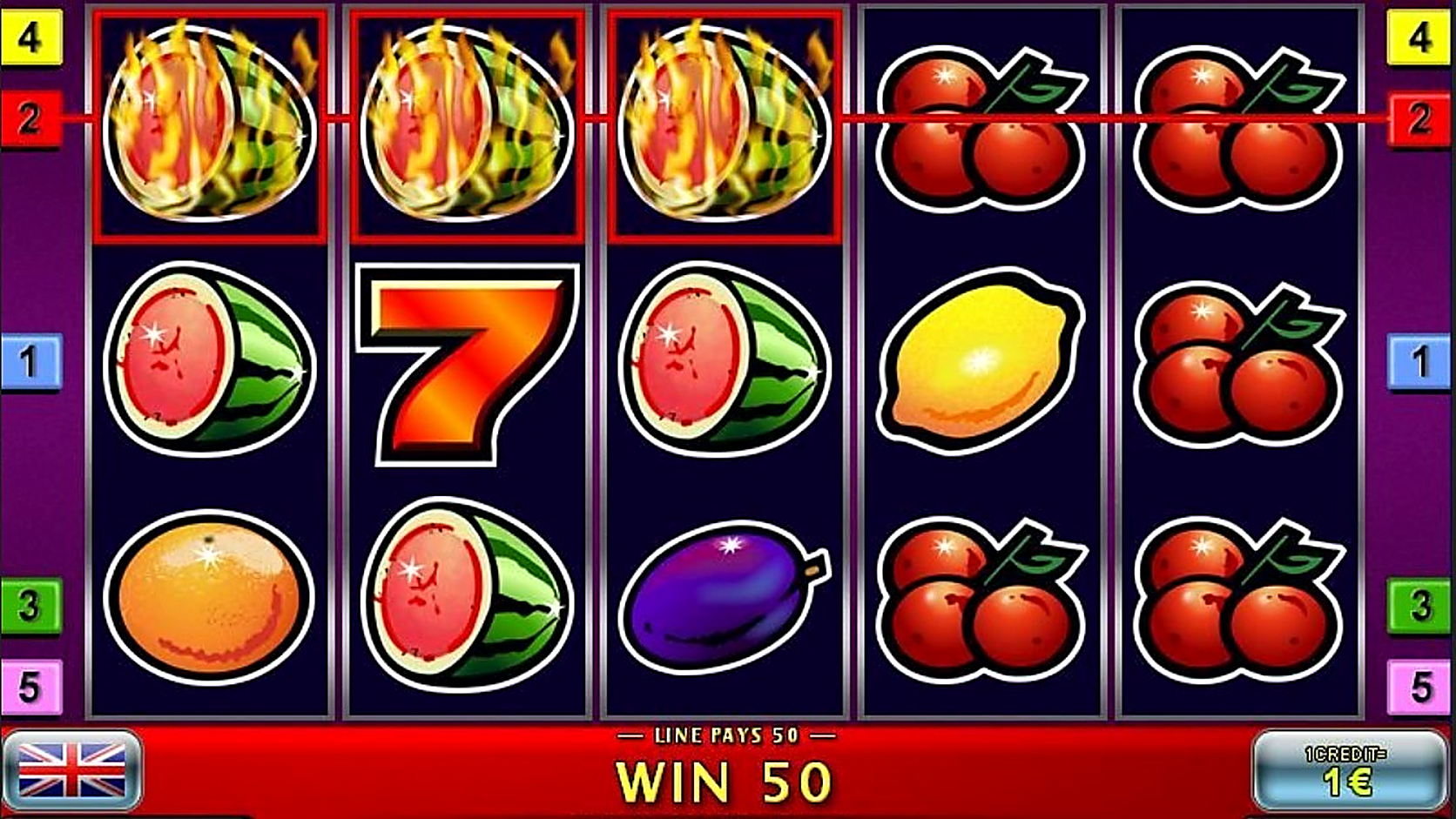
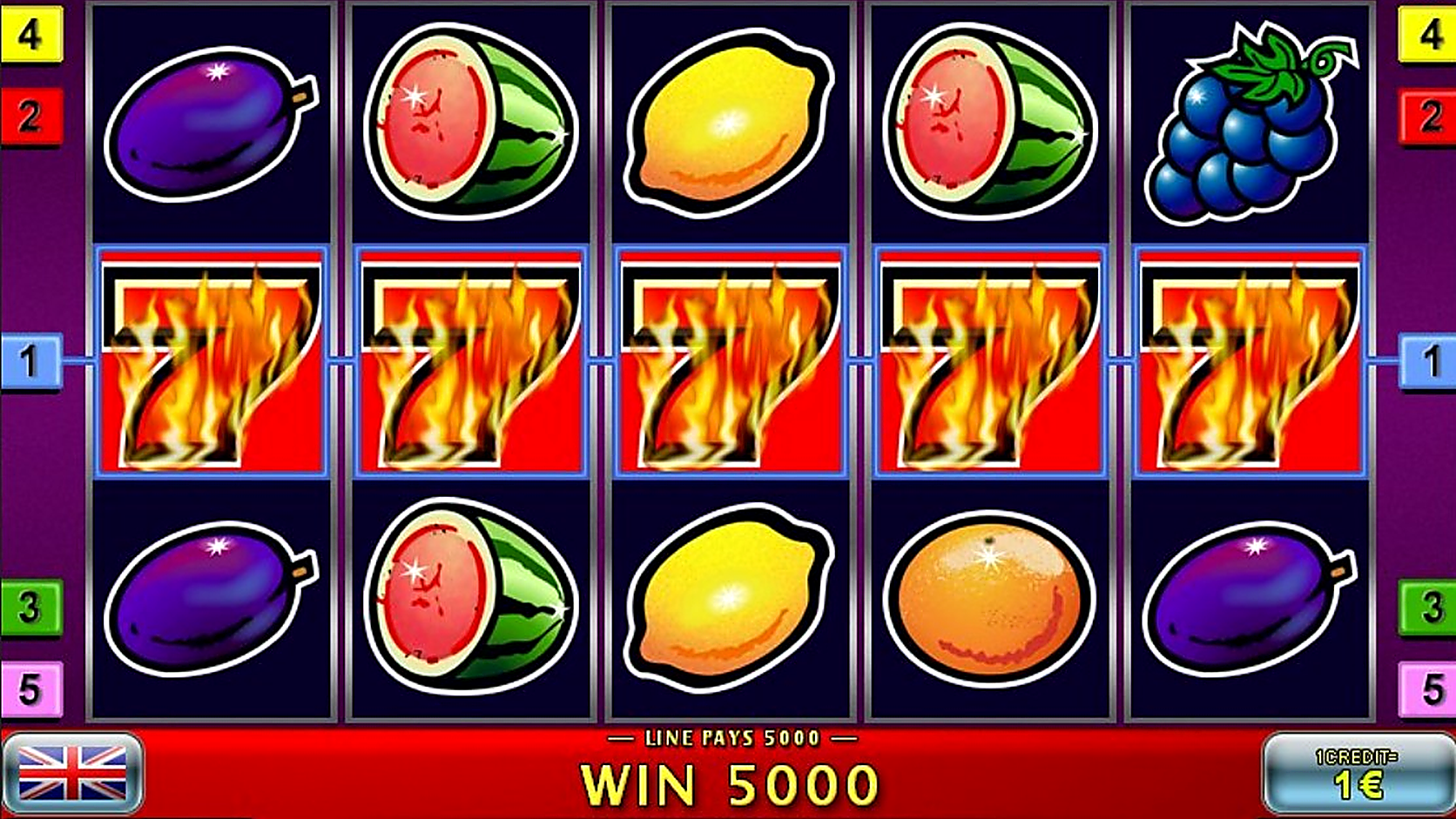
The three pictures in this article come from genuine Sizzling Hot deluxe material rather than generated replacements. They have been cropped, enlarged and sharpened to 1672×941 for horizontal publishing. The two reel pictures show real winning screens, including the center-line flaming Seven result that displays LINE PAYS 5000.
Five Reels Are All the Story It Needs
The game opens without characters, maps or introductory scenes. Its setting is the machine itself. Purple reel glass, red control panels and numbered line markers create the look of a casino cabinet adapted to a browser.
Each spin places fifteen symbols across a 5×3 grid. Winning line combinations begin on the first reel and run from left to right. Three matching symbols are normally required, with cherries paying from two consecutive symbols.
The five line markers sit at the edges of the reel window. One route runs through the middle row. Two use the upper and lower rows. The remaining paths move diagonally across the grid. The coloured markers make the active routes readable without opening a separate diagram.
All five lines belong to the standard configuration. A total bet is divided across them. This line-bet structure explains much of the confusion found in reviews and casino lobbies.
The machine does not need a story because its symbols already carry decades of gambling history. Cherries stand for the smallest regular result. Lemons, oranges and plums fill the lower fruit group. Grapes and watermelons sit above them. Flaming Sevens carry the largest line payment. Golden stars ignore the line routes and pay as Scatters.
Nothing on the grid substitutes for another symbol. A near-match remains a near-match. Three lemons cannot be completed by a Wild because no Wild exists.
That absence makes every settled line literal. What appears on the first three, four or five reels is exactly what the paytable evaluates.
The Official Rules Are Short but Precise
NOVOMATIC's specification defines the main game in a few sentences. Line combinations run from the first reel toward the right. Regular symbols pay on selected lines. Only the highest win is paid on each selected line. Line wins are multiplied by the credits bet per line.
The star follows different rules. Scatter combinations can appear anywhere, do not depend on a selected line and are multiplied by the total bet. Scatter awards are then added to line wins.
Those statements settle several common questions.
A regular fruit combination cannot begin on reel two. Matching fruit on reels two, three and four does not pay when reel one contains another symbol.
Two different regular awards on the same line do not stack if one is contained inside the longer combination. Five cherries pay the five-cherry amount rather than the three-cherry amount plus the four-cherry and five-cherry amounts.
Stars do not need to sit beside one another. Three stars located on separate rows still create the three-Scatter award.
A spin can contain both a line win and a Scatter win. The two amounts are added after their separate calculations.
This is the whole base structure. There is no second reel set waiting behind the stars and no hidden bonus map attached to the Sevens.
The Paytable Uses Line-Bet Units
The largest source of bad information around Sizzling Hot deluxe is not the RTP. It is the unit used by the original paytable.
Regular symbol values are expressed as multiples of the bet placed on one line. If all five lines use one credit each, the total spin costs five credits.
Five flaming Sevens on one line pay 5,000 times the line bet. Four pay 1,000 times the line bet. Three pay 100 times the line bet.
Watermelons and grapes share the next level. Five pay 500 line-bet units, four pay 200 and three pay 50.
Plums, oranges, lemons and cherries pay 200 line-bet units for five, 50 for four and 20 for three. Cherries also pay five line-bet units when two begin from the left.
The star is calculated against total bet instead. Five stars pay 50 times total bet, four pay 10 times and three pay 2 times.
When every spin activates five equally funded lines, converting regular symbols to total-bet units requires division by five. A five-Seven line is therefore 1,000 times total bet. Three Sevens are 20 times total bet. Five grapes or watermelons are 100 times total bet.
This conversion is why database pages often label the maximum as x1,000. They are describing the strongest single-line result relative to the full five-line spin stake.
The original screen can still display LINE PAYS 5000 because that message uses line-bet units. Both statements can be correct at the same time.
One Seven Line and a Full Screen Are Different Maxima
Five Sevens across one payline create the top award for that line: 5,000 line-bet credits.
With five active lines at one credit per line, the total wager is five credits. The line result is therefore 1,000 times the total wager.
A full screen of Sevens is a separate calculation. Every one of the five paylines contains five Sevens. Each line returns 5,000 line-bet credits. Five winning lines produce 25,000 line-bet credits in total.
Compared with the five-credit total stake, that full-screen result equals 5,000 times total bet.
This explains why some sources publish x1,000 and others publish x5,000. The x1,000 figure describes the top single line measured against the entire five-line stake. The x5,000 figure describes five top lines landing together on a full screen.
An operator may impose a game-round cap or cash maximum, so the local rules still matter. Currency settings can also change the displayed cash amount without changing the symbol ratios.
The genuine Seven screenshot in this article shows one center-line combination. Its message reads LINE PAYS 5000 and WIN 5000 because the interface is counting the original credit units.
It does not show a full-screen result. The other ten positions contain assorted fruit. Calling that screen x5,000 of total bet would be incorrect unless the selected stake contains only one funded line, which is not the normal five-line comparison.
The Star Is a Payer, Not a Door to Free Spins
The golden star is the only Scatter symbol. It pays from any visible positions and does not follow the five coloured line routes.
Three stars pay two times the total bet. Four pay ten times. Five pay fifty times.
The star does not start Free Spins. It does not open a pick screen, change the reels or add a multiplier. Its purpose is immediate payment.
This distinction matters because many current slots use Scatter as shorthand for bonus trigger. Sizzling Hot deluxe predates that assumption and treats the Scatter as a self-contained prize symbol.
The star's use of total-bet multiplication also separates it from regular fruit. A three-star result is two times the whole spin cost, regardless of the amount assigned to each line.
Scatter payment can sit beside line payment on the same spin. Suppose three stars appear while cherries also connect on an active route. The star amount and cherry line amount are calculated separately and then added.
Because the stars can land anywhere, no aiming pattern or line selection changes their geometric requirement. The RNG chooses the reel result, and the scatter counter evaluates the fifteen positions.
Five stars pay far less than one line of five Sevens when both are measured against total bet. The star's strength is positional freedom, not the highest prize.
Cherries Change the Rhythm With a Two-Symbol Win
Every regular symbol except cherries needs at least three matches. Cherries begin paying from two.
Two cherries from the left return five times the line bet. With five lines funded equally, that amount equals the full total stake when it occurs on one line.
Three cherries pay 20 line-bet units, which converts to four times total bet under a five-line stake. Four pay 50 line-bet units, equal to ten times total bet. Five pay 200 line-bet units, equal to forty times total bet.
The two-cherry exception gives the machine a small-result pathway that other fruit symbols lack. It does not make cherries a substitute or Scatter. They remain ordinary line symbols with a shorter minimum chain.
A two-cherry result must still begin on reel one and follow an active route through reel two. Cherries on reels three and four alone do not pay.
The exception also contributes to the approximately 12 percent hit frequency. Some paying spins return only around the stake rather than producing meaningful profit.
Hit frequency counts payments, not profitable rounds. A two-cherry line may cause the screen to register a win even when other line stakes were lost and the total credited amount only equals or falls below the entire spin cost.
This is one reason balance movement should be read through net change rather than the presence of a celebration.
Twelve Percent Hit Frequency Is Not Twelve Percent Profit Frequency
The official specification places hit frequency at approximately 12 percent when five lines are played.
In simple language, the model records a paying result on roughly twelve spins per hundred across a very large sample. It does not state that twelve spins per hundred finish in profit.
A payment smaller than total stake still counts as a hit in many game specifications. One modest line can return part of the five-line wager without recovering all of it.
The 12 percent figure also does not mean a payment must appear within every block of eight or nine spins. Random sequences can run much longer without a hit or place several hits close together.
One thousand spins would have an expected hit count near 120 under this profile. The actual count can differ because the outcomes are random.
Some databases round the figure to 13 percent. The first-party document uses approximately 12 percent at five lines, which is the stronger reference for the original profile.
Different RTP variations may use altered reel strips or symbol weights and could produce a slightly different measured rate. The help file inside the active version should take priority.
The low-looking number fits the game's prize structure. There are no Wilds to repair near-misses, no cascading sequence to produce a second evaluation and no Free Spins to add zero-cost reel results.
Every paid spin gets one visible grid and one settlement.
The RTP Menu Is Wider Than Most Reviews Admit
The familiar return setting is 95.66 percent. That is not the only official version.
NOVOMATIC's specification lists eight return profiles: 88.14, 90.02, 92.28, 94.16, 95.09, 95.66, 96.15 and 97.04 percent.
The spread between the lowest and highest is 8.90 percentage points. That difference is large enough to change long-run mathematical cost substantially.
At 95.66 percent, expected cost is 4.34 units for every 100 units of turnover. At 92.28 percent, it rises to 7.72. At 90.02 percent, it reaches 9.98. At 97.04 percent, it falls to 2.96.
For 10,000 units of turnover, those expected costs become 434, 772, 998 and 296 units respectively.
The symbol artwork can remain identical across profiles. A screenshot cannot reveal which mathematical version an operator uses.
The help screen or certified game information must display the active return. A casino review that always prints 95.66 percent may be wrong for the deployed copy even when its screenshots are genuine.
This multi-profile structure is more important than arguments about medium or high volatility. RTP changes the long-run mathematical price. A descriptive volatility label does not.
The official document also notes that market requirements and legislation can affect specifications. Regional configuration should therefore be treated as part of the real product, not a footnote.
Volatility Labels Conflict Because the Official Field Is Blank
Independent pages call Sizzling Hot deluxe low, medium, medium-high and occasionally high volatility. They cannot all describe the same category accurately.
The official specification includes a volatility field but does not place a readable category beside it. That omission is useful evidence: no precise first-party label should be invented.
The paytable and hit frequency still allow a structural reading. Approximately 12 percent of spins pay something. Small cherry hits exist, but the strongest line award reaches 5,000 line-bet units. There are no bonus rounds to redistribute value across extra spins.
That combination can create dry stretches punctuated by fruit or Seven results. It does not by itself tell us where a casino rating scale would draw the boundary between medium and high.
Volatility also changes with the perspective used. A player focusing on single-line awards may view the top result as large. A comparison against modern slots capped at 10,000x or more makes the same ceiling look restrained.
The most accurate review avoids a categorical label and describes observable structure instead: about 12 percent hit frequency, multiple RTP profiles, a literal line paytable, no Wild and no bonus feature.
Those facts are more useful than a word whose definition changes from site to site.
No Wild Means Near-Misses Stay Dead
Sizzling Hot deluxe has no Wild symbol. Every winning regular combination must be formed by identical symbols.
Two Sevens followed by a watermelon do not become a three-Seven win. Four grapes separated by an orange cannot connect across the break.
The lack of substitution lowers visual ambiguity. It also contributes to the feeling of empty space between payments.
Modern slots often use stacked Wilds, expanding Wilds or random replacements to rescue partial combinations. This machine does none of that.
The flaming artwork on winning fruit should not be mistaken for a transformation symbol. Fire is a celebration state placed over the symbols after the line has already won.
Likewise, the flaming Seven is simply the top regular symbol. Its flames do not multiply the payout beyond the value printed in the table.
A winning line is therefore easy to audit. Start from reel one, follow the coloured route and count identical symbols until the chain ends. Apply the line-bet value for that length.
That transparency is one of the game's strongest qualities. It reduces the gap between what the screen shows and what the paytable calculates.
No Free Spins Means Every Reel Result Has a Visible Cost
There is no Free Spins round in the base specification. The star pays immediately and returns the game to the next paid spin.
This changes session accounting. Every main reel result is linked to a new accepted stake. There is no ten-spin feature creating extra grid evaluations from one trigger.
Turnover is therefore easy to calculate. One hundred spins at five units create 500 units of turnover. Nothing needs to be deducted for free rounds.
The absence of a bonus also means the RTP is carried entirely by line and Scatter payments, plus any optional wrapper mechanic that may be enabled in a particular build.
No bonus purchase exists in the classic version. A casino button selling direct access to Free Spins would identify another Sizzling Hot product.
Some newer sequels use extra reel sets, win ways, jackpots or hold-and-win mechanics. Their rules must not be imported into this review.
The plain structure makes a losing sequence feel direct. There is no meter suggesting that progress has accumulated and no bonus tease to soften an empty screen.
That directness is either the main attraction or the reason to leave, depending on what someone expects from a slot.
The Gamble Screen May Depend on the Deployment
Many online versions add an optional Gamble button after a win. The usual format asks the player to predict red or black. A correct call doubles the eligible amount; an incorrect call loses it.
Current archive pages record this feature, and hands-on reviews describe using it. The core NOVOMATIC specification examined for this article does not list the Gamble screen among the base game rules.
That mismatch suggests the option can depend on the market, cabinet or online wrapper. It should be checked in the active client rather than assumed.
The Gamble result is a new risk decision after the reels have already settled. It does not change the probability of the original line win.
If the eligible amount is 10 units, a successful red-or-black guess normally raises it to 20. A failed guess reduces it to zero. Repeating the choice can create 40, 80 and higher amounts, but each step places the entire current sum at risk.
The true odds and any Gamble cap belong to the local rules. A graphical deck does not prove a perfect 50/50 model if other outcomes or limits exist.
Declining Gamble preserves the settled reel award. Using it changes the distribution after the hit but does not turn an unfavourable reel RTP into a favourable game.
Autoplay may disable the decision in some builds because automatic rounds cannot pause for a manual colour choice.
Fire Is a Win Indicator, Not a Multiplier
When a line pays, the winning symbols can appear covered in animated flames. This is where the name Sizzling Hot becomes part of the interface.
The flames identify the successful route and draw attention to the matching symbols. They do not create a separate factor.
The genuine Seven image shows the middle row burning while the blue center line crosses all five reels. LINE PAYS 5000 appears beneath the grid.
The other genuine image shows three watermelon symbols burning along the red line. The message reads LINE PAYS 50.
Both screens demonstrate the same process. The RNG settles the symbols. The line evaluator identifies a valid chain. Fire is layered over those positions. The amount appears in the win field.
This presentation is effective because no extra text is needed. A viewer can see which symbols belong to the award and which symbols are irrelevant.
The animation also prevents the plain fruit grid from feeling completely static. The machine stays simple without making a win look identical to an idle screen.
Calling the flames a multiplier would double-count the event. The printed paytable amount already determines the line value.
Why the Five Paylines Matter More Than They Seem
Five lines look sparse beside games with twenty, forty or hundreds of routes. The smaller number changes both readability and stake structure.
Every route can be identified by one numbered marker. The player does not need a large overlay to understand the grid.
With equal line stakes, total bet is exactly five times the line bet. This makes conversion between the original paytable and total-bet multiples straightforward.
The limited line count also means many matching symbols do not pay because they sit outside the five routes. A board can contain several cherries or lemons without forming a left-to-right combination.
More paylines would increase the number of evaluated paths but would also change the mathematics and total cost. Sizzling Hot deluxe is tuned around five.
Some wrappers allow line selection; others lock all five. The official hit-frequency figure specifically refers to five lines played.
If fewer lines can be selected, the hit rate for that spin would naturally fall because fewer routes are evaluated. The selected total stake would also change.
Modern database conversions generally assume all five are active, which is the correct basis for expressing the single Seven line as 1,000 times total bet.
Line Bet, Total Bet and Credits Must Not Be Mixed
Suppose one credit is placed on each of five lines. Total bet is five credits.
Three Sevens on one line pay 100 line-bet credits. Compared with the five-credit spin cost, that equals 20 times total bet.
Five grapes pay 500 line-bet credits, equal to 100 times total bet.
Five low fruits pay 200 line-bet credits, equal to 40 times total bet.
Two cherries pay five line-bet credits, equal to one times total bet.
The star does not need conversion because its table already uses total bet. Three stars pay two times total bet.
If the line bet rises to two credits, total bet becomes ten. A five-Seven line pays 10,000 credits, which is still 1,000 times the ten-credit total.
Changing denomination scales the cash result but leaves the ratio intact.
The interface screenshot showing one credit equal to one euro is a particular demonstration setting. It is not a universal minimum or a recommended stake.
The correct number before Spin is the total amount to be deducted, not the coin value printed in a corner by itself.
The Paytable Has a Clear Internal Ladder
Sizzling Hot deluxe uses four regular symbol tiers.
The flaming Seven stands alone at the top. Its five-symbol line pays ten times more than five watermelons or grapes.
Watermelon and grapes share the second tier. Their values are identical at three, four and five symbols.
Plum, orange, lemon and cherry share the third tier for chains of three or more. Their printed values match at every one of those lengths.
Cherry gains a fourth role through its two-symbol payment.
The star sits outside this ladder because it pays against total bet from any positions.
This hierarchy is easy to remember after a few spins. Red Seven is highest. Large fruit follows. Small fruit shares one table. Cherries can pay from two. Stars ignore lines.
No character portrait or themed object requires separate memorisation. The artwork communicates category through familiar fruit shapes.
That clarity is part of the game's longevity. The result can be understood without pausing for a tutorial after every mechanic.
The Screen Looks Old Because It Preserves the Cabinet
The purple background, hard reel borders, square buttons and numbered line markers belong to an older digital design language.
Greentube did not rebuild the classic into a flat modern interface. The browser version retains the feeling of a physical NOVOMATIC cabinet.
That preservation has practical strengths. Symbols are large. Contrast is high. The win field is obvious. Line markers remain visible.
It also has weaknesses. The control panel can look dense on a small phone, text may feel narrow and the reel animation lacks the cinematic depth of newer releases.
The fruit art uses thick white outlines that separate each symbol from the dark reel background. This is functional rather than subtle.
Seven and star symbols are equally direct. Their shapes remain recognisable even when the reels move quickly.
The title artwork uses red, orange and yellow flames around a metallic logo. The palette matches the win animation without adding a separate world behind the machine.
Age is visible, but it is not accidental neglect. The cabinet look is the product.
The Genuine Win Screens Explain More Than Promotional Art
The two gameplay pictures show the actual line system at work.
In the fruit image, the red line passes through the top row of the first three reels and then across the upper positions on reels four and five. Three watermelon symbols occupy the first three required points. The final two positions contain cherries, so the chain stops at three. The machine displays LINE PAYS 50.
That 50 is the paytable value for three watermelons in line-bet units.
In the Seven image, the blue center line crosses five flaming Sevens. The machine displays LINE PAYS 5000.
The symbols above and below the center line do not affect that award. They demonstrate why one top line is not the same as a full-screen result.
The edge markers also show all five line colours. A line is a route through positions, not a separate reel.
These authentic images are more useful than a dramatic mockup because they expose the unit language used by the cabinet.
The only processing applied for this article was proportional cropping, enlargement, light contrast adjustment and sharpening. No symbols or numbers were replaced.
The Machine Is Fast Because Nothing Interrupts It
After the reels stop, the game checks five lines and the Scatter count. If nothing pays, the next stake can be accepted.
There is no cascade, collection meter or feature transition to extend the round.
A paying line adds a short flame animation. A Gamble screen may appear in deployments where that option is active, but it can be declined.
This short cycle can produce high turnover when spins are repeated quickly. A simple game is not automatically a slow game.
At five units per spin, 200 spins create 1,000 units of turnover. The time taken does not change that total.
Autoplay, when present, can make the stake count less visible because no bonus breaks the sequence. The history panel should remain available.
Fast settlement is useful for reading the rules but can make repeated wagering feel mechanical. The balance and total bet deserve more attention than the flame animation.
Near-Misses Have No Stored Progress
Two Sevens on the first reels may look close to a major payment. They do not increase the chance of Sevens on the next spin.
Four stars do not make five stars more likely later. The Scatter count resets after settlement.
There is no persistent meter, symbol collection or chest waiting to open.
This makes gambler's-fallacy claims especially easy to reject. The machine does not hide a progress system that could justify chasing another spin.
Reel strips may be weighted, so symbols need not be equally likely. That weighting belongs to the math model and does not change because a symbol appeared or failed to appear recently.
The fire animation also leaves no stored heat. A winning line does not make the machine hotter in the statistical sense.
The title describes art and celebration, not a streak mechanic.
RTP Is a Turnover Ratio, Not a Session Forecast
At the 95.66 percent profile, 10,000 units of turnover carry an expected gross return of 9,566 and an expected mathematical cost of 434.
Those numbers describe the model over a very large sample. They do not forecast one 100-spin session.
The 12 percent hit rate and top-line award create a wide range of possible short results. One session can end far below 95.66 percent. Another can land a large Seven line and finish far above it.
RTP also does not state how many wins are profitable. A payment equal to total stake raises hit count without increasing balance.
Changing stake size does not alter the percentage within the same profile. It scales every cash outcome.
Changing from the 95.66 profile to 92.28 does alter expected cost. That is why the help-screen number matters more than a generic review badge.
No betting pattern changes the reel weights. Alternating large and small stakes changes monetary exposure, not the long-run ratio.
The Optional Gamble Does Not Repair the RTP
A double-or-nothing decision can turn a small win into a larger one. It can also erase the entire amount.
If the colour guess were perfectly even and paid a true double, its expected value before any cap would be neutral. That would preserve the value already won rather than raise the reel RTP.
If the implementation contains a house edge, tie outcome or restriction, expected value may be lower. The local rules determine this.
Repeated guesses increase variance. A win of five units can become ten, twenty and forty, but one incorrect call returns zero.
The reel result remains separate. A five-unit line win followed by a failed Gamble is recorded as a reel hit and a final loss of the awarded amount.
This option appeals to people who want a decision in an otherwise automatic game. It should not be described as a method for beating the paytable.
Why It Stayed in Greentube's Catalogue
Greentube still refers to Sizzling Hot deluxe as one of its classics and has included it in integrations across several regulated European and Latin American markets.
The game's longevity comes from recognition and portability. Fruit symbols cross language barriers. Five lines fit on small screens. The rules require little localisation.
Land-based familiarity also matters. The online version resembles machines already known from gaming halls in Central and Eastern Europe.
The title became a base for later variations, including versions with more reel sets, win ways, jackpots and other mechanics. Those successors exist because the original symbol set remains recognisable.
Simplicity also lowers the learning burden. Returning users do not need to study a new modifier sequence after an update.
The tradeoff is narrow replay structure. Someone who wants narrative bonuses or changing boards will find little beyond the base spin.
Longevity does not prove favourable mathematics. It proves that the design still has an audience.
The Classic Version Must Not Be Mixed With 10 Win Ways
Sizzling Hot deluxe 10 Win Ways is a later product with a different reel structure, cascading reactions and thousands of possible win routes.
It is not the game reviewed here.
The classic version has one 5×3 grid and five fixed paylines. It does not use falling-symbol reactions or a second reel set.
The RTP, maximum, bet range and mechanic list of 10 Win Ways cannot be copied into a classic Sizzling Hot deluxe article.
The same warning applies to Cash Connection, Jackpot or Hold and Win titles carrying Sizzling Hot branding.
The easiest identity check is the reel screen. Purple background, five line markers, basic fruit and one grid identify the classic design.
Common Errors in Sizzling Hot deluxe Reviews
The first error is saying that the star triggers Free Spins. It pays cash and ends the spin.
The second is inventing a Wild. No Wild exists in the official table.
The third is calling LINE PAYS 5000 a 5,000-times total-bet win. It is 5,000 times line bet, normally equal to 1,000 times a five-line total stake.
The fourth is ignoring a full-screen Seven result. Five simultaneous top lines can mathematically reach 5,000 times total bet before any local game-round cap.
The fifth is printing 95.66 percent as the only possible RTP. Eight official profiles are listed.
The sixth is converting approximately 12 percent hit frequency into 12 percent profitable spins.
The seventh is assigning a confident volatility category when independent sources disagree and the official field is blank.
The eighth is treating fire as a multiplier. Fire marks the line win.
The ninth is borrowing mechanics from Sizzling Hot deluxe 10 Win Ways or jackpot sequels.
The tenth is claiming that recent losses make a Seven result due.
Reading the Win Field Correctly
The screen can display three different monetary ideas: credit denomination, line payment and final win.
One credit may represent a selected currency amount. The line bet is the number of credits assigned to one payline. Total bet combines the funded lines.
LINE PAYS identifies the award attached to the highlighted route under the original credit table.
WIN totals the current spin's eligible line and Scatter awards.
If several paylines win, the final WIN field can exceed the value shown for one highlighted line. The interface may cycle through each route before displaying the total.
A paying number should then be compared with total bet to determine net result. A five-credit return after a five-credit spin is break-even, not five credits of profit.
The balance history is the best record when animation cycles too quickly.
Mobile Scaling Preserves the Symbols Better Than the Controls
The 5×3 grid adapts well to landscape phones because only fifteen large pictures need to remain visible.
The control panel is harder to scale. Line count, total bet, denomination, autoplay and Start may compete for the narrow lower edge.
Full-screen mode reduces browser interference. Landscape orientation keeps the fruit large enough to distinguish grapes from plums.
Touch targets should be checked before rapid spins. The Max Bet button can sit close to other controls in older layouts.
The current online implementation may differ from the cabinet screenshots in this article. Wrapper design, stake range and language selector can change while reel math remains recognisable.
Connection loss after a spin should not alter the server result. Reopening history is safer than placing a duplicate wager.
No direct public Demo capture was possible during this review because the accessible demo pages were blocked or failed to launch in the test environment. The original screenshots and first-party specification were therefore used instead.
Philippine Readers Need to Check the Active RTP First
The fruit imagery and short rules make Sizzling Hot deluxe easy to understand in a mobile casino lobby. The key local issue is not translation. It is configuration.
An operator may use any certified RTP profile permitted by its market. The title screen will look the same at 95.66, 92.28 or another return setting.
Peso limits also depend on the wallet. An old screenshot showing one credit equal to one euro does not establish a Philippine stake range.
The local help file should disclose total bet, RTP and any maximum cash payout. It should also state if Gamble is enabled.
GCash or Maya availability belongs to the casino cashier, not to the game itself. A review of reel math does not verify the operator.
The classic game may appear under Greentube, NOVOMATIC or a platform category. Its five-line grid and exact symbol set are stronger identity checks than the lobby folder.
Who Still Gets Something From This Design
The natural audience is someone who wants reel outcomes without a long bonus sequence. Every payment comes from visible fruit, Sevens or stars.
Fans of physical-style cabinets may recognise the sound, line markers and credit language immediately.
Anyone who enjoys analysing a literal paytable also gains clarity. The full rule set fits into a small number of calculations.
The game is less suited to people waiting for Free Spins, character scenes or progressive pots. None exists in the classic build.
Someone seeking very frequent payment may also find the approximate 12 percent hit rate severe, especially when some hits only recover a small part of total stake.
The multiple RTP profiles make operator selection more consequential than usual. The same artwork can hide a large difference in long-run cost.
Final Assessment: The Math Is More Interesting Than the Fruit
Sizzling Hot deluxe looks almost too simple to support a deep review. Five reels, five lines and eight symbol types appear to settle the matter in a few paragraphs.
The depth sits in the units. Regular symbols pay against line bet. Stars pay against total bet. Five Sevens on one line display 5,000 line-bet credits but equal 1,000 times total bet when five equal lines are active. A full screen can create five such line awards and reach 5,000 times total bet before local caps.
The RTP menu adds another important layer. The widely quoted 95.66 percent build is only one of eight official settings. The range extends from 88.14 to 97.04 percent.
The rest is intentionally direct. Approximately 12 percent hit frequency at five lines. Cherries pay from two. Other fruit pays from three. Stars pay anywhere. No Wild. No Free Spins. No jackpot. An optional red-or-black Gamble may appear in some online deployments.
The genuine screenshots show why the game remains readable after so many years. A successful route burns, its line colour stays visible and the cabinet prints the exact line payment beneath the reels.
Sizzling Hot deluxe does not need to imitate a modern release. Its value as a design lies in refusing to hide the wager behind a long chain of mechanics. The symbols stop, the five lines are checked, the stars are counted and the balance moves. For readers willing to examine line bet, total bet and active RTP, that simplicity reveals more mathematics than most elaborate slots place on screen.
By Fairy Editorial - 05 Aug 2026

Golden Dragon 2
Golden Dragon 2 Review: Four Free-Game Paths Guard a 1,000x Treasure
Golden Dragon 2 comes from a period when a sequel could still fit inside a compact 5×3 cabinet. It does not add expanding grids, hundreds of thousands of ways or a store full of bonus purchases. XIN Gaming builds the game around 25 fixed paylines, a golden chest carrying random win multipliers and three dragon eggs that open a choice between four Free Games modes.
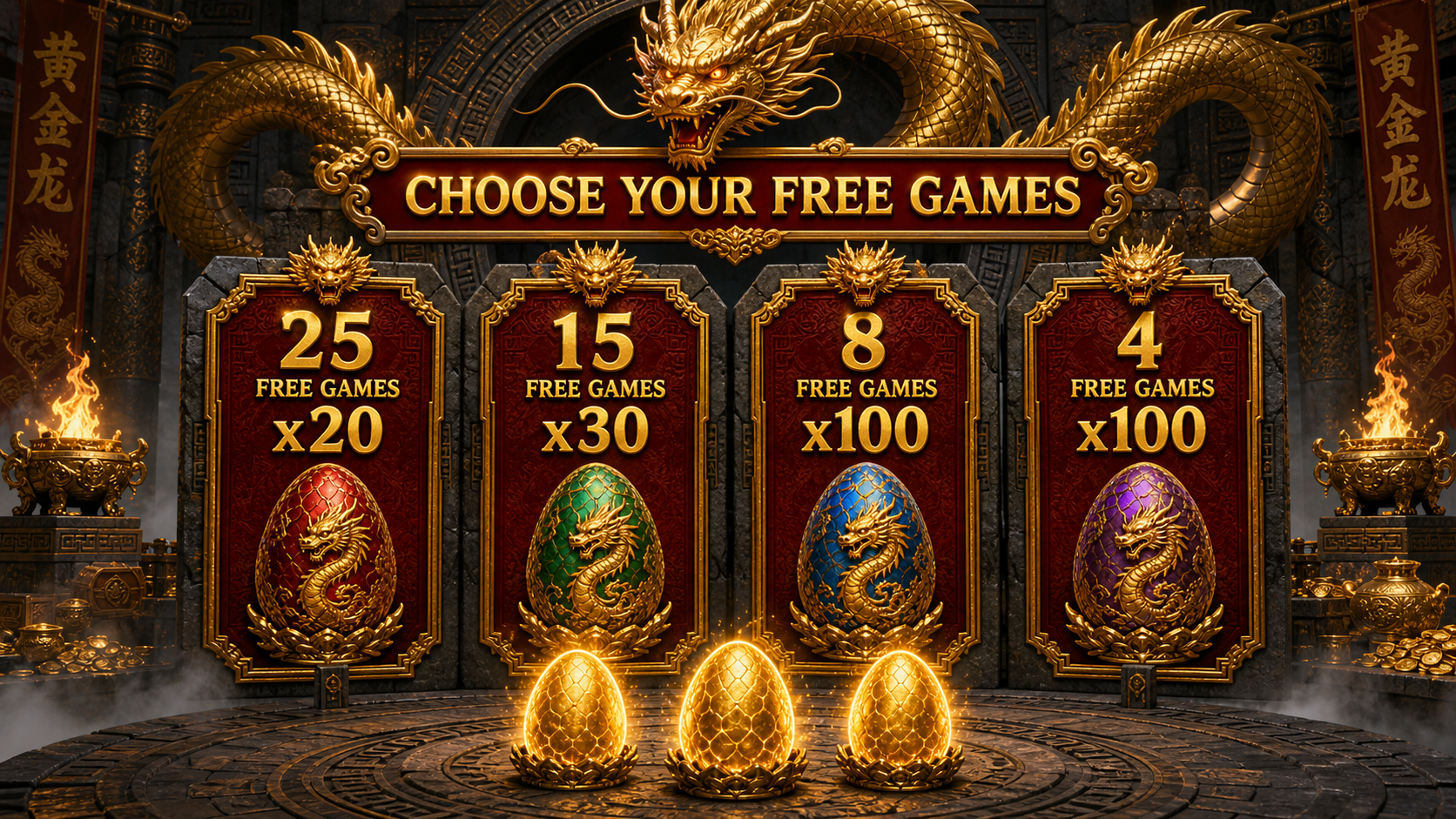
That choice gives the 2017 release its lasting point of interest. The bonus is not presented as one fixed package. Archived material lists 25, 15, 8 and 4 Free Games, paired with multiplier ceilings of x20, x30, x100 and x100. More rounds sit at one end. Fewer rounds with a higher stated multiplier range sit at the other. The selection does not remove chance, but it lets the player decide how the bonus will distribute that chance.
The underlying specification is unusually clear for an older XIN title. Public records agree on a release date of 7 January 2017, a 5-reel by 3-row layout, 25 paylines, 96.24 percent RTP, high volatility, a listed maximum of 1,000 times the stake and an archived betting range from 3 to 6,000 units. The build uses JavaScript and HTML5 and is recorded as mobile compatible.
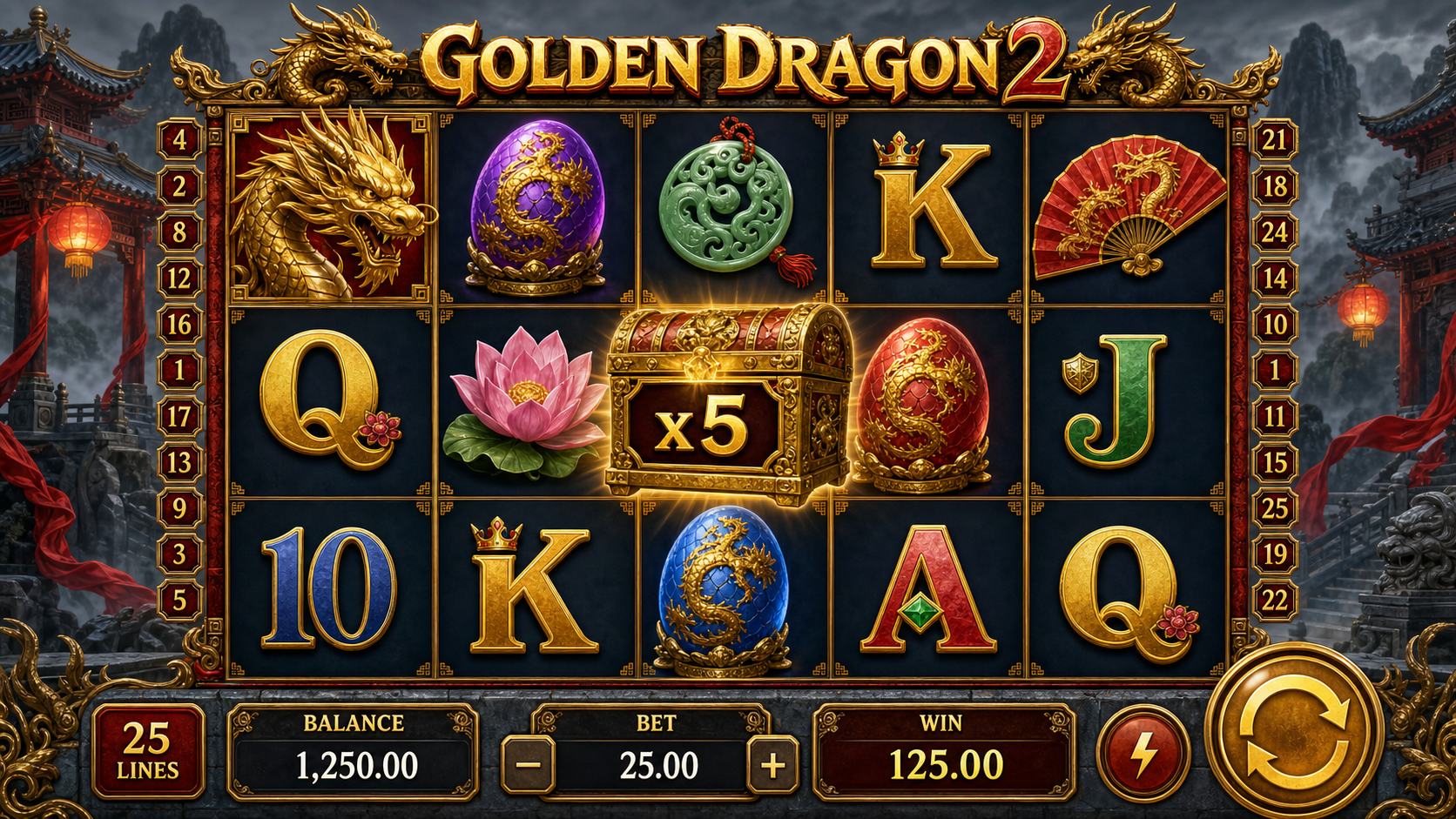
The public Demo no longer runs. Archive pages retain nine gallery entries, but the full-resolution originals are no longer accessible for reliable publication. The three wide pictures in this article are therefore editorial reconstructions based on the confirmed gray fantasy setting, golden dragon, treasure chest, dragon eggs, 5×3 board and four-choice bonus. They are not XIN Gaming screenshots, and numbers shown inside them must not be treated as an original paytable.
A Sequel Built Around Choice Rather Than Grid Size
The number 2 in the title suggests a return to an established dragon world, but the surviving record says more about the sequel than it does about the first game. Golden Dragon 2 is the version with the well-documented 25-line board, random chest multiplier and selectable Free Games modes.
Its design belongs firmly to the mid-2010s. Fifteen positions form the whole play area. Wins follow fixed lines rather than adjacent clusters. The bonus begins through a recognisable trigger symbol instead of a purchased entry button. A large result tops out at 1,000 times rather than five or six figures.
The compact format keeps the rules visible. A spin has three main questions. Did regular symbols connect across an active line? Did the golden chest apply a random multiplier to a win? Did three dragon eggs start the Free Games selection?
That is enough structure to create several result types without turning the help screen into a manual. The chest matters during ordinary play. The eggs aim toward a second phase. The 25 lines make the base calculation familiar to anyone who has used an older video slot.
The sequel label also creates a research risk because numerous studios have released games called Golden Dragon, Golden Dragon II or Golden Dragon 2. Some use 243 ways. Some are modern Hold and Win games. Others belong to land-based cabinets or social casino apps.
The correct identity markers here are XIN Gaming, the January 2017 date, 96.24 percent RTP, high volatility, 25 paylines, a 1,000-times maximum, golden chest multipliers and three dragon eggs leading to a four-part bonus choice. A page missing those markers may describe a different game.
The 5×3 Cabinet Keeps Every Position Legible
Five reels and three rows create fifteen visible symbols. That small board leaves little room for confusion about where a line begins and ends.
Fixed paylines normally evaluate matching symbols from the leftmost reel toward the right. The accessible archive confirms 25 lines but does not expose the original line diagram at readable resolution. The in-game help screen should therefore be used to check exact line shapes and the minimum number of matching symbols.
Unlike an all-ways game, symbol position matters beyond simple reel adjacency. A matching symbol on reels one, two and three pays only when those positions sit on one active route described by the line map.
Twenty-five lines can cross the grid through horizontal, diagonal and zigzag paths. A single arrangement may pay on several lines when symbols overlap. Each line is evaluated under the game's own paytable, after which valid wins are added together.
The format also explains the archived minimum bet of 3 units with some uncertainty. Older games sometimes state betting ranges in coins, line stakes or total credits. A value of 3 does not automatically mean that all 25 lines cost only three currency units. The deployed interface must show the total deducted by the next spin.
The generated gameplay illustration displays line numbers along both sides to communicate the fixed-line structure. Their order is editorial rather than a reproduction of XIN's original route map.
The cabinet's strength is speed of reading. Three rows make the eggs easy to count, the chest easy to locate and line wins easier to trace than on a six-row modern grid. Its limitation is equally plain: fewer positions restrict the number of simultaneous events the screen can stage.
Twenty-Five Paylines Mean Twenty-Five Routes, Not Twenty-Five Reels
The term 25 paylines is often misread as 25 chances independent of stake. In a fixed-line slot, it means the board contains 25 predefined routes across the same fifteen positions.
A total wager may be divided across those routes. If the spin costs 25 credits, the line stake could be one credit. If the spin costs 50 credits, the line stake could be two credits. The exact denomination system belongs to the local interface.
This matters when reading symbol payouts. An old paytable may list awards in line-bet units rather than total-bet units. A displayed value of 100 for five matching symbols could mean 100 times the amount assigned to that line, not 100 times the entire spin stake.
The published 1,000-times maximum is normally quoted against the total stake by modern databases, but the original help file should settle any difference in terminology.
All 25 lines appear to be integral to the game profile. No archive labels them adjustable. If a local version permits fewer active lines, disabling some routes may alter hit frequency and the cost per spin without improving the underlying value.
The line system also shapes chest multipliers. A chest attached to one line win may multiply only that win. A global chest mechanic may multiply the combined result. Public descriptions say that the golden chest can multiply wins by random multipliers, but they do not expose the exact order of calculation.
That missing detail should stay open. A reviewer cannot safely claim that one chest multiplies every winning line, stacks with another chest or substitutes for every symbol until the original rules confirm it.
The Golden Chest Makes Ordinary Spins Less Predictable
The chest is the base game's main modifier. Archived descriptions state that it can multiply wins by random multipliers.
This wording suggests that the chest does not merely pay a fixed symbol award. It changes the value of another winning result. The accessible records do not publish its complete multiplier set, landing restrictions or calculation sequence.
Some archive commentary describes the chest as a high-value Wild carrying a random multiplier. Other summaries separate Wild and multiplier tags without naming the symbol. Because the original paytable images cannot be recovered at useful resolution, the safest statement is narrower: the golden chest is associated with random win multiplication.
That still changes the texture of the base game. A normal line can finish at its printed value. A chest-assisted line may rise above that amount when the random factor applies.
Random multiplier does not mean a multiplier rises over time. It is not a persistent meter and not a cash-out mechanism. The game selects a factor under its rules and applies it to an eligible result.
Two questions matter during a working spin. First, which win is eligible? Second, is the displayed multiplier already included in the final WIN amount? The balance history should answer the second even when the animation moves quickly.
The chest also supports the treasure theme without needing a separate side screen. Opening a chest to reveal a factor connects the picture to the calculation.
No dependable source lists a guaranteed minimum factor. A multiplier may appear rarely, and its highest value may be rarer still. A visible chest on one losing arrangement does not automatically create a payment unless its symbol rules say so.
Three Dragon Eggs Unlock the Main Decision
The trigger condition is recorded consistently: three dragon eggs start the Free Games feature. The eggs act as the bonus symbols in the surviving descriptions.
The exact reel restrictions are not available. They may land anywhere, occupy particular reels or count through a Scatter-style rule. The archive tags include Scatter symbols, but the original help file is needed before stating that eggs pay independently of lines.
Once three eggs appear, the game moves to a choice screen rather than immediately starting a fixed number of rounds. Four options are listed in later archive material: 25, 15, 8 or 4 Free Games.
The visible decision is the feature's defining trait. A person who prefers more attempts can choose the 25-round route. Someone willing to accept a shorter sequence can select 15, 8 or 4 rounds in exchange for access to a different multiplier scale.
The egg trigger itself remains random. Picking a mode does not help the eggs arrive. The decision occurs only after the bonus has already been won.
The eggs also work as clear storytelling. A dragon guards treasure, three eggs appear, and the bonus lets the viewer choose how the dragon's power will be used. The mechanic and imagery support each other.
The trigger should be recorded before the feature transition. A mobile disconnection at that moment must not erase an accepted result. Reopening the game or transaction history should restore or settle the pending bonus under the server rules.
If a current casino displays a different trigger count or only one bonus mode, its version should be checked carefully. It may be another profile, an altered build or a different Golden Dragon title.
Four Bonus Routes Turn Quantity Into Risk
The Free Games menu creates a direct trade between the number of rounds and the multiplier ceiling attached to the selected route.
The archived options are 25 rounds with multipliers up to x20, 15 rounds with multipliers up to x30, 8 rounds with multipliers up to x100 and 4 rounds with multipliers up to x100.
The word up to is essential. Choosing x100 access does not mean every line win receives x100. It identifies the recorded upper boundary for that mode. Actual multipliers and their frequencies remain random.
The two shortest choices sharing the same x100 ceiling may look odd. They can still differ through multiplier weights, reel strips, win frequency or another rule not visible in the short archive summary. The missing Demo prevents a direct comparison.
It would be wrong to claim that four rounds are automatically better or worse than eight simply because both mention x100. If both used identical reels and identical multiplier probabilities, eight rounds would dominate four. Their coexistence suggests some additional mathematical distinction, but that distinction cannot be verified from the accessible record.
The 25-round route spreads the feature over more spins with a lower multiplier ceiling. More rounds increase the number of observations, but they do not guarantee a larger total.
The 4-round route compresses the sequence. A few poor outcomes can finish it quickly. A strong multiplier result may create a sharp jump. The emotional swing becomes concentrated even before considering the game's high-volatility label.
This is a choice of distribution, not a strategy that changes RTP unless the help screen says the modes have different theoretical returns.
The Bonus Choice Is Not a Skill Edge
A selectable bonus feels strategic because the player makes a decision after seeing four risk profiles. That decision affects how the feature unfolds, but it does not automatically create an advantage over the house.
Well-designed choice bonuses usually balance their modes around similar expected value. More rounds pair with smaller potential factors; fewer rounds pair with larger but less dependable factors.
The accessible Golden Dragon 2 data does not publish RTP separately for the four choices. No mode can be called mathematically best from the advertised ceilings alone.
Consider a simplified example. Twenty-five rounds capped at x20 could carry small factors frequently. Four rounds capped at x100 could assign x100 to only a tiny share of wins. Both paths could still reach the same average return.
The game does not reveal multiplier probabilities in the surviving summaries. Counting maximum values without their probabilities is incomplete analysis.
Personal preference remains relevant. A longer feature creates more reel activity and usually a smoother-looking sequence. A shorter one reaches its result sooner and may place more of the feature value into a small number of events.
That preference should be chosen before the outcome, not changed because a previous feature went poorly. A weak 25-spin bonus does not make the four-spin route due to pay more next time.
Calling one path safe and another dangerous is only a description of shape. Every route is still random, and all can finish below the triggering stake in net terms unless the rules include a guaranteed minimum.
What High Volatility Means Here
Golden Dragon 2 is listed as high volatility. That label indicates wider movement around the theoretical return than a low-volatility game, generally through less regular profitable results or greater dependence on stronger events.
It does not mean that every win is large. High-volatility slots still produce small line payments, sub-stake returns and empty spins.
The bonus architecture supports the label. Three eggs must arrive before the Free Games choice appears, and the larger multiplier ceilings sit inside selected bonus modes. The random chest adds another layer of result variation.
The 1,000-times maximum is moderate by current standards, yet volatility and maximum win describe different things. A 1,000-times game can be highly volatile if meaningful returns occur infrequently. A 10,000-times game can place more value into frequent small wins while keeping its top result extremely remote.
Hit frequency is not published in the accessible archive. No honest percentage can be assigned to winning spins, profitable spins, chest activations or egg triggers.
A handful of Demo rounds would not answer those questions even if the game still loaded. High volatility is a property of the full probability model, not a feeling created by twenty spins.
For currency exposure, stake size remains the direct control. Reducing a 100-unit spin to 10 units reduces each result's cash movement by 90 percent. It does not change the stated RTP or turn the game into a low-volatility model.
The bonus choice then changes how the feature looks within that model. The 25-round route spreads events across more spins; the shorter routes concentrate them.
RTP at 96.24 Percent
The listed theoretical RTP is 96.24 percent. Across a very large sample matching the certified model, the expected return is 96.24 units for every 100 units staked.
The corresponding mathematical cost is 3.76 percent of turnover. One thousand units of total stakes carry an expected gross return of 962.40 units and an expected cost of 37.60 units.
At 25 units per spin, forty spins create 1,000 units of turnover. The expected cost remains 37.60, but an actual forty-spin result can sit far above or below that figure.
High volatility makes short-session deviation especially important. A run without the eggs or a strong chest factor may fall below the theoretical mean. One high-value bonus can move the balance far above it.
RTP is not the chance of winning a spin. A 96.24 percent number does not mean 96 winning spins out of 100. Hit frequency and return size combine to form RTP, and the hit frequency is unknown here.
The full figure includes base-line returns, chest multipliers and Free Games. Bonus rounds are not separate free value added on top of 96.24 percent. Their contribution is funded by paid-spin mathematics.
The archive does not state separate RTP values for the four bonus choices. It is reasonable to expect balancing, but equal return should not be asserted without the original rules.
Regional or operator versions can use another math profile. The live help screen takes priority over the historic 96.24 percent listing. A current copy should disclose its own value before a paid spin.
Why the 1,000x Maximum Needs Context
The maximum listed result is 1,000 times the stake. A 3-unit wager makes that 3,000 units. A 100-unit wager makes it 100,000 units. A 6,000-unit wager would make it 6,000,000 units if the historic upper bet and multiplier could be combined without an operator cap.
That final example illustrates why currency and platform limits matter. The archive's 3-to-6,000 range may refer to credits or coin settings rather than direct cash units. A casino may impose a lower maximum payout.
The 1,000-times figure also does not identify the route to the top. It may require a high-paying line, a chest multiplier, Free Games accumulation or a combination of those events.
No progressive jackpot is recorded. The ceiling scales with stake instead of growing through network contributions.
Compared with current slots advertising 10,000x or more, 1,000x looks restrained. That does not make it common. The frequency of the top outcome remains unpublished and may be extremely low.
Maximum win must also be separated from maximum multiplier inside a bonus option. An x100 Free Games factor does not imply the whole game caps at x100. It may multiply a qualifying line before the entire feature total is counted, while the game-level cap remains x1,000.
The exact calculation order should appear in the paytable. If a current build shows a different maximum, the operator should identify the version rather than relying on the old catalogue record.
The Historical Bet Range Needs Careful Translation
Public records list a minimum bet of 3 and maximum bet of 6,000. Those numbers describe the catalogue configuration, not every modern wallet.
Older slots often use credits, coins per line and coin value as separate controls. A minimum shown as 3 may come from a denomination setting rather than a direct three-dollar or three-peso deduction.
The total bet field is therefore the number that matters before Spin. It should already include all active lines and coin settings.
A Philippine-peso deployment may map credits to whole peso amounts, fractional units or a different range. A Demo wallet may show fictional credits unrelated to cash.
The ratio between 3 and 6,000 is 2,000 to one. That is a very broad historic range. It suggests that the original framework was designed for flexible operator configuration rather than one fixed audience.
High volatility makes the top end particularly consequential. Increasing the stake does not improve egg frequency, multiplier chance or RTP under the published model. It only scales monetary outcomes.
The interface should lock stake controls while the reels move. After Free Games end, it should return to the same paid-spin stake without silently changing denomination.
If the game remembers the previous amount after a reload, the balance and total bet should be checked again. Old HTML5 wrappers can restore settings differently from the central game client.
Symbols Need Roles, Not Invented Pay Values
The archive identifies dragons, eggs, a chest and treasure imagery. The 5×3 board likely combines those premium pictures with lower card ranks common to the era.
Three symbol roles can be discussed with confidence. Regular symbols form line wins. The dragon eggs trigger Free Games when three land. The golden chest is connected to random win multipliers.
Wild and Scatter tags appear in the database, but their exact artwork and substitution rules are not recoverable from the readable archive. One secondary article calls a golden dragon the Wild and a yin-yang icon the Scatter, yet this conflicts with the repeated egg-trigger description.
The conflict is a reason for restraint. The eggs can trigger the feature without needing to be labelled as a yin-yang symbol. A Wild may be the dragon, chest or another object. The original paytable is the authority.
No payout amounts should be copied from similarly named dragon games. A five-of-a-kind value from another studio has no place here.
The editorial gameplay image uses a dragon, eggs, jade, lotus, fan, chest and card ranks to create a plausible 2017 board. It is visual support, not documentation of the original symbol set.
In a working copy, the paytable should answer four questions: which symbol substitutes, which symbol triggers the bonus, how many matching icons are needed, and if Scatter awards depend on lines.
Those answers matter more than decorative descriptions of the art.
Gray Stone Makes the Gold Read Better
The archived theme tags include gray, dragons, eggs, chest, treasure and fantasy. Gray is an unusual tag for a prosperity slot, where red and gold normally dominate.
The darker setting gives the dragon and treasure room to stand out. Gold against charcoal stone creates immediate hierarchy. Eggs can use jewel colours without blending into the background.
Red can remain an accent through silk, lanterns or reel trim rather than covering the whole screen. This keeps the board legible when the chest reveals a multiplier.
The golden dragon belongs to the East Asian serpentine form: long body, antler-like horns, whiskers and no required wings. That silhouette separates it from medieval Western dragon slots.
The chest connects wealth imagery to a mechanical event. The eggs connect the creature to the bonus. Both objects do more than decorate the reels.
Sound likely uses gongs, drums, bells or plucked strings typical of the theme, but the unavailable Demo prevents a hands-on audio description. It would be wrong to claim a precise soundtrack or effect sequence.
The same limit applies to animation. A chest may open, glow or display its factor; eggs may crack before the selection screen. Those actions are plausible but cannot be confirmed from the current public build.
The reconstructed pictures use gray mountains, carved stone, gold, red silk and jewel-coloured eggs because they align with the archived theme. They do not reproduce XIN's original asset files.
The Bonus Menu Changes the Pace Before the First Free Spin
Many slots begin Free Games immediately after a trigger. Golden Dragon 2 inserts a decision screen between the eggs and the first free result.
That pause matters. It makes the trigger feel like ownership of a choice rather than passive entry into a preset mode.
The player must compare round count with multiplier ceiling. Twenty-five looks substantial. Four looks brief. The x100 label pulls attention in the opposite direction.
This framing creates tension even though no reel is moving. The bonus has already been won, yet the final shape remains undecided.
The menu should make all four profiles visible at once. Hiding odds or multiplier conditions behind separate buttons would weaken informed choice.
After selection, the choice should be locked for that feature. There is no evidence that a route can be changed midway.
The chosen number of rounds needs a counter. The associated multiplier range should also remain visible or accessible so the player remembers which profile is active.
At feature end, the total should be displayed separately from the last spin win. A four-spin mode can finish quickly, making this summary especially important.
The selection itself carries no extra stake. It is part of the bonus started by the triggering paid spin. Any operator asking for another wager at that point would be using a materially different mechanic.
Comparing the Four Modes Without Pretending to Know the Odds
The 25-round path creates the largest sample inside one feature. If each round has an independent chance of a line win, more rounds reduce the chance that the entire sequence feels empty. The x20 ceiling limits the stated multiplier height.
The 15-round path trims ten rounds and raises the published ceiling to x30. It sits between duration and concentrated factor size.
The 8-round path cuts the sequence nearly in half again and reaches x100 access. Its total may depend more strongly on a small number of reel outcomes.
The 4-round path is the shortest and also lists x100. Its separate existence signals an unreported difference in factor distribution or reel behaviour. Without that difference, it would be hard to justify choosing four over eight.
This is where many reviews overstate. A mode with a higher printed ceiling is not automatically stronger. Expected value requires every possible result multiplied by its probability.
None of those probabilities is public in the accessible record. The mode menu describes maximum factor access, not full mathematical value.
The longer paths may suit someone who values time inside the feature. The shorter paths suit someone who wants the result concentrated and resolved quickly. Neither preference predicts profit.
The most honest comparison stays at that level until a working rules page reveals the multiplier tables.
Random Multipliers Can Distort Memory
Large factors are memorable. A chest revealing x20 or a short bonus landing x100 will be remembered longer than many ordinary line results.
Memory therefore overweights rare events. A person may leave with the impression that the x100 mode pays frequently after seeing one strong clip, even when the factor is statistically remote.
The opposite distortion also occurs. A sequence of low factors can make the chest feel inactive even though its distribution is working as designed.
Only a complete round history can show what happened in one account. Even then, a small history cannot establish the true probabilities.
Multiplier and win must also be separated. An x100 factor applied to a tiny qualifying line may create a lower cash amount than x20 applied to a much larger line.
This is why maximum factor alone does not define the largest feature total. Base line value, number of qualifying lines, factor rules and remaining spins all matter.
The game-level x1,000 cap places a final boundary above these calculations. A displayed x100 inside the feature is one component, not necessarily the settlement ceiling by itself.
A clear results screen should show the unmultiplied win, the applied factor and the final credited amount. If it shows only the last number, account history remains the reliable record.
Mobile Play Works Best in Landscape
The recorded HTML5 build supports desktop and mobile play. A 5×3 grid adapts well because fifteen large symbols remain readable on a phone.
Landscape orientation gives the reels width while leaving space for the Spin button, stake controls and line indicators. Portrait mode may shrink the payline numbers or push the feature counter into a narrow strip.
The older 2017 design may sit inside a modern casino wrapper. Browser headers, live-chat bubbles and cashier overlays can cover the corners even when the game itself scales correctly.
Full-screen mode reduces those conflicts. It also makes the Free Games choice easier to tap without selecting the wrong panel.
Connection handling matters around the egg trigger. The server should preserve an accepted bonus even if the device loses signal before a mode is selected. The help file should explain how the choice is restored or assigned.
Frame drops should not change RNG settlement. They may shorten a chest animation or skip a reel stop, but the account record remains decisive.
Battery-saving settings can reduce frame rate on older phones. Muting sound and closing other browser tabs may improve presentation, though no direct device test was possible with the offline Demo.
The wide reconstructed images mirror this expected phone orientation. They are sized at 1672×941 for large backend display.
The Public Demo Is Gone, So Claims Need Boundaries
Current archive pages state that the Demo is unavailable. Several old Play buttons now lead to advertising pages or unrelated casino listings rather than a working XIN client.
The missing build prevents direct checks of reel timing, chest factor values, stake controls, language options, autoplay, turbo mode and bonus restoration.
It also means this article cannot claim a measured session. No honest spin count, bonus frequency or loading-time figure can be recorded without access to the original game.
Nine gallery labels survive, including reel screen, workflow images and paytable pages. Their inaccessible full-size files confirm that extensive documentation once existed but do not justify enlarging small thumbnails.
The editorial reconstructions solve the image requirement while keeping their status clear. They use verified mechanics and theme rather than copying another Golden Dragon game.
The research boundary improves the review. It stops generic claims about smooth performance, frequent wins or specific music from filling the gaps.
If a working XIN deployment reappears, an updated test should capture the help screen first. The key targets are symbol identities, payline map, chest factor set, four bonus profiles, maximum-win calculation and interrupted-round procedure.
Until then, the archived numerical profile is stronger evidence than unlabelled gameplay videos from similarly named releases.
How to Identify the Correct Version in a Casino Lobby
Start with the studio name. The information panel should identify XIN Gaming.
Next check the board. It should use five reels, three rows and 25 fixed paylines. A 243-way layout, six-row grid or Hold and Win panel identifies another title or a materially changed version.
The help screen should list RTP close to the archived 96.24 percent figure or disclose a regional alternative.
The maximum should be stated as 1,000 times under the known profile. A larger figure needs an explanation.
The special objects should include a golden chest tied to random multipliers and three dragon eggs tied to Free Games.
The bonus menu should contain four choices rather than one automatic spin count. Its round counts and multiplier conditions should be checked against the archive.
The total bet must be visible in wallet currency. Do not assume that the old range of 3 to 6,000 maps directly to pesos or dollars.
Round history should store the wager, result and feature total. A transaction ID is important if a disconnection occurs during the selection screen.
These checks take less time than reading a long promotional description and protect against mixing similarly named dragon games.
What the Sequel Does Better Than a Plain Dragon Reskin
Many dragon slots place a gold creature above ordinary reels and stop there. Golden Dragon 2 connects its core objects to mechanics.
The chest changes win value. The eggs start the bonus. The bonus asks for a risk-shape decision. Each major picture has a job.
The four-mode selection gives the sequel a recognisable identity even years after its public Demo disappeared. Without that menu, it would be another 25-line fantasy slot from 2017.
The design also creates two layers of anticipation. First comes the search for three eggs. Then comes the decision about how to use the won feature.
Random chest multipliers keep the base round from functioning only as a waiting room. A paid spin can still gain extra value without triggering the eggs.
The 5×3 board helps those mechanics remain readable. A chest or egg cannot disappear inside a huge grid.
The weakness is opacity around the four modes. Printed ceilings are not enough to compare their mathematics. A stronger help file would disclose factor ranges and calculation rules.
Its 1,000-times cap also looks small beside current releases, though it suits the older cabinet and keeps expectations grounded.
Where the Design Shows Its Age
The fixed 25-line grid is direct, but it lacks the board transformations now common in newer slots. No expanding reels, cascading chain or symbol-collection meter is recorded.
The archived betting range uses credit language that may confuse a modern mobile reader accustomed to one total-bet field.
The maximum of 1,000 times is modest in a market filled with five-digit claims. Marketing pages may struggle to present it beside newer high-cap games.
The art direction may also feel heavier than current flat mobile interfaces. Gray stone, ornate frames and detailed gold can crowd a small screen if the scaling is poor.
The absent public Demo is the largest practical sign of age. A game can still exist inside closed aggregators while becoming difficult to verify independently.
Yet some older choices remain sensible. Fifteen symbol positions are easy to read. The bonus decision is meaningful without being complicated. A clear maximum is easier to understand than several nested jackpot levels.
Age therefore affects access and presentation more than the central idea. The quantity-versus-multiplier choice still works as a compact bonus structure.
Mistakes That Common Reviews Make
The first mistake is confusing Golden Dragon 2 with another studio's Golden Dragon II. The title alone is not enough.
The second is calling the game a 243-way slot. The XIN record specifies 25 paylines.
The third is saying that every chest guarantees a large factor. Random multiplication does not state frequency or minimum value.
The fourth is calling the dragon eggs ordinary line symbols only. Three eggs are tied to the Free Games trigger.
The fifth is stating that one bonus path has the best RTP. Separate return values are not published.
The sixth is treating x100 on the choice menu as the game's top win. The recorded game-level maximum is x1,000.
The seventh is turning 96.24 percent RTP into a 96.24 percent chance of winning each spin.
The eighth is translating the historical 3-to-6,000 range directly into a specific currency.
The ninth is saying high volatility means frequent large wins. It means wider result variation, not a promise of size or frequency.
The tenth is presenting reconstructed images as original gameplay. The pictures in this article are clearly marked editorial.
Session Mathematics Without Empty Advice
At 10 units per spin, 100 spins create turnover of 1,000 units. Applying 96.24 percent mathematically gives an expected gross return of 962.40 and an expected cost of 37.60.
At 50 units per spin, the same 100 spins create turnover of 5,000. Expected gross return becomes 4,812 and expected cost becomes 188.
These figures scale linearly. The random session result does not. One egg trigger, chest factor or high bonus can shift the account by far more than the expected cost.
The high-volatility label warns that short samples may differ sharply from the theoretical mean.
Bonus choice does not change the stake already paid for the triggering spin. It changes the distribution of the resulting feature.
If a feature returns 80 units after a 10-unit trigger, net gain for that cycle is 70 units. The FREE label means no new stake is taken for those rounds; it does not erase the original 10-unit cost.
If the result field displays 5 units on a 10-unit paid spin, that is a paying outcome but a net loss of 5 units. Counting any payment as profit overstates performance.
Turnover should be calculated from accepted paid spins, not from Free Games. A 25-round bonus adds time and outcomes but should not add another 25 base stakes.
The Philippine Mobile Audience Will Notice the Bonus Choice
Golden Dragon 2 uses a theme already familiar across Philippine casino lobbies: dragons, gold, eggs and treasure. The mechanic beneath that imagery is more distinctive than the theme itself.
The four-choice screen translates easily because the central information is numerical. Round counts and multipliers require little text.
Landscape play suits a modern phone, though the ornate 5×3 cabinet must remain large enough for line values and balance figures.
Peso denomination requires local checking. The archived range cannot be pasted into a PHP specification without seeing the deployed wallet.
Mobile data stability matters during a bonus selection. The feature should remain recorded on the server when a connection drops, but the operator rules must state restoration behaviour.
The game may appear inside an aggregator tab rather than directly under XIN Gaming. Opening the information panel is safer than trusting the lobby thumbnail.
Local availability and legal status change with the operator and jurisdiction. A mechanical review does not establish that every casino carrying the title is authorised.
The older release may appeal most as a change from current hold-and-win copies. Its bonus asks for a visible choice instead of collecting six identical cash symbols.
Who Will Understand Its Appeal
Fans of fixed-line slots will recognise the board immediately. There is no need to learn cluster sizes, falling symbols or shifting reel heights.
Readers who like risk selection inside bonuses have a stronger reason to care. The 25, 15, 8 and 4-round paths make the feature personal without claiming that timing affects the RNG.
Those who prefer long bonus sequences may lean toward the 25-round mode. Those who want a compact result may favour the short profiles.
High-cap jackpot seekers may find x1,000 limited. The title is not built around a giant progressive pool.
Anyone seeking skill will also find little evidence here. Choosing a distribution is not the same as changing the game's long-run house margin.
The game fits best when its older structure is treated as intentional rather than compared only through maximum-win advertising.
Availability remains the obstacle. Finding a review page is easier than finding a working public XIN Demo. A casino copy should be verified before its rules are trusted.
Final Assessment: The Eggs Matter More Than the Dragon
Golden Dragon 2 looks like a conventional fantasy slot at first glance. Five reels, three rows, gold trim and a coiling dragon place it firmly inside a familiar genre.
Its identity appears when three eggs land. The following menu asks how the bonus should be shaped: many rounds with a lower factor ceiling, or fewer rounds with access to larger factors.
That mechanic gives the 2017 release more substance than its modest 1,000-times maximum suggests. The random golden chest also keeps base spins relevant instead of reducing them to a search for bonus symbols.
The verified specification is strong enough for a grounded verdict: 5×3 layout, 25 fixed lines, 96.24 percent RTP, high volatility, x1,000 maximum, archived 3-to-6,000 stake range, JavaScript and HTML5 technology, random chest multipliers and a three-egg Free Games trigger.
Several details remain inaccessible because the public Demo and full-size paytable images are gone. Exact symbol awards, Wild identity, multiplier weights, mode RTP values and the difference between the 8-spin and 4-spin x100 profiles need confirmation inside a live build.
The three editorial images support publication without hiding that uncertainty. They reconstruct the verified structure rather than borrowing a picture from another studio.
Golden Dragon 2 is not a modern spectacle built around an enormous grid. It is a compact high-volatility slot with one well-judged decision at the center. The dragon guards the treasure, but the four eggs-and-multiplier paths are what make the game worth remembering.
By Fairy Editorial - 05 Aug 2026

Crazy Ball
Crazy Ball Review: XIN Gaming Turns a Casino Round Into a Breakable Arcade Board
Crazy Ball does not begin with five reels or a row of card symbols. Its central idea is a bouncing ball moving through obstacles, striking targets and searching for a special chest. That small change in structure matters more than a new Wild animation ever could. It shifts attention away from matching pictures and toward the path of a moving object.
The surviving public record identifies XIN Gaming as the studio and places the release on 21 September 2020. Database listings classify it under other casino games rather than a standard reel format. They also record a theoretical RTP of 96.95 percent, a top result of 100 times the wager, a listed stake range of 1 to 100 units, HTML5 technology and a Free Games mechanic tied to the destruction of a special chest.
Those details form a useful outline, but they do not amount to a complete rulebook. The old public Demo no longer loads, XIN Gaming has little surviving first-party material for this title, and archived galleries no longer expose their full-resolution assets. Exact block values, ball counts, bonus length and prize order should therefore be checked inside the help screen at the casino carrying the game.
That limitation shapes this review. Confirmed database facts are stated as facts. Mechanical readings based on archived descriptions are identified as readings. Details that cannot be verified are left open instead of being filled with familiar slot rules borrowed from another title.
The three pictures in this article are editorial reconstructions made for this review. They use the confirmed dark-blue arcade theme, bouncing-ball premise, destructible barriers, special chest and Free Games idea. They are not XIN Gaming screenshots and should not be read as a paytable.
The Name Hides a Different Kind of Casino Game
Crazy Ball is easy to misfile. The title sounds like a casual mobile app, a football crash game or a live lottery show. Search results now mix all three. None of those products belongs in a review of XIN Gaming's 2020 release.
The clearest archived description calls it a new game inspired by Bouncing Ball. The task is to destroy obstacles and collect prizes. A special chest opens the path to Free Games. That language points to an arcade-style outcome presentation rather than reels, paylines or a live presenter.
It is still a casino game of chance. The ball may look physical, but the visible route should be treated as a representation of a server result. The same principle applies to digital roulette, Plinko and modern instant games: motion tells the story of the result; it does not necessarily create that result through a consumer-grade physics simulation.
This distinction stops the screen from making false promises. A viewer may see a ball skim past a valuable target and feel that a slightly different bounce would have changed the payment. In a regulated build, the random number generator and game math govern settlement. The animation maps that outcome into a readable sequence.
The arcade surface changes the rhythm, not the basic contract. A stake is chosen, a round begins, the machine resolves it and any return appears in the balance. No reliable record suggests that timing a click, steering the ball or tapping the screen during flight changes the result.
Anyone meeting the game through an operator should verify this in the rules panel. If the interface shows directional controls or a genuine choice stage, that action belongs in the analysis. If it only presents a launch button, the round is closer to an instant RNG game wearing pinball clothes.
A Release That Now Lives Mostly in Archives
Crazy Ball reached catalogues in September 2020, with one archive also showing an August 2020 update date. That timing puts it in the period when HTML5 had become the normal route for mobile casino content and studios were testing formats outside the conventional reel cabinet.
Its current scarcity is part of the story. Several well-known game directories still preserve a listing, yet their Demo frames report that the title is unavailable. Some casino search pages no longer show any operator carrying it. This does not prove that every deployment has vanished, but it does mean a reader should not assume that any page bearing the name contains a live XIN build.
Age alone is not the issue. Many 2020 slots remain widely syndicated. Specialist arcade products can disappear faster because they depend on old aggregator contracts, narrow regional demand or platform integrations that are no longer maintained.
The thin first-party trail also creates a research trap. Later products called Crazy Ball or Crazy Balls now dominate search engines. One is a football-themed crash title. Another is a live bingo game show. A Steam release uses the same two-word name for a physics challenge. Their screenshots, RTP figures and rule sets are irrelevant here.
The correct identity markers are XIN Gaming, the 2020 release record, a 96.95 percent listed RTP, a 100-times cap, dark-blue arcade imagery and the special chest mechanic. If an operator page instead shows a rising football multiplier, a live host or bingo cards, it is a different product.
An old title also deserves stricter checking at the cashier level. Currency range, rounding, interrupted-round handling and regional RTP variants may sit in the operator wrapper rather than in the historic catalogue. A current in-game help file carries more weight than a six-year-old database entry.
The Board Replaces Reels With Motion
A normal slot asks the eye to scan a grid after it stops. Crazy Ball asks the eye to follow movement. The ball becomes the focal point, obstacles create milestones, and the chest supplies a visible long-term target.
This presentation changes how losses feel. On reels, a losing round may appear as a static collection that never forms a line. On an arcade board, the ball travels, collides and narrowly misses objects before the return is known. The journey fills the waiting time with near-contact moments.
Those moments must be interpreted carefully. A near miss is not evidence that the next round is closer to a payment. It is visual grammar. The board uses position and collision in the same way a slot uses two bonus symbols beside an empty reel.
The format also compresses the symbol hierarchy. Instead of remembering ten paying icons, the viewer mainly needs to understand which objects are ordinary barriers, which objects carry cash value, which parts redirect the ball and which chest starts the special mode.
That is a strong fit for a phone held sideways. A wide board leaves room for a falling route, prize targets and a compact balance panel without shrinking everything into a tall reel window. XIN Gaming's archived theme tags include arcade, ball and dark blue, all consistent with that layout.
The absence of a surviving Demo prevents a precise description of every object. It would be careless to assign numbers to blocks or claim that each collision adds a fixed amount. The dependable reading is broader: the round is staged as a ball breaking obstacles, and reward presentation is tied to what it hits or destroys.
The most useful mental model is not pinball skill but automated prize theatre. The board makes the result legible through impact, debris and forward motion. The stake still buys one completed RNG sequence.
What Happens After the Launch
The archived copy reduces the base round to two verbs: destroy and receive. A ball enters the board, meets obstacles and turns those impacts into a result. The special chest sits inside that same logic rather than arriving as an unrelated Scatter screen.
The likely player flow is brief. First comes stake selection. Next comes the launch. The ball then follows its programmed visual route through the board, after which the result is credited. If the chest condition is met, the Free Games sequence begins.
Only the first and last stages are certain in every casino build: a wager must be accepted before the round and a settled amount must appear afterward. Details between them may differ by version. The board could use one ball or several, fixed targets or refreshed layouts, instant cash values or a final accumulator.
No dependable source confirms manual aim, flippers, a stop button that changes the path, or a cash-out choice. The visual comparison to pinball should not be stretched into claims of skill. Unless the local rules explicitly describe a decision, clicking after launch is best treated as irrelevant to settlement.
Round history is more important than the impact animation. It should record stake and win even when the ball sequence freezes or the browser closes. When a mobile connection drops, reopening the game or checking account history is safer than assuming the visible screen reflects the server state.
The result display also needs to distinguish total return from net profit. A displayed win of 2.00 on a 1.00 stake may mean 2.00 credited in total, leaving 1.00 profit. Casino interfaces are inconsistent on this point. The transaction history resolves it better than the celebratory number alone.
An operator with the title should expose a help panel before the first paid round. That panel ought to state how obstacle prizes combine, how the chest is destroyed, what the Free Games sequence changes and how the 100-times limit is applied.
The Chest Gives the Board a Narrative Target
The special chest is the most important object in the surviving description because it connects the base round to Free Games. Its role is more concrete than a generic bonus icon: it must be destroyed.
Destruction implies progress inside a collision-based scene. The ball may hit the chest directly, remove protection around it or reduce a durability state. The archived wording does not settle which interpretation is correct. It only confirms that breaking the special chest is the trigger condition.
That matters for expectations. Three Scatter symbols are not mentioned. A meter filled by every paid round is not mentioned. A purchasable bonus is not mentioned. Importing any of those common slot conventions would turn an incomplete record into a false rulebook.
The chest still changes attention during a round. Ordinary obstacles explain small outcomes, while the chest points to a second stage. Even before it breaks, its presence gives the ball's movement a destination.
Good visual design should make the chest state readable. A fresh chest, a damaged chest and an opened chest need clearly different silhouettes or effects. If the game uses several hits, the interface should show progress without asking the viewer to remember a previous flash.
The trigger also needs a clear settlement message. A rapid transition into Free Games may look impressive, but the player should see that the paid base round has ended and that following launches do not deduct the regular stake.
Because the old Demo is offline, the number of free rounds cannot be verified. The generated third image uses ten rounds only as editorial scene design, not as a factual claim. The actual counter in an operator build may be different.
Reading the 96.95 Percent RTP Correctly
The listed RTP is 96.95 percent. It describes the theoretical share of stakes returned across the full mathematical model over a very large number of rounds. It does not promise that a session returns 96.95 percent.
At one unit per round, 10,000 rounds create turnover of 10,000 units. A model matching the published figure has an expected gross return of 9,695 units and an expected mathematical cost of 305 units. The expected cost per unit staked is 0.0305.
That calculation does not predict the actual balance after 10,000 rounds. Random distribution, the 100-times cap, hit frequency and bonus allocation can move a real sample far from its mean. The RTP is a long-run ratio built into the model, not a session refund mechanism.
The percentage also says nothing by itself about how often the chest opens. Two games can share the same RTP while placing value in very different places. One may pay many small obstacle hits. Another may reserve a larger portion for uncommon chest rounds.
Crazy Ball's archived sources do not publish the base-game contribution and Free Games contribution separately. Any statement such as the bonus holds 40 percent of RTP would be invented.
Currency has no effect on the percentage when the same math profile is used. A one-peso unit and a one-dollar unit face the same theoretical ratio, although rounding and operator limits may differ. A regional build may also use another certified RTP setting, so the number in the live help screen should be checked against 96.95 percent.
The return figure is relatively transparent compared with the rest of the surviving data. It appears consistently across multiple archives. Still, a current operator can only be assessed from its own help file. The historic listing cannot certify a private copy, a reskin or an altered integration.
The 100-Times Cap Defines the Ceiling
The archive lists a maximum win of 100 times the wager. That ceiling is modest beside modern reel slots advertising several thousand times. In an arcade instant game, however, a lower cap may support a shorter gap between ordinary returns and the top result.
A 1.00 stake makes the listed ceiling 100.00. At 10.00, it becomes 1,000.00. At 100.00, it becomes 10,000.00. Currency denomination changes the cash figure while the multiplier stays at 100.
The cap should not be mistaken for a jackpot. No progressive pool is recorded, and a fixed multiplier rises only in direct proportion to stake. A progressive jackpot changes independently as wagers enter a network.
The available data does not say how 100 times is reached. It could be one top target, an accumulated board total, a Free Games total or a hard limit applied after several prize events. Only the in-game pay rules can answer that.
Cap placement matters. If 100 times limits one base launch but Free Games can stack several launches, the entire bonus might exceed it. If the limit applies to the whole game cycle, no combined base-plus-bonus result can pass 100 times. The phrase max win alone does not distinguish those models.
Readers should also check if the displayed maximum is gross return or net win. Game databases usually use multiplier language for the credited prize, but operator rules remain the authority.
A smaller ceiling changes the type of suspense. Crazy Ball is not built around dreaming of a 50,000-times screen. Its appeal rests more on visible collisions, chest access and compact round resolution. Anyone choosing it solely for a huge top prize has misunderstood its scale.
Bet Range: A Historical Listing, Not a Universal Promise
The archived range is 1 to 100 in common currency units. That is a ratio of one hundred between the smallest and largest selectable stakes.
Operator deployment can change those numbers. A wallet using Philippine pesos may show whole values, while another currency may use decimals. Social or Demo credit modes may use fictional units. The game server can also impose jurisdictional caps below the original setting.
This is why a review should not phrase 1 as a guaranteed peso minimum. The archive labels the range across dollar, euro and pound fields, which tells us about the catalogue profile rather than every local cashier.
The high end also deserves context. A 100-unit stake paired with a 100-times maximum creates a listed top cash return of 10,000 units. That does not mean the game accepts a 100-unit stake in every market or that an operator's daily payout rules have no further limit.
Before launch, three numbers should be visible together: balance, total stake and last win. The board's movement can draw the eye away from the stake selector, so a clear lockout during animation prevents accidental repeated launches.
Some instant games remember the previous stake after reloading. A return to the page should therefore begin with a fresh check rather than an automatic tap in the old button position.
Nothing in the available rules indicates that higher stakes alter the RTP, chest probability or target layout. A larger wager should scale currency results, not improve the random chance. If a local help panel states stake-dependent eligibility, that condition needs to be read before play.
Volatility Cannot Be Inferred From the Theme
No trustworthy archive assigns Crazy Ball a volatility grade or hit frequency. Labelling it low, medium or high would be guesswork.
The 100-times cap narrows the far tail compared with a 10,000-times slot, but cap size alone does not reveal variance. A game can reach 100 times extremely rarely and return zero often, creating sharp swings. Another can reach the same cap rarely while paying small amounts on many rounds, creating a smoother record.
The Free Games trigger adds another unknown. If a major share of RTP sits behind the chest, long stretches without a trigger may dominate session results. If the base board carries most of the return, the bonus may act as an occasional lift rather than the main source of value.
Animation can also disguise mathematical pace. A ball that hits six objects may feel busy even when the settled return is zero or below stake. Counting collisions is not the same as counting profitable rounds.
The cleanest way to describe risk is therefore structural. Each launch puts the full selected stake at risk. The round may return less than stake, more than stake or nothing. The largest listed settlement is 100 times. Exact frequencies remain unpublished in the accessible record.
An operator history containing a few dozen rounds cannot fill that gap. Small samples are dominated by chance and may miss the chest entirely. Thousands of verified results would still estimate only the deployed version, not every regional configuration.
The absence of a volatility label is not a flaw in itself. It is a reason to avoid routine copy that assigns a category without evidence.
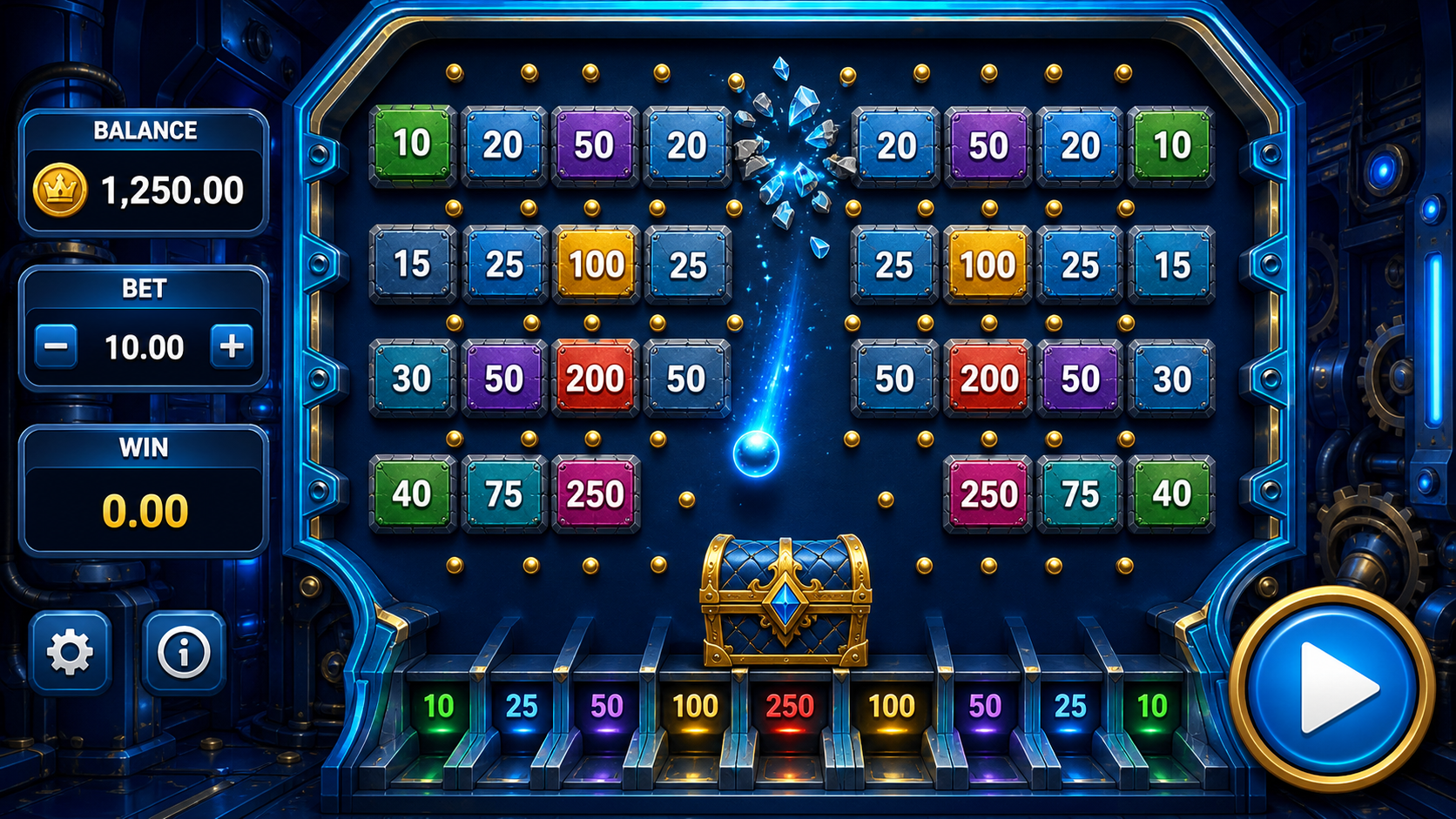
Busy Animation Does Not Mean Player Control
Crazy Ball borrows the visual language of skill machines: trajectories, ricochets, destructible objects and apparent near misses. That language naturally invites the hand to search for control.
The available description does not confirm aiming, steering or timing. A viewer should assume an RNG-led sequence unless the live rules identify a decision that changes probabilities.
This is more than a legal distinction. It affects every claim about tactics. If the launch angle is cosmetic, practising a tap rhythm cannot improve expected return. If obstacles are selected after the random result, tracking the ball cannot predict the next board.
Even genuine physics on screen would not automatically create skill. The server could choose a result first and then calculate a believable route. It could also use weighted launch parameters that appear physical but remain random.
A clear interface normally resolves the question. A simple Play button followed by locked controls signals passive settlement. A draggable aim line, published target probabilities or selectable risk lanes would signal a choice. No surviving Crazy Ball material documents those elements.
The safest wording is that the player starts the round and watches the ball break obstacles. The ball's exact route is part of the result presentation. There is no verified basis for calling Crazy Ball a game of dexterity.
This makes the title closer to Plinko-style casino products than to a real pinball table. The screen borrows physical cause and effect, but the wager remains governed by chance.
The Board Is Designed for Landscape Play
The theme works best across a wide frame. A ball needs vertical travel, but the controls and account information also need room beside the board. Landscape orientation gives both areas enough space without covering the action.
On a small phone, portrait mode would likely compress the obstacles or hide parts behind browser chrome. Turning the device sideways allows larger targets, clearer value labels and a visible chest state.
HTML5 technology supports browser play without a dedicated app. That does not guarantee identical performance on every device. Older graphics chips, power-saving modes and unstable mobile data may slow impact effects or sound.
Animation speed should not alter settlement. If the browser drops frames, the server result remains the same, but the visual sequence may jump from one collision to another. Checking the recorded win is more useful than replaying the apparent path from memory.
Touch placement also matters. A large launch button near the board edge is convenient, yet it should sit far enough from stake controls to prevent a second tap from changing the next wager. The balance needs to remain visible after full-screen mode begins.
Sound carries much of the arcade identity. Different tones can separate ordinary blocks, higher-value objects and the chest. Muting the game should not remove essential information; visual states still need to explain what happened.
The dark-blue palette helps bright projectiles and gold rewards stand out. It also keeps the playfield readable when several impacts occur close together. Too much debris can hide settlement values, so the interface must return quickly to a clear end state.
Free Games Should Be Read as a Separate Accounting Stage
The database tag says Free Spins, while the descriptive text says Free Games. Since there are no confirmed reels, Free Games is the more accurate term for the mechanic.
The trigger is the destruction of a special chest. After that point, later ball sequences should occur without a new base stake. The interface needs to show a counter, the current accumulated win and the point at which paid play resumes.
No reliable source confirms the number of rounds. It also does not confirm extra balls, richer target values, multipliers, a persistent board or retriggers. Those details are common in arcade bonuses, but common is not the same as verified.
The value of Free Games is already included in the 96.95 percent RTP. A free launch has no separate independent generosity; its expected return is funded by paid wagers across the full model.
This point corrects a frequent misunderstanding. Reaching the chest does not put the account into a house-edge-free mode. It activates the portion of the game math assigned to that sequence.
The bonus can still create a different emotional pace. Several launches in a row remove the repeated stake deduction from the visible flow, letting the total win accumulate. The final comparison must still be made against the paid stake that triggered the sequence.
Suppose a one-unit base launch starts a bonus and the final credited amount is 8.00. The net gain for that game cycle is 7.00 if no other stake was taken. Looking only at the bonus total without the triggering stake overstates profit by one unit.
The help panel should also explain interrupted bonuses. If the browser closes during the third free launch, the server should preserve or complete the remaining sequence under its rules. The account history is the proper place to confirm final settlement.
The Artwork Makes Impacts Carry the Story
Crazy Ball's dark-blue arcade setting is a practical choice rather than decorative excess. Bright balls, coins and chest effects remain legible against a low-light board.
The main object must stay visible at speed. A glowing rim or trail lets the eye follow its path through crowded barriers. Impact flashes mark cause and effect: the ball reaches an object, the object breaks and a value is recorded.
Gold naturally belongs to the chest and higher-priority prizes. Cyan can identify rails, ordinary energy and motion. A third accent colour helps separate stronger blocks from background machinery.
The visual hierarchy matters because the format lacks familiar slot symbols. A viewer arriving for the first time should understand the board through shape alone. Fixed walls need to look solid. Breakable targets need to look vulnerable. The chest needs to look exceptional without hiding its damaged state.
Animation should end cleanly. Too many particles after settlement can make a losing or low-return round seem larger than it was. The final win field must take priority over debris.
The reconstructed illustrations use those principles but are not evidence of the original interface. Their purpose is to support the article when the original full-size images and Demo are unavailable. Labels and values in them are examples only.
For backend publishing, that distinction is important. A caption calling them editorial reconstructions avoids suggesting that XIN Gaming released these exact frames. The game name and confirmed mechanics remain accurate; the precise UI arrangement is interpretive.
How a Round Can Feel Longer Than It Is
An arcade path inserts suspense between stake acceptance and settlement. Each bounce divides one RNG result into several visible beats.
The first beat is launch. The second is the approach to the obstacle field. Later beats come from collisions, redirections and the chest attempt. A final value resolves the sequence.
A reel slot may reveal all five columns within a second. Crazy Ball can stretch a similarly simple settlement across a longer animation without adding another wager decision.
This has two effects on pace. The number of rounds per minute may fall, reducing turnover at the same stake. At the same time, every round can feel more eventful, which may weaken awareness of how many stakes have already been accepted.
Time and turnover should therefore be separated. Ten slow rounds at 10 units still create 100 units of turnover. A long animation does not reduce the amount at risk per launch.
Autoplay is not confirmed in the surviving records. If a casino build includes it, the interval must be long enough for result and balance to remain visible. Rapid automatic relaunch would undermine the board's main strength: readable cause and effect.
The best pace for this format is one that lets the viewer follow the ball without mistaking spectacle for added value. The account numbers should settle before the next launch control reactivates.
Near Misses Are Visual, Not Statistical Progress
A ball passing beside the chest can feel closer to a bonus than a dead reel. The geometry turns distance into emotion.
Nothing in the public rules says that a near miss raises the chest chance on the next launch. Unless a persistent damage meter visibly survives between rounds and the rules confirm it, each new paid round should be treated as a fresh event.
The same applies to blocks. Breaking many low-value obstacles does not prove that a higher-value path is due. A route that looks unusually unlucky does not force compensation later.
Casino animation often creates what psychologists call counterfactual thinking: the mind imagines a small change that would have produced a better result. A ball missing a chest by a few pixels is especially good at generating that thought.
The correct statistical question is not how close the picture came. It is how the RNG allocates outcomes. That allocation is hidden in certified math, not measurable from screen distance.
If the game truly stores chest damage across paid rounds, the interface must say so and show the state. That would make progress real within the stated mechanic. The archived description does not confirm persistence, so this review does not assume it.
The distinction protects the reader from chasing a visual story. A near miss can be entertaining, frustrating or memorable. It is not a debt that the next round owes.
RTP Does Not Tell Us the Chest Frequency
The 96.95 percent figure covers every return in the model. It cannot be reversed into a bonus probability without more data.
Imagine two simplified designs. In the first, the chest appears once every 20 rounds on average and has a modest value. In the second, it appears once every 200 rounds with a much larger average value. Either design could be tuned to the same total RTP.
The 100-times cap places an upper boundary but still leaves many possible distributions. The model could pay frequent 1.1-times results and rare 100-times results. It could concentrate around 2 to 10 times. It could use Free Games mainly to assemble medium outcomes.
Hit frequency would narrow the possibilities, yet that number is also absent. Volatility is unlisted. No bonus contribution is published. The responsible analytical stance is therefore limited but clear.
We know the theoretical long-run return, the listed cap and the trigger object. We do not know the exact probability of a profitable base round, the chance of chest destruction or the average bonus value.
Marketing language cannot fill those gaps. Words such as frequent, regular or generous need numerical support. A handful of recorded sessions would still be too small to establish them.
If a current build exposes a formal paytable with target weights, those numbers should replace the uncertainty. Until then, the chest is a known mechanic with an unknown activation rate.
A 100-Times Limit Changes Session Expectations
High-cap slots sometimes allow one rare event to erase a very long loss sequence. Crazy Ball's recorded 100-times ceiling sets a smaller rescue limit.
At a fixed stake, a top result can recover at most 99 full losing stakes in gross arithmetic if the prize includes the triggering stake. A deeper drawdown cannot be erased by one capped round.
That does not make the game safe. Repeated full-stake losses can still accumulate quickly, and the top result may be rare. It only means the distribution has a known upper wall.
The cap also changes how a reviewer should describe potential. Phrases suggesting life-changing jackpots or enormous four-digit multipliers do not belong here. The game is scaled around double-digit and lower triple-digit multiples.
For a 5-unit stake, the listed maximum is 500 units. A 50-unit stake raises it to 5,000 units while multiplying every loss by ten as well. Larger currency prizes do not create better mathematical value.
The ceiling can help compare two titles, but it cannot identify the better choice. RTP, hit pattern, animation pace and personal tolerance all matter. Crazy Ball's strongest difference is format, not raw multiplier size.
The Free Games screen may make accumulated values look open-ended. The published cap should still govern the relevant settlement scope. The help file needs to state that scope plainly.
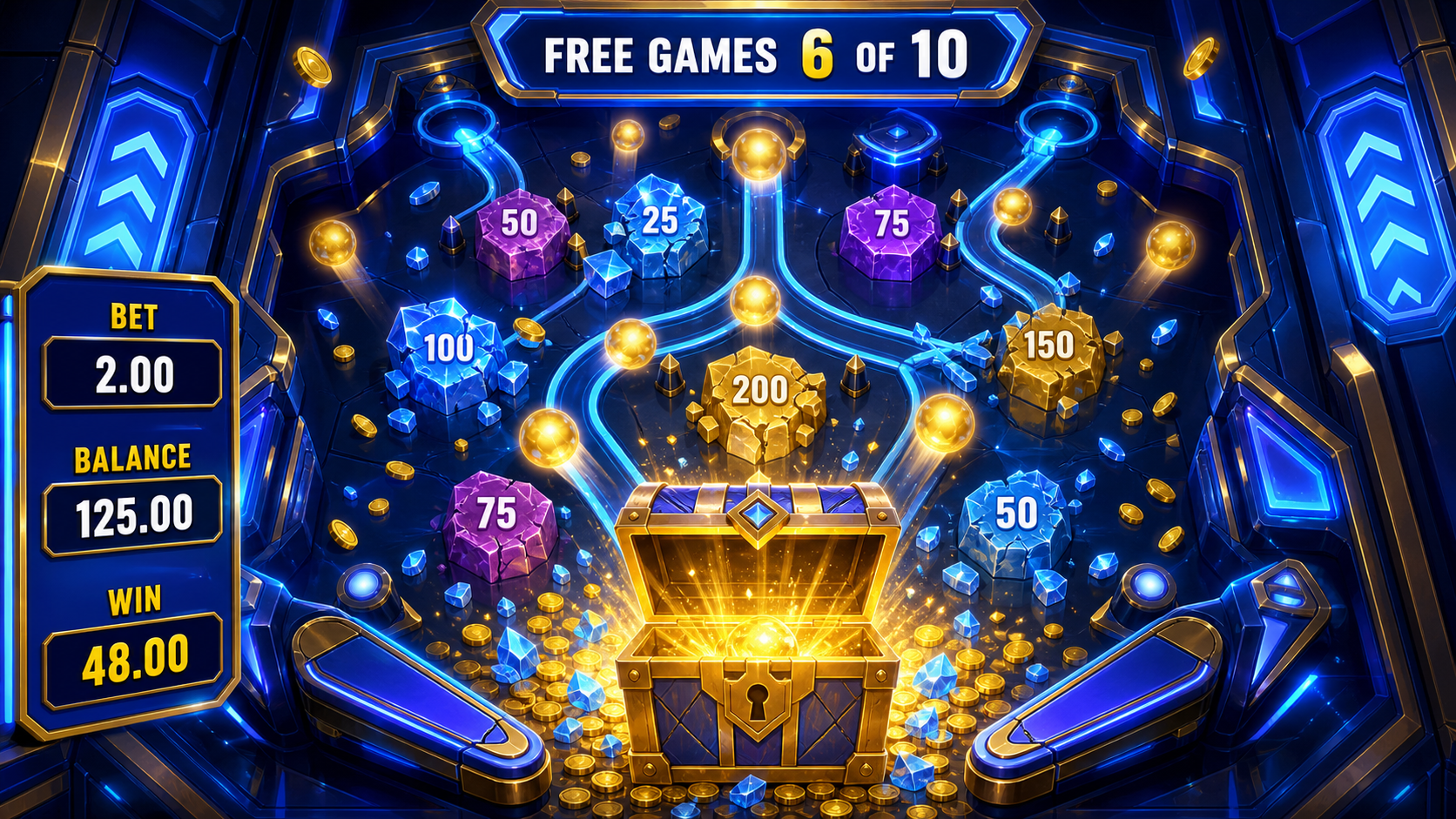
What the Old Demo Could Not Confirm
The public Demo links checked for this review no longer start the game. One directory labels it temporarily unavailable; another says its Demo is not available at present. That prevents a direct test of launch timing, target values, bonus length and mobile controls.
It also prevents a screenshot-based check of the current XIN art. Archived galleries show that multiple images once existed, but full-resolution retrieval is blocked or missing. Small search thumbnails are not suitable for a large article image.
Rather than enlarge an unreadable thumbnail or borrow art from another Crazy Ball, this review uses newly made editorial visuals. They stay close to the confirmed theme but avoid claiming fidelity to an inaccessible build.
The missing Demo also limits performance claims. It would be wrong to say that the game loads in three seconds, runs smoothly on a particular phone or resumes correctly after a disconnection without testing it.
Sound, language support, turbo mode and autoplay are likewise unverified. They may exist in some wrappers, but none belongs in a factual specification until seen in the deployed rules.
This gap should not be hidden behind confident prose. A deep review is not measured by how many precise claims it makes. It is measured by how well it separates known data from attractive guesses.
If XIN Gaming or an operator restores a working build, the first checks should be the help file, RTP version, maximum settlement scope, chest condition, number of Free Games, controls and transaction history. Those observations would justify an updated hands-on section.
How to Check a Current Casino Copy
A valid operator page should identify XIN Gaming rather than merely displaying the title. The help screen should use the same 96.95 percent RTP or clearly state its local variant.
Next comes the game type. The screen should show a ball-and-obstacle board with the special chest mechanic. A football rising through multipliers, a bingo studio or a rolling Steam puzzle identifies another product.
The pay rules should state the top settlement and how object values combine. If the page advertises more than 100 times, the discrepancy needs an explanation such as a later version or different profile.
The stake selector should match the wallet currency and show the total before launch. Historical 1-to-100 data is a reference point, not proof of local limits.
The Free Games rules should name the trigger and counter. They should also explain what happens after connection loss. If the chest breaks but the screen freezes, account history should record the completed cycle.
Round identifiers are useful. A support team can investigate a disputed result only when the wager has a timestamp or transaction number. A screenshot of a bouncing ball without an ID may not be enough.
Finally, the operator should state jurisdiction, age restriction and account terms outside the game. A correct game client does not compensate for an unlicensed or untrustworthy cashier.
What Makes the Format Work
Crazy Ball has one clear design advantage: the theme and mechanism describe the same action. A ball bounces because the game is about a ball. Obstacles break because destruction is the route to prizes. A chest opens because it starts the secondary mode.
Many slots attach a theme to unchanged reels. Here the presentation depends on the theme. Replacing the ball with five columns would remove the product's identity.
The board also creates readable anticipation. The viewer knows where the ball is, what lies below it and which object matters most. That spatial relationship can make a modest 100-times game feel more immediate than a much larger but abstract paytable.
The short rules footprint helps too. A player does not need to learn dozens of symbols before the first launch. The central questions are what breaks, what pays and how the chest triggers.
Its weakness comes from the same source. When the player has no control, the physical presentation may imply more agency than exists. A clear help screen and locked controls are essential.
Another weakness is archival fragility. Specialist games outside the reel mainstream can become hard to access after distributor contracts change. Crazy Ball is now easier to describe from databases than to play in public Demo mode.
The concept remains distinct despite that scarcity. It sits between instant casino math and mobile arcade theatre, with neither a reel grid nor a live host controlling the scene.
Who Is Most Likely to Appreciate It
The natural audience is someone tired of standard paylines but still comfortable with a fully chance-based wager. The main attraction is watching a result move through space rather than reading a static grid.
Short-rule readers may also prefer it. The known structure is compact: select a stake, launch the ball, watch obstacles break and reach the special chest for Free Games.
The 100-times cap may appeal to people who dislike products built almost entirely around microscopic chances at enormous multipliers. That preference should not be confused with lower risk, because actual hit frequency and volatility remain unpublished.
The title is less well matched to anyone seeking strategy. There is no verified steering, aiming or cash-out decision. Arcade appearance does not establish a skill edge.
Jackpot hunters will also find the ceiling limited. No progressive prize is recorded, and the fixed maximum is far below modern high-cap slots.
Collectors of older HTML5 casino formats may find Crazy Ball interesting as a 2020 experiment. It shows how studios moved beyond reel reskins and used mobile-game motion to stage RNG results.
Availability is the practical obstacle. A reader may find review pages long before finding a working XIN deployment. That is a reason to verify the studio and rules, not a reason to play a similarly named substitute under the assumption that it is the same game.
The Mathematics Behind a Short Session
RTP gives a mean, but the missing hit distribution stops us from calculating an exact session variance. Some arithmetic is still possible.
At 2 units per launch, 50 rounds create 100 units of turnover. Applying 96.95 percent mechanically gives an expected gross return of 96.95 units and an expected cost of 3.05 units.
At 10 units per launch, the same 50 rounds create 500 units of turnover. Expected gross return becomes 484.75 and expected cost becomes 15.25.
Those values scale linearly with stake. They do not describe a likely ending balance. A session could hit the chest and finish far above the mean, or miss major outcomes and finish far below it.
The 100-times cap puts an upper bound on one settlement but does not tell us the lower half of the distribution. Exact chances of zero, sub-stake return and profit remain unknown.
This is why bankroll slogans add little. The useful facts are turnover, stake size, cap and uncertainty. Reducing the stake reduces currency swing in direct proportion. It does not change the stated RTP.
Round speed also changes total exposure. Fifty launches completed in ten minutes create the same turnover as fifty launches completed in half an hour. The slower version simply spreads it across more time.
A session record should list stakes and settled returns rather than count satisfying collisions. The account moves through credits, not visual impacts.
Common Errors Around Crazy Ball
The first error is mixing it with Crazy Balls by Evolution. That is a live bingo game show released years later. Its presenter, numbered balls and bonus rounds have no connection to XIN Gaming's arcade title.
The second is mixing it with the football crash game carrying the same name. A rising multiplier and cash-out button belong to that separate product.
The third is calling the XIN title a normal slot. Some catalogues place every RNG game in a slot folder, but Crazy Ball has no confirmed reel layout or paylines.
The fourth is treating ball movement as player skill. No accessible rules confirm aim or steering.
The fifth is saying the chest always awards a fixed number of free rounds. The trigger is recorded; the count is not.
The sixth is describing 100 times as a progressive jackpot. It is a fixed maximum multiplier in the archived data.
The seventh is turning 96.95 percent into a prediction for one session. The percentage is a long-run mathematical ratio.
The eighth is treating the historic 1-to-100 range as a universal local limit. Operator currencies can change it.
The ninth is using generated artwork as proof of the original interface. The pictures here are labelled editorial reconstructions for that reason.
The tenth is assuming an unavailable Demo means the game never existed. Several independent archives preserve the same studio, release date and mathematical profile. Scarcity today does not erase the older deployment.
A Better Way to Read the Result Screen
The moving ball is the spectacle, but the account fields settle the wager. A disciplined reading order starts with total stake, then final return, then balance.
The route comes afterward. It explains how the game chose to stage the outcome, not how much the wallet received.
If the screen labels a number WIN, check if the stake has already been returned. A 0.80 display after a 1.00 wager may be a paying round but still a 0.20 net loss.
If Free Games begin, note the balance before the first free launch and the final total after the counter ends. That prevents each free result from being mistaken for a new deposit into the wallet.
If the animation freezes, do not place a duplicate wager immediately. Reopen history and check if the server settled the original round.
If the chest appears damaged, check the rules before assuming that damage remains for the next paid launch. A reset animation may restore it completely.
This reading method removes some of the confusion created by arcade presentation. It also makes different casino games easier to compare because every result returns to the same three numbers: stake, gross return and net change.
Crazy Ball in the Philippine Mobile Context
The format has obvious relevance to a phone-first casino audience. A single launch button, wide board and short visual sequence need less reading than a large English paytable.
The listed stake scale, however, should never be copied directly into peso claims without checking the operator. A PHP wallet may remap denominations or impose its own minimum.
Landscape use can be inconvenient on crowded mobile pages. Browser headers, chat bubbles and cashier overlays may cover the edges. Full-screen mode and a stable connection improve legibility, but the operator must make balance and exit controls easy to reach.
Data usage is likely higher than a static reel game because of animated debris and repeated ball motion, although the unavailable Demo prevents a measured figure. Wi-Fi or a stable mobile signal reduces interrupted sequences.
Language localisation matters most in the help file. The board itself may rely on numbers and icons, but chest rules, maximum-win scope and malfunction handling need clear text.
The title should appear under XIN Gaming in the lobby. Some aggregators rename studios or place them inside a larger platform tab, so the in-game information icon is the final check.
Local legal availability changes over time. A review of mechanics does not establish that a specific casino is authorised in a reader's location.
Final Assessment: A Strong Idea With an Incomplete Modern Record
Crazy Ball earns attention because its central action is immediately readable. One ball, a field of breakable obstacles and a special chest create a stronger identity than another set of conventional reels.
Its surviving mathematical profile is clear enough for a grounded summary: XIN Gaming, release date 21 September 2020, HTML5 build, 96.95 percent theoretical RTP, archived stake range from 1 to 100, listed maximum of 100 times and Free Games triggered by destroying a special chest.
The rest needs restraint. Volatility, hit rate, exact target values, bonus length, chest probability, retriggers, autoplay and manual control are not confirmed by the accessible record. A current operator help screen must answer them.
The missing public Demo is the largest drawback for a present-day review. It blocks hands-on timing tests and authentic high-resolution capture. The three editorial images here solve the publishing need without pretending to be original XIN screenshots.
As a design, Crazy Ball sits in an appealing middle space. It has the immediate accounting of an instant game and the movement of a small arcade machine. The ball turns one random settlement into a sequence of impacts, while the chest gives the board a destination.
As a wagering product, it remains governed by chance. No bounce pattern, near miss or chest approach changes the long-run 96.95 percent figure. The 100-times ceiling also keeps its scale well below jackpot-led releases.
The result is an older casino experiment worth examining for its format rather than for huge prize claims. Found in a verified XIN Gaming lobby with a complete help file, it can still feel distinct. Found only through a similarly named game, it should be checked carefully before any of its rules are assumed.
By Fairy Editorial - 04 Aug 2026

Millionaires Island
Millionaires Island Review: Five Roads to Fortune Beyond the Million-Dollar Shore
Millionaires Island dresses wealth as a holiday destination. A private beach, blue water, a yacht, a seaplane, poolside drinks, diamonds, and a submarine all point toward the same fantasy: money has removed every practical problem, so the only decision left is how to spend the afternoon. The progressive meter above the reels then turns that fantasy into the central wager.
The game has more substance than its millionaire branding suggests. Beneath the tropical scenery sits a five-reel, three-row layout with 25 fixed paylines. Five island symbols anywhere in the main game claim the progressive pool. Pool Party symbols on reels one, three, and five award three to seven free games. Those free games use their own random Wild system. A second reels-one-three-five trigger opens the Submarine Bonus, where Low, Medium, and High Risk choices lead to different multiplier ceilings. An Ace in the exact centre cell starts a card pick. Every 35 main-game spins bring five Big Symbol rounds involving a yacht or seaplane.
That is five separate activation rules inside one conventional reel frame. The jackpot watches the whole grid. Pool Party and Submarine symbols watch three named reels. The Ace watches one exact position. Big Symbol watches a spin counter. Millionaires Island is therefore less about one giant bonus and more about several clocks running beside one another.
The title was created as a proprietary PokerStars Casino game under the corporate lineage later known as The Stars Group. An official launch announcement appeared on 4 January 2017 and described it as the brand's debut exclusive slot. A major slot database records 7 April 2017 instead. The safest reading is that the official announcement marks the public launch while the later date belongs to a database catalogue record or another rollout point. Treating the two dates as proof of two separate games would be a mistake.
The commonly recorded RTP is 96.57 percent. Stakes in the original listing run from 0.50 to 50, and all 25 lines remain active at every level. Variance, hit frequency, and the odds of the progressive trigger are not published in the dependable material located for this review. Those missing figures matter because a large jackpot meter says nothing about how frequently any prize channel appears.
The First Island in PokerStars Casino History
Millionaires Island carries several developer labels across the web. Some pages call it a PokerStars Casino proprietary slot. Others attach The Stars Group. Older corporate material refers to Amaya, which owned PokerStars at the time of launch. These labels describe successive parts of the same business history rather than competing studios.
The January 2017 announcement called Millionaires Island PokerStars Casino's debut exclusive slot. It was developed for the operator rather than licensed as a standard third-party title. Amaya later adopted The Stars Group name, and Flutter Entertainment completed its combination with The Stars Group in May 2020. Current corporate ownership does not rewrite the game's original authorship.
This background is useful when checking a casino lobby. The authentic title should have the tropical resort setting, a 5 by 3 grid, 25 fixed lines, a progressive meter, Pool Party scatters, the Submarine round, a centre-Ace card game, and the 35-spin Big Symbol cycle. A similarly named island slot with a hold-and-win coin board or variable ways is not the same product.
The launch announcement also described desktop and mobile access and a progressive jackpot with a minimum payout of one million US dollars in the original network. That amount belonged to a regulated operator system. It was not a universal prize attached to every static demo, review page, or copied lobby image.
Millionaires Island later shared its linked pool with Stars Mega Spin, another proprietary Stars title released in November 2017. The first game kept its tropical presentation while the later cabinet used classic fruit symbols inside a space setting. Their visual identities differ, but much of their underlying rule grammar is closely related.
Public records now preserve the rules better than the playable build. The official how-to page remains available, yet commonly indexed demo access is disabled. This review therefore assesses documented mechanics, surviving first-party material, and catalogue data. It does not claim a fresh real-money session or pretend that an archive page is a live jackpot client.
Twenty-Five Paths, Not Hundreds of Ways
The base cabinet uses five reels and three visible positions per reel. Wins follow 25 fixed paylines. Each line draws a particular route across the grid, beginning on reel one and moving through consecutive reels.
Fixed-line geometry is stricter than a ways-to-win system. Suppose matching yacht symbols appear on the first three reels. They do not automatically form a win merely because each reel contains one. Their row positions must follow one of the 25 active paths. A symbol in the top cell of reel one may connect to the middle cell of reel two only when a defined line makes that turn.
All 25 paths are active on every paid spin. There is no reduced-line mode in the published setup. Changing the total wager changes the monetary value carried by the line set rather than removing paths from the screen.
That rule matters when comparing a 0.50 spin with a 50 spin. Both use the same reel map and both retain progressive eligibility. The difference is stake value, not access to extra paylines or a hidden jackpot switch.
The public material does not preserve a dependable full paytable for every ordinary icon. Diamonds, luxury transport, drinks, playing cards, and island imagery fit the setting, but exact line awards should be read inside the local help panel. Repeating guessed symbol values would make a review appear precise while reducing its accuracy.
Wild substitution belongs to the line system. The Wild assists ordinary combinations, while marked Pool Party, Bonus, and jackpot symbols follow their own activation conditions. The official summary is much clearer about the special triggers than about Wild exclusions or direct Wild payments. A current client should settle those smaller paytable questions.
The 25-line arrangement gives the game a readable skeleton. Bonus screens may interrupt the reels, but the base method never changes into clusters, tumbling symbols, or variable reel heights. Every ordinary result returns to the same map.
Five Island Emblems Can Replace the Entire Session
The progressive condition is direct: five Millionaires Island symbols must appear anywhere on the reels during the main game. They do not need to sit on one payline. Their row positions may differ, because the trigger counts the marked symbols across the full grid.
The main-game restriction is equally important. Five matching emblems during free games or another bonus state should not be treated as a jackpot claim unless the active rules explicitly say otherwise. PokerStars limits the published trigger to the base game.
Every standard wager qualifies, including the minimum. A maximum-bet instruction is therefore wrong for this title. The player does not unlock the progressive by raising coin value or pressing a separate jackpot button.
When the five required symbols land, they do not add a normal five-of-a-kind payment on top of the progressive award. The official rules remove that extra line interpretation. The jackpot is the payment for that exact group.
The pool is a currency prize, not a fixed multiple of the triggering stake. A database field showing 1,000,000 should not be translated into 1,000,000 times the bet. At the historical minimum wager of 0.50, a one-million-dollar award would equal two million stake units. At a larger wager, the same currency amount produces a smaller stake multiple.
The launch meter stood above 1.1 million dollars and carried a stated minimum payout of one million within the original eligible network. Later promotional material recorded a 4.8 million dollar win on a 0.50 spin. That event proves that the minimum stake was eligible in that network. It does not reveal the chance of the five-symbol result and does not make another minimum-bet spin more likely to win.
Four jackpot symbols are still a losing near miss for the progressive condition. They do not build credit toward the fifth. The next reel result is not made more favourable by the previous screen, the age of the pool, or a long period without a winner.
No reliable public rule sheet gives the jackpot probability per spin. The meter may rise through linked wagering while the trigger remains extremely rare. Visible pool growth measures accumulated value under network rules; it is not a countdown.
Pool Party Starts With Three Named Reels
Free games begin when Pool Party scatter symbols appear on reels one, three, and five. Position within each reel does not matter. The first scatter may land at the top, the second in the middle, and the third at the bottom. The required reel numbers are the deciding factor.
A Pool Party symbol on reel two or reel four does not replace a missing symbol on one of the three required reels. This is more restrictive than the common three-scatters-anywhere rule and explains why a screen with three visible Pool Party icons may still fail to start the round.
The trigger awards a random total of three to seven free games. The player does not select the number, and the count is not described as a direct reward for bet size. Two visually identical trigger screens may therefore lead to rounds of different length.
Three games make the event brief. Seven create more chances for the bonus-only Wild layer to alter the grid. The spin count is part of the prize calculation, even before any reel result is known.
No dependable public instruction confirms a retrigger. It would be unsafe to promise that another set of Pool Party symbols adds spins during the round. If a current build includes that rule, its own help file should state the required positions and the added count.
The chosen wager is carried into the free-game award under the local game configuration. There is no published evidence of a bonus purchase, ante bet, or optional paid shortcut in the original 2017 design.
The trigger fits the theme without using a generic FREE SPINS tile. A pool party is one activity on the island, so the symbol functions as both destination sign and Scatter. More importantly, its reels-one-three-five map becomes easy to remember once the rule is known.
Random Wilds Give the Short Round Its Weight
The free-game state adds a random Wild event that does not operate in the ordinary base spins. On each free game, one to five Wilds may appear.
Count alone does not decide their value. On a fixed-payline grid, location is crucial. One Wild placed on a central crossing may repair several line patterns, while three Wilds scattered across unrelated cells may assist only a small number of combinations.
A Wild does not turn every icon on its reel into a match. The 25 routes still govern payment. It substitutes inside a valid sequence and remains bound to the cell where it appears.
The public wording allows one through five Wilds on a free spin but does not publish the probability assigned to each count. Five should not be assumed to appear as often as one. Nor does the rule say that a Wild must create a paid line after it arrives.
The design keeps the bonus close to the base cabinet. Reel size, line count, and symbol structure stay intact. Instead of replacing the screen with an unrelated collection game, the round changes the density of substitution.
This is also why the difference between three and seven awarded spins matters. More spins mean more applications of the random-Wild rule, not merely more repetitions of the base result.
The feature can still end below the value of the triggering wager sequence. Free refers to the absence of an added charge for those awarded rounds, not to a guaranteed profit. The final bonus total comes from the line payments created across the whole set.
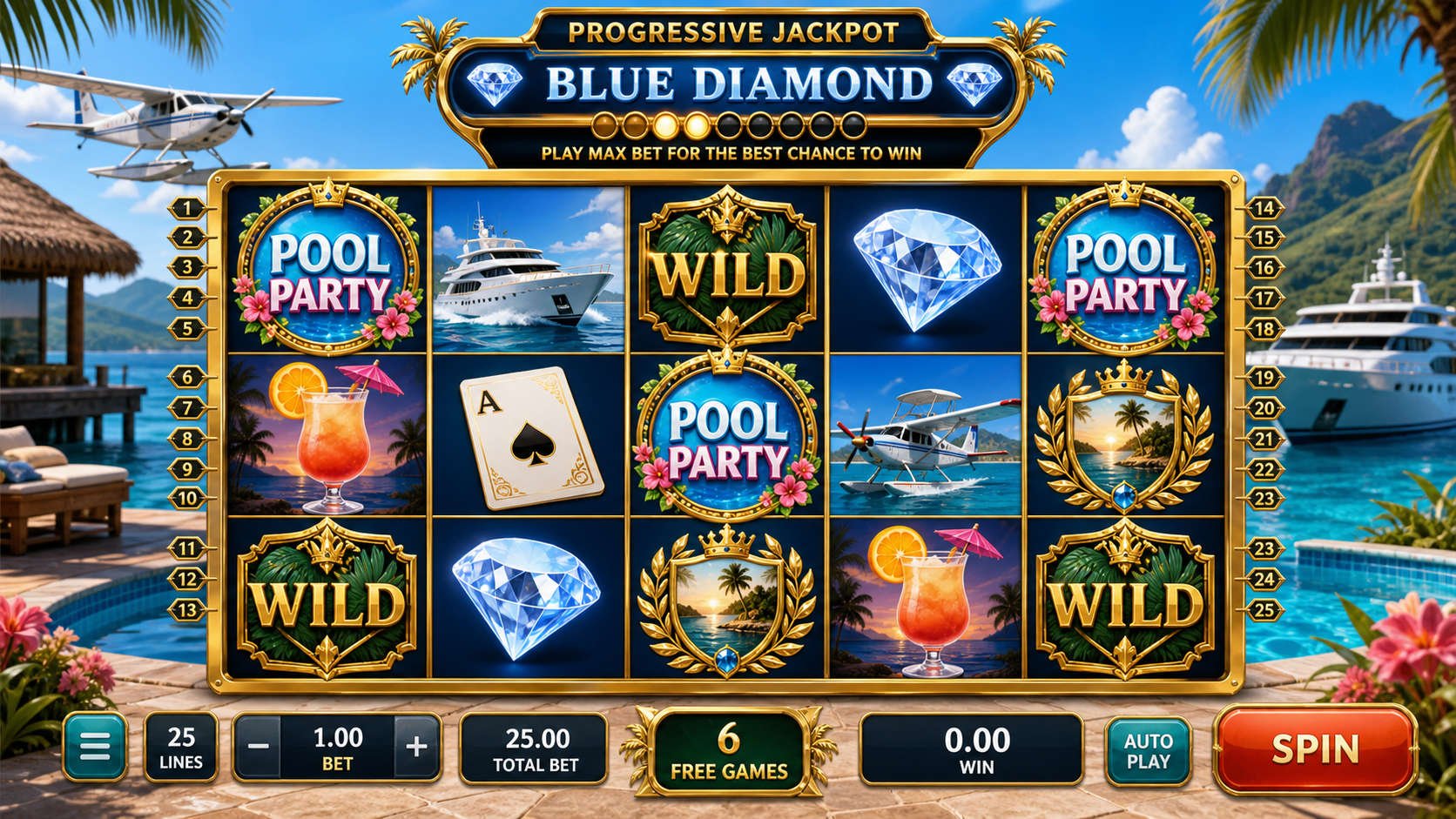
The Submarine Goes Deeper as the Risk Ceiling Rises
The Submarine Bonus is activated by three or more Bonus symbols on reels one, three, and five. As with Pool Party, the three named reels matter more than a conventional payline.
Once the underwater screen opens, the player chooses Low, Medium, or High Risk. This first decision sets the prize profile for the subsequent picks. Low Risk reaches up to 10 times per pick. Medium reaches up to 30 times. High reaches up to 500 times.
The phrase up to is the most important part of those limits. Choosing High Risk does not place 500 times behind the next object, and selecting Low does not promise ten times. The numbers are ceilings within three different distributions.
The round allows up to ten picks. On each step, one item is selected from three covered choices to reveal a prize. Up to ten does not mean that every activation always lasts for ten selections. A stopping result or another rule inside the active paytable may end the sequence earlier.
It is tempting to multiply ten picks by the 500-times ceiling and advertise 5,000 times as a standard bonus maximum. The public rule does not justify that arithmetic. It states a per-pick upper limit and a maximum possible number of picks, without publishing the probability tree or confirming that ten top values can coexist in one round.
The risk selector is more meaningful than a cosmetic pick. Choosing a tier changes which prize distribution applies. Yet the later object selection is still random from the player's perspective. A pearl shell that concealed a small value in the previous bonus does not become more likely to hold a large one next time.
Low Risk may reduce dispersion, while High Risk allows a much larger top value. The complete set of possible multipliers and their weights is not available in the first-party summary, so claims about average return by tier would be speculation. Different ceilings alone do not prove that one tier has a higher theoretical return.
The underwater theme gives the decision a clear narrative. The submarine descends from a luxury holiday into a treasure search, and greater depth is associated with a broader risk range. The screen changes setting without abandoning the island's wealth fantasy.
From a review standpoint, this is the cabinet's most substantial side game. Free games change reel composition, the Card Bonus is a compact reveal, and Big Symbol changes coverage on a schedule. Submarine is the point where the player selects a risk profile before the random result unfolds.
One Ace, One Cell, Two Cards
The Card Bonus has the smallest trigger footprint in the game. An Ace must land in the exact centre position of the reel grid. On a five-reel, three-row cabinet, that is the middle row of reel three.
An Ace in any other cell is only part of the ordinary symbol result unless the paytable assigns it a line award. Three Aces are not required, and an Ace somewhere on the centre reel is not enough. The middle cell itself activates the side game.
After the trigger, two cards are selected to form a compact poker hand. The resulting hand determines the payment under the bonus table.
This should not be described as full five-card poker. Two selected cards cannot naturally form a straight, flush, full house, or four of a kind without additional hidden rules. The local prize page defines the shortened hand ladder and its values.
The card theme is a quiet link to PokerStars. It uses the operator's best-known game without covering the tropical reels in corporate branding. The bonus also proves how deliberately Millionaires Island uses position. One event watches all 15 cells, two events watch three reels, while the Card Bonus watches only one square.
Picking one card before another does not create a skill edge. The interface invites participation, but no public rule indicates that card location can be predicted from earlier rounds.
Big Symbol Arrives After Thirty-Five Main Spins
The Big Symbol system uses a visible or internal count rather than a random Scatter trigger. Every 35 spins played in the main game, the luxury yacht or seaplane doubles in size on some reels. The altered state lasts for five rounds.
The scheduled arrival does not guarantee a win on the thirty-fifth spin or during the five awarded rounds. It guarantees activation of the larger-symbol presentation. Reel outcomes and line connections remain random.
An enlarged yacht or seaplane can occupy more than one cell on a reel. That extra coverage may place the same symbol on several of the 25 line routes at once. Payment still depends on matching positions across consecutive reels.
The official Millionaires Island guide names the yacht and seaplane as the symbols involved. Diamonds, drinks, cards, Wilds, Pool Party signs, and jackpot emblems should not be assumed to grow under this event.
Only main-game spins lead to the activation. The public guide does not say that free games, Submarine picks, or Card Bonus actions advance the 35-spin count.
Some secondary summaries borrow extra clauses from Stars Mega Spin, such as counter pauses or denomination locks. The closely related game does document such restrictions, but the accessible Millionaires Island page does not. Shared architecture makes those clauses plausible; it does not make them verified. This review leaves them unclaimed.
Persistence is another open question. No dependable public statement says that the count survives logout, app closure, a change of device, or a move between play-money and real-money modes. If the active client displays a counter, that display and the transaction history are stronger evidence than an old review.
Big Symbol adds a predictable change of tempo to an otherwise random cabinet. The result remains chance-based, yet the next altered reel state is tied to countable main-game activity. That distinction makes the system memorable without turning it into a strategy game.
Five Activation Languages on the Same Fifteen Cells
Millionaires Island becomes easier to read when each event is classified by what it counts.
The progressive counts five marked island symbols anywhere across the base grid.
Pool Party checks for its symbols on reels one, three, and five, then assigns three to seven free games.
Submarine checks a separate Bonus symbol on the same three reels, then asks for a risk tier and object picks.
The Card Bonus checks one Ace in the centre cell.
Big Symbol checks the number of main-game spins and changes yacht or seaplane coverage for five rounds after the thirty-fifth.
These rules are compact individually, but they produce a dense cabinet. A newcomer who treats every marked icon as a normal Scatter will misread most of the screen. Three special symbols anywhere may look promising while failing both reel-specific conditions. Four island emblems may look like a huge line win but remain one short of the progressive. An Ace at the top of reel three may pay normally without opening the card screen.
The advantage is separation. Each trigger has a distinct symbol and a distinct spatial rule. Once those maps are learned, the game rarely creates ambiguity about which event has started.
This architecture also reduces dependence on one rare bonus. A session may encounter a centre Ace, a scheduled Big Symbol sequence, or one of the reels-one-three-five events without ever approaching the progressive. The millionaire prize dominates the advertising, but smaller systems shape most actual play.
Reading the 96.57 Percent RTP Correctly
The widely indexed theoretical RTP is 96.57 percent. That number represents the long-run share of total stakes returned by the tested configuration across a very large sample.
It does not mean a 1.00 spin is expected to display 0.9657 immediately. A reel result settles in discrete amounts, often zero, sometimes below the spin cost, and occasionally far above it. Only a huge collection of outcomes approaches the theoretical ratio.
The value also does not promise that every licensed version uses the same math file. Operators sometimes select approved RTP variants. The percentage printed in the loaded client's help panel should take priority over an old catalogue entry.
Public records do not clearly separate base-game return from progressive contribution. Without the original math sheet, the 96.57 percent figure should not be divided into guessed portions for ordinary lines, free games, Submarine, Card Bonus, Big Symbol, and jackpot.
Variance is not published in the strongest sources. It would describe how widely results are spread around the average, but assigning low, medium, or high from visual impressions would be weak analysis. A game can show frequent small line hits while reserving a large share of value for rare outcomes.
Hit frequency is also unlisted. That measure would count how often some payment appears, not how often a spin earns more than it costs. On 25 active lines, several small symbol awards may still add up to less than the total stake.
The separate prize channels suggest an uneven return profile. Ordinary line wins form the base layer. Random Wilds alter short free-game rounds. Submarine reaches different per-pick ceilings. Big Symbol returns on a schedule but does not guarantee payment. The progressive sits at a currency scale far beyond the ordinary cabinet.
Monthly operator reports sometimes show an actual return measured from real wagers during one reporting period. Such a number may sit above or below 96.57 percent because the sample is finite and large prizes can distort the month. It is not a replacement RTP and should not be pasted into a review as the theoretical specification.
The absence of published volatility and jackpot odds is a meaningful limitation, not a blank to fill with marketing language. The known RTP supports long-run comparison. It cannot predict session length, bonus frequency, or the chance of becoming the next jackpot winner.
The Original Wager Range and Its Hidden Context
The common game record lists total bets from 0.50 to 50 in supported dollars, euros, or pounds. All 25 lines stay active across that range.
A peso-facing casino may translate the amounts into local credits or use another approved configuration. A converted minimum is not proof that the game joins the original dollar network. Currency display, game rules, and progressive connection are three separate issues.
The lowest wager qualifies for the jackpot. Raising the stake must not be described as unlocking the top prize. The celebrated 4.8 million dollar hit from a 0.50 spin is a historical example of that eligibility rule.
Eligibility does not automatically mean identical expected jackpot value per currency unit at every stake. Contribution formulas and prize terms may scale with bet size even when every level can trigger. The public summary does not publish that split.
The three Submarine risk tiers do not change the price of the triggering spin. They select a multiplier range after entry. The Card Bonus likewise comes from the centre Ace rather than an added side wager.
No verified original rule mentions a bonus buy, increased-odds switch, or ante-bet option. If a modern wrapper places a tournament, mission, cashback label, or promotional free-spin pack around the title, that belongs to the operator layer rather than the 2017 reel math.
A Resort Theme Built Around Transport and Access
The setting is not simply a beach with expensive objects scattered on the reels. Its recurring idea is access. A yacht reaches the island by sea. A seaplane arrives by air. A submarine descends below the water. Pool Party marks the social space, and the progressive symbol represents ownership of the destination itself.
That makes the bonus map unusually coherent. Free games occur at the pool. The risk round travels underwater. Big Symbol enlarges the two machines that connect the island to the outside world. Cards add a quieter PokerStars reference inside the resort.
Gold trim and cool blue water create the expected wealth palette. Diamonds, cocktails, luxury vehicles, and island emblems are direct rather than subtle, but the theme benefits from that clarity. Each special icon can be recognized quickly on a 5 by 3 grid.
The small cabinet also suits horizontal phone screens. Five wide reels leave room for distinct yacht and seaplane art, while a larger cluster grid would make the detailed transport symbols harder to read.
The inactive public demo prevents a fair judgment of reel speed, music, voice work, and transition timing in 2026. Static art and official descriptions cannot reproduce audio balance or input delay. A serious review should state that limit instead of inventing a play session.
The three images in this article are original editorial reconstructions derived from confirmed rules and surviving visual references. They are not screenshots from the live PokerStars client. Their jackpot meter and interface values are illustrative only.
Millionaires Island and Stars Mega Spin Share a Skeleton
Stars Mega Spin arrived later in 2017 and joined the Millionaires Island jackpot pool. The two games use different scenery but reveal close mechanical kinship.
Both use five reels, three rows, and 25 fixed lines. Both place a five-symbol progressive trigger in the main game and accept all standard bet levels. Both use reels one, three, and five for free games and a risk-based pick bonus. Both attach a poker-card side event to a centre Ace. Both schedule five Big Symbol rounds after 35 main spins.
The symbols translate the same grammar into different worlds. Millionaires Island uses Pool Party scatters, a Submarine round, yacht and seaplane growth, and a tropical jackpot emblem. Stars Mega Spin uses lemons, marked sevens, classic fruit-machine icons, and a neon space frame.
This relationship explains why later promotional pages discuss the two titles together. Activity across a linked pool can change the meter even when only one cabinet is visible in the local lobby.
It also creates a research trap. A clause documented for Stars Mega Spin is not automatically confirmed for Millionaires Island. Closely related software may share rules, but a review should not copy denomination locks, counter pauses, or retrigger terms across titles unless the island guide states them.
Millionaires Island has historical priority. It established the proprietary progressive system and the resort version of the trigger map. Stars Mega Spin expanded the network and repackaged the structure for a different audience.
The earlier game also has the stronger thematic link between mechanism and setting. A submarine risk screen belongs naturally below an island, and a pool party makes sense as a free-game gateway. The later space cabinet gains retro contrast, while the island cabinet gains narrative consistency.
The 4.8 Million Dollar Story Is Evidence, Not a Forecast
PokerStars still recounts a 4.8 million dollar Millionaires Island jackpot won on a 0.50 spin. The operator describes it as its largest casino jackpot at the time and notes that the winner was on the first day of casino play.
The story confirms two rule points. Minimum wagers were eligible, and the progressive could rise far above its one-million-dollar floor before being hit.
It does not support the usual myths attached to a large win. A first day carries no statistical privilege. A low stake is not luckier than a high stake. A large meter does not mean the trigger is about to appear. One anecdote cannot reveal the distribution behind millions of unsuccessful rounds.
The masked account name and promotional summary also do not replace transaction-level rules. Currency, jurisdiction, verification, withdrawal procedure, and tax treatment belonged to that winner's account and time period.
Historical prize stories are most useful as proof that the network operated as described. They are weakest when turned into predictions about the next session.
The same caution applies to older reports of seven-figure awards in separate markets. They establish past payouts, not present access from every location. A current client must show an eligible meter and applicable terms before those examples become relevant.
Current Access Is More Complicated Than the Rules
The original announcement stated desktop and mobile availability. The HTML5 format recorded by slot databases also supports browser-based play. Yet current access depends on market, licence, account type, and the operator catalogue.
A game page visible through search may be an archived information page rather than a working launch path. That is the present situation with commonly indexed demo access: rules and gallery entries remain, but the free-play client does not load.
The progressive adds another layer. A static demo might imitate the symbols without joining the real network. Only an eligible real-money client can show a claimable live pool.
Account location matters more than interface language. An English page may serve several jurisdictions, while the available casino products change after login. A VPN-visible webpage does not establish legal access or jackpot eligibility.
Older proprietary games can also disappear during platform migrations. The core rules may survive in a help archive even after a local lobby removes the title. That is why this review separates documented design from current distribution.
On mobile, the grid itself should translate well to landscape orientation. The harder elements are the 25 line markers, progressive terms, Big Symbol counter, and small centre-Ace trigger. A well-maintained client needs to keep those details readable without hiding the rules behind several menus.
Transaction history becomes especially important when a connection drops during a pick round or a scheduled Big Symbol sequence. The server record, not the frozen animation, decides the settled result.
What a Philippine Listing Must Prove
A Philippine player should not treat the The Stars Group label as proof that a local site carries the official version. Three separate checks are required.
First, the operator must be permitted to accept play from the account's location under the rules that apply at the time. A familiar game name does not validate the casino.
Second, the loaded title should match the documented cabinet: 5 by 3 reels, 25 fixed lines, the five-symbol base-game progressive, Pool Party on reels one, three, and five, Submarine risk selection, centre Ace, and the 35-spin Big Symbol cycle.
Third, the progressive meter must belong to the eligible network described in the local terms. A copied interface can display a large number without connecting to the PokerStars pool.
The help panel should state RTP, currency, bet range, jackpot eligibility, and any jurisdiction-specific restriction. If its RTP differs from 96.57 percent, record the local figure rather than assuming the database is current.
The platform should also identify the game transaction in account history. A completed spin needs a round ID, stake, result, and bonus detail. That record is more useful than a promotional screenshot if a dispute occurs.
Local currency introduces another question. A peso amount may be a direct pool, a converted display, or a separate network. The terms should explain conversion and payment limits. The old one-million-dollar floor cannot simply be pasted onto every PHP lobby.
This verification is not a generic warning added to fill space. It follows directly from the product's identity as an operator-exclusive linked progressive. Remove the verified network, and the headline mechanic loses its financial meaning.
Where the Design Still Works
Millionaires Island's strongest decision is to give each bonus a different spatial language. The progressive counts the full grid. Pool Party and Submarine use alternating reels. The card event uses one cell. Big Symbol uses elapsed base spins. The variety comes from rules rather than a constantly changing board.
The 25-line base remains easy to audit. Winning routes can be traced, Wild placements can be checked, and an enlarged transport symbol has a visible effect on coverage.
Pool Party changes the math with one to five added Wilds instead of introducing an unrelated reel set. That keeps the free-game round connected to the base paytable.
Submarine adds the clearest choice in the cabinet. Low, Medium, and High Risk state their ceilings plainly, and the player understands that the decision changes dispersion before the picks begin.
The Card Bonus is small but well placed. A centre Ace creates a rare positional surprise and ties the resort back to PokerStars without overwhelming the island art.
Big Symbol supplies a scheduled event in a game dominated by random entry. Knowing that the altered state appears after 35 main spins changes the rhythm, even though it cannot guarantee a payment.
The main weakness is fragmentation. Five activation systems require explanation, yet several of them may be brief. A player drawn by modern multi-stage bonuses may find the individual events modest once the novelty fades.
The unpublished jackpot odds, hit frequency, and official variance classification also limit mathematical comparison. RTP alone cannot show how much return belongs to ordinary lines versus the rare progressive.
Age and exclusivity are practical drawbacks. A 2017 proprietary title is harder to locate than a current multi-operator release, and an archive listing cannot reproduce the linked-jackpot context.
The theme is intentionally literal. Luxury objects, cocktails, diamonds, and private transport leave little room for ambiguity. That clarity helps symbol recognition, though readers who prefer restrained art may find the millionaire fantasy blunt.
Final Assessment: More Than a Meter Above the Reels
Millionaires Island earns attention for the machinery below its jackpot total. The game fits five activation models into a 5 by 3, 25-line cabinet without changing its basic payment map.
Five island emblems anywhere in the main game claim the progressive, and every normal bet level qualifies. Pool Party symbols on reels one, three, and five award three to seven free games with one to five random Wilds on each spin. Bonus symbols on those same reels open the Submarine round, where Low, Medium, and High Risk reach per-pick ceilings of 10, 30, and 500 times. A centre Ace opens the two-card side game. Every 35 main spins bring five Big Symbol rounds using the yacht or seaplane.
The 96.57 percent RTP is a useful long-run specification, but it does not fill the gaps left by unpublished variance, hit frequency, and progressive odds. The million-dollar figure belongs to a linked currency pool, not a million-times-bet ceiling.
Its history is equally important. PokerStars announced the title in January 2017 as its debut exclusive slot. A later database date records April, and Stars Mega Spin joined the pool in November. Those records show a product that grew from one branded island cabinet into a small proprietary jackpot network.
The game has aged best in the way it organizes attention. Most spins ask for ordinary line reading. The player also watches alternating reels, one centre cell, the full-grid jackpot count, and the 35-spin clock. Several kinds of anticipation exist without a large or irregular reel matrix.
Its current weakness is access rather than conceptual clarity. Public rules remain, but the common demo is unavailable and market eligibility varies. A Philippine listing must prove that it is the correct build and that its meter belongs to a legitimate network.
Viewed as a piece of slot design, Millionaires Island is not merely a tropical skin built around a remote jackpot chance. The pool party, submarine, cards, transport symbols, and private resort all map onto separate parts of the rule set. The dream is extravagant, but the cabinet beneath it is unusually disciplined.
By Fairy Editorial - 03 Aug 2026
Stars Mega Spin
Stars Mega Spin Review: The Space Slot Where Every 35th Spin Matters
Stars Mega Spin looks like a fruit machine launched through an airlock. Bells, BARs, red sevens, lemons, cherries, and playing cards sit inside a blue and violet spacecraft cabinet. Above them is the real reason the title existed: a linked progressive jackpot carrying a guaranteed minimum of one million US dollars in its original PokerStars markets.
The Stars Group released the game on 10 November 2017 as its second in-house progressive slot. It shared its Mega Jackpot with Millionaires Island, the studio's earlier proprietary release. That shared pool made Stars Mega Spin more than another branded casino exclusive. It became one entrance into a network prize funded across two games and the eligible PokerStars player base.
Yet the jackpot is only one part of the cabinet. The game runs on five reels, three rows, and 25 fixed paylines. Three lemons on reels one, three, and five start three to seven free games. Random Wilds then appear only within that round. A separate 7s Bonus lets the player choose low, medium, or high risk before making prize picks. An Ace in the exact centre position starts a small poker-hand game. Every 35 qualifying base spins activate five Big Symbol rounds.
That is a large rule set for a screen that resembles an old one-armed bandit. The design is less about one elaborate bonus than several compact interruptions arriving through different conditions. One trigger counts five symbols anywhere. Two triggers care about reels one, three, and five. One trigger cares about a single cell. Another relies on a fixed spin counter.
The RTP is widely recorded at 96.57 percent. The original stake range was 0.50 to 50 in supported currencies, and all 25 lines remained active. Variance and hit frequency are not published in the dependable records located for this review. The progressive jackpot also needs jurisdictional context: the million-dollar guarantee belonged to the linked PokerStars system, not to every casino lobby that may now display an archived listing.
Not a Megaways Game and Not a Generic Mega Spin
The name creates two common errors. First, Stars Mega Spin does not use Megaways. It has 25 fixed paylines, five reels, and three rows. Search pages that describe thousands of changing ways are mixing this game with a different product.
Second, Mega Spin is not a family name for every multi-reel or wheel-based slot. In this title, Mega refers mainly to the linked Mega Jackpot and the cosmic branding. The reels remain a conventional 5×3 arrangement.
The correct version carries The Stars Group as its original developer and was exclusive to PokerStars Casino at launch. The company described it as a proprietary in-house game rather than content licensed from an outside slot studio. Its recorded release date, space setting, 25 lines, 96.57 percent RTP, and progressive link separate it from similarly named titles.
Corporate ownership later changed. Flutter Entertainment completed its combination with The Stars Group on 5 May 2020. The PokerStars brand remained active under the larger Flutter group, while Stars Mega Spin kept the developer name attached to its original 2017 record.
That history explains why current pages may use several labels. One database says The Stars Group. A Flutter Studios careers page lists Stars Mega Spin among proprietary Stars titles. A PokerStars casino page treats it as an exclusive house game. These are different layers of the same lineage, not three unrelated developers.
The practical screen check is simple. The real game should show 25 fixed lines, classic fruit-machine icons in a neon space frame, a progressive meter, and the documented lemon, seven, Ace, and Big Symbol systems. A hold-and-win coin grid, Megaways counter, or five separate reel windows belongs somewhere else.
Twenty-Five Lines Stay Active on Every Paid Spin
Stars Mega Spin uses 25 paylines rather than ways-to-win counting. Each line traces a fixed path across the 5×3 grid. Some routes run straight through the top, middle, or bottom row. Others bend through diagonal, V-shaped, or zigzag arrangements.
An ordinary line win begins on reel one and follows matching symbols through consecutive reels. Symbols must occupy the cells defined by that line. A bell in the top-left corner does not connect to a bell in any arbitrary position on reel two; the route decides which next cell matters.
This is the major distinction from 243 ways. In a ways game, any matching position on the next reel may connect. Here a symbol can appear on each of the first three reels and still fail if those cells do not share an active payline.
All 25 lines are played automatically. The player does not lower the number of active paths to reduce the spin cost. Stake adjustment changes the monetary value attached to the fixed line set.
That fixed geometry also applies at the minimum wager. The official rules state that all bets qualify for the progressive jackpot, including the lowest bet. There is no requirement to press Max Bet or activate an extra jackpot line.
The arrangement suits the retro fruit-machine theme. Twenty-five lines are broad enough to create diagonal movement but still small enough for individual routes to be traced during a win animation. The game does not need a ways counter or variable reel heights.
The exact paytable for bells, BARs, fruit, sevens, and card ranks should be checked in the local help panel. Public records preserve the symbol themes and special rules more clearly than the complete ordinary payout ladder. A publisher should not attach guessed values to those icons.
Wild substitution also belongs to the line calculation, although the accessible official guide does not reproduce every exclusion. The star-themed Wild is expected to replace ordinary paying symbols, while bonus triggers retain their own conditions. The local rule page remains the final authority on direct Wild awards or excluded bonus icons.
Five Mega Symbols Open the Linked Jackpot
The progressive trigger is unusually direct. Five Stars Mega Spin symbols must appear anywhere on the reels during the main game. Their positions are not restricted to one payline and do not need to sit on reels one through five in a left-to-right pattern.
The words during the main game matter. Free games and other bonus screens do not qualify as jackpot-trigger states under the published rule. A five-symbol arrangement inside a bonus should not be assumed to unlock the linked pool.
All stake levels qualify. A minimum-bet spin has jackpot eligibility, just as a higher stake does. That rule removes the old progressive convention in which only a maximum coin wager could reach the top prize.
The five trigger symbols do not create a separate five-of-a-kind line payment in addition to the jackpot. PokerStars states this explicitly. Once the five-symbol condition is met, the progressive award replaces any assumed direct payment for that exact group.
At launch, Stars Mega Spin shared the Mega Jackpot with Millionaires Island. Activity in either linked title contributed to the network pool under the applicable system rules. A win then reset the progressive according to its terms, with the advertised minimum returning to one million US dollars.
The shared pool has two consequences for analysis. First, the meter can move even when nobody appears to be playing Stars Mega Spin in the same session. Bets placed through the linked game may affect it. Second, the value of the progressive is not a fixed multiplier of one particular wager.
A database field that lists a maximum win of 1,000,000 is therefore better read as a currency-level jackpot reference than a million-times-stake ceiling. One million dollars on a 0.50 spin and one million dollars on a 50 spin represent very different stake multiples.
The displayed jackpot amount, reset rule, currency, eligible market, and payment cap should all be read in the live client. A historic launch guarantee does not prove that an unlicensed mirror or archived demo participates in the same current pool.
The Jackpot Is Large, but Its Chance Is Not Published
A million-dollar floor attracts attention, yet prize size says nothing about trigger frequency. The official guide explains the required five symbols but does not publish the odds of landing them.
No dependable public source located for this review gives a jackpot probability per spin. A meter can rise quickly while the trigger remains extremely rare. The visible total reflects accumulated contributions and reset structure, not a countdown toward an inevitable win.
The trigger also cannot be approached through near-miss arithmetic. Four Mega symbols do not make the fifth more likely on the next round. Each random result is generated independently under the certified game model.
Likewise, a long period without a winner does not mean the pool is due. Progressive systems are designed to remain available until the required random event occurs. Pool age changes the amount at stake, not necessarily the probability of the five-symbol arrangement.
The minimum-bet eligibility rule is often misunderstood as equal expected cash value across all wagers. Eligibility only means the trigger is possible. The applicable terms may still define how contributions, prize allocation, taxes, currency conversion, or maximum account payments work.
For that reason, the jackpot should be treated as a separate mathematical layer above the ordinary 96.57 percent record unless the local help file states exactly how progressive contribution is included in RTP. Some games publish a base return and a jackpot contribution separately. Others combine them into one theoretical figure.
Stars Mega Spin's public database pages do not preserve that split. The 96.57 percent value is useful, but it should not be reverse-engineered into a jackpot probability without the original math sheet.
What 96.57 Percent Says and What It Leaves Unanswered
The recorded RTP is 96.57 percent. That figure describes the theoretical share of stakes returned across a very large number of rounds under the relevant configuration. It is not a forecast for one evening or one account.
At a total wager of 1.00, the number does not mean every spin returns 0.9657. Most spins settle above or below that amount, and many return zero. The percentage emerges only after the full mix of ordinary line wins, bonus rounds, and any included progressive contribution is measured over a long sample.
The figure also does not reveal pacing. Variance remains unlisted in the better records. One secondary database calls the title medium or low risk, but its own variance field is inconsistent. Without an official classification or a verified simulation, assigning a firm level would overstate the evidence.
The feature mix suggests that return is distributed through several channels. Small line wins occupy the base cabinet. Free games add random Wilds. The 7s Bonus can reach much larger pick multipliers at its high-risk setting. The Card Bonus creates another side payment. Big Symbols alter reel coverage every 35 counted spins. The progressive sits far above all of them.
That structure can create irregular session texture even if ordinary fruit-machine wins appear often. A few base hits do not reveal how much theoretical value sits in rare bonus outcomes. A known RTP and an unknown variance profile should be presented as separate facts.
Hit frequency is also unavailable. It would measure how often some payment occurs, not how often a spin ends in profit. A small card or fruit win can be lower than the total cost of all 25 lines and still count as a hit.
The local game information page may state a different RTP if the operator uses an approved alternative model. Any percentage displayed inside the installed version should take priority over an old database record. The 96.57 percent value belongs to the widely indexed original specification.
Lemons Must Land on Reels One, Three, and Five
The free-game trigger is more restrictive than a standard anywhere Scatter count. Three lemon Scatter symbols must appear on reels one, three, and five. A lemon on reel two or reel four does not replace one of those required positions.
The row does not matter. A lemon may occupy the top cell of reel one, the bottom cell of reel three, and the middle cell of reel five. The trigger cares about the three named reels rather than a payline shape.
When the condition is met, the game randomly awards between three and seven free games. The starting count is not selected by stake, line result, or player decision. It is determined by the bonus award.
Three free games is a short round. Seven gives more chances for the bonus-only Wild system to appear. The difference in count can materially affect the value of two triggers that look identical on the reels.
Free games use the same coin denomination and number of lines as the triggering spin. Since all 25 lines are normally active, the geometric setup remains the same. The player is not asked to redesign the wager after the bonus starts.
The wording about coin denomination matters if the interface separates coin size from coins per line. A copied promotional spin with a different nominal value may not follow the same rule as a naturally triggered bonus. The transaction record should show the preserved configuration.
No official rule located here states that lemons retrigger free games during the round. Unless the active help panel confirms a retrigger, it should not be promised. The documented certainty is the original reels-one-three-five trigger and the random award of three to seven spins.
The lemon is a clever symbol choice because it belongs to the traditional fruit-machine set while acting as a space-slot Scatter. The game does not need a separate spaceship icon for every rule. Familiar objects carry new conditions inside the neon frame.
Random Wilds Change Only the Free-Game Round
The random Wild event is exclusive to free games. On each bonus spin, between one and five Wilds can appear. Their arrival is added to the reel result rather than tied to a separate player choice.
One Wild may simply repair a broken three-symbol line. Several Wilds can support more routes or extend stronger combinations, depending on their positions. Because Stars Mega Spin uses fixed paylines, placement matters as much as count.
Five Wilds spread across unrelated cells do not automatically form five of a kind. The marked payline must still connect them or use them as substitutes inside a legal left-to-right sequence.
The official wording says one to five Wilds can appear on each free spin. This indicates that the random Wild layer is active throughout the awarded round rather than occurring on only one selected spin.
It does not establish that five Wilds are equally likely to appear as one. Bonus systems usually weight smaller and larger additions differently. No public probability table is available, so each count should not be assigned an assumed chance.
The Wild event also does not create extra free games by itself. It changes symbol coverage. The number of remaining spins is still governed by the original random award and any retrigger rule shown in the local build.
The design gives free games a clear identity without replacing the cabinet. The reels stay at five by three, the 25 lines stay visible, and the symbol ladder remains familiar. Extra Wild placements are the mathematical distinction.
That restraint keeps the round easy to audit in the history panel. A completed entry should show the stopped symbols, inserted Wilds, winning lines, and resulting payment. If the visible Wild count and history disagree, the platform record should be saved before the next spin.
The 7s Bonus Makes Risk a Visible Choice
Three or more 7s Bonus symbols on reels one, three, and five activate the 7s Bonus. Like the lemons, the trigger is reel-specific. The symbols do not need to sit on one line.
Once inside, the player chooses Low, Medium, or High Risk. The chosen level changes the prize range attached to the picks. Low reaches up to 10x, Medium reaches up to 30x, and High reaches up to 500x per pick.
The round grants up to ten picks. For each pick, the player chooses one item from three to reveal a multiplier. The exact stopping condition and prize distribution should be read from the active rules, but the three risk ceilings are clearly documented by PokerStars.
The decision is real in the sense that it selects a prize profile. It is not a method for predicting which covered item holds a particular multiplier. Once a risk tier is chosen, the hidden outcome still comes from the game system.
Low Risk limits the upper end to 10x per pick. That narrower ceiling may correspond to a less dispersed prize set, though the official public guide does not list every possible value. Medium raises the ceiling to 30x. High creates access to 500x per pick but may concentrate more probability in small or ending outcomes.
The words up to are critical. High Risk does not award 500x automatically, and ten picks are not guaranteed simply because the screen permits up to ten. A promotional summary that multiplies ten by 500x and presents 5,000x as a certain bonus award is misreading the rule.
The bonus creates one of the few moments in the game where a selection changes the risk profile. Most slot choices merely reveal a predetermined result. Here the initial tier selection defines which prize distribution applies, even though the later object picks remain random.
This system also separates the 7 symbol from the ordinary red seven used in classic slots. The trigger should be identified by its bonus marking and placement rules. A normal paying seven on the wrong reel does not automatically open the screen.
The Centre Ace Starts a Two-Card Side Game
The Card Bonus uses the most exact trigger in the cabinet. An Ace card symbol must appear in the centre reel position. In a 5×3 grid, that means the middle cell of reel three.
An Ace elsewhere does not satisfy the condition. The trigger is not three Aces, an Ace on any payline, or a full card-symbol combination. It is one named symbol in one named cell.
After activation, the player picks two cards to create a mini poker hand. The hand then determines the prize according to the game's bonus table.
The accessible official guide does not publish the entire hand ranking or each multiplier. A pair may reasonably outrank two unrelated cards, but exact payments should not be inferred from standard poker rules. A slot bonus can assign its own shortened ranking and values.
The two-card format also cannot create normal five-card hands such as a full house or straight flush without additional community cards or special rules. Calling it a mini poker hand is more accurate than describing it as full poker.
The selection fits the PokerStars environment without turning the base reels into a branded poker table. Card ranks already belong to the lower symbol set, and the centre Ace briefly switches the game from paylines to a two-card reveal.
As with other pick bonuses, choosing the left or right card based on previous results does not change the random model. The interface creates participation, not card counting. A completed bonus should be judged by the hand shown and the payment recorded.
The Card Bonus is smaller in conceptual scale than the progressive, yet it may occur more often. Frequency is not published, so that comparison cannot be quantified. Its role is to break the base-spin cycle through an exact-cell surprise.
Every 35 Counted Spins Bring Five Big Symbol Rounds
The Big Symbol system is deterministic at the trigger-count level. Every 35 spins played in the main game cause the 3 BAR or Bell symbol to double in size on some reels. The altered state lasts for five rounds.
This does not mean the 35th spin must win. It means the special reel presentation activates according to the counter. The resulting symbols and line payments remain random.
The doubled symbol occupies more visible cells on its reel, which can increase the number of paylines carrying that icon. A large Bell across two positions may connect to Bell symbols on several neighbouring paths. Its value still depends on the final route and paytable.
Only the 3 BAR or Bell is named for enlargement. Cherries, lemons, sevens, card ranks, and jackpot symbols should not be assumed to double under the same event.
The five Big Symbol spins do not count toward the next 35-spin trigger. The counter effectively pauses during the event. After the five rounds finish, ordinary qualifying base spins resume building toward the next activation.
Big Symbol rounds must use the same coin denomination as the spin that triggered them. This prevents a denomination change after the counted sequence has already earned the event.
The official rule refers to coin denomination rather than only total bet. If an interface permits different coins-per-line settings at one denomination, the help panel should clarify what remains locked. The safe expectation is that the relevant wager configuration cannot be manipulated during the five awarded rounds.
Bonus spins and other special screens should not be assumed to advance the base-game counter. The documentation limits the trigger to the main game and excludes active Big Symbol rounds from the next count.
This mechanism changes session planning more than a purely random bonus. The player can see that a known number of counted spins leads to the event. It still does not guarantee a profitable result, and stopping before the trigger may leave progress subject to the platform's persistence rules.
No public statement confirms that the counter survives logout, device changes, a long account break, or movement between real- and play-money modes. A visible counter and the operator's terms should decide that question.
Four Trigger Languages Share One Reel Set
Stars Mega Spin is easiest to understand by separating its triggers.
The progressive speaks the language of total count: five Mega symbols anywhere in the main game.
Free games speak the language of fixed reels: lemons on one, three, and five.
The 7s Bonus uses the same reel pattern but a different marked symbol.
The Card Bonus speaks the language of one exact cell: an Ace in the centre of reel three.
Big Symbol uses elapsed qualifying spins: every 35 base rounds, followed by five altered rounds.
These systems rarely compete for interpretation. A lemon does not behave like a Mega symbol, and an Ace does not need two partners. The icon itself tells the player which counting rule to use.
The disadvantage is cognitive load. A screen that resembles a simple fruit slot actually asks the player to remember five activation models. Someone who assumes every special symbol works as a standard three-Scatter trigger will misread most of the cabinet.
The official how-to page is therefore more important than the visual style suggests. The rules are not hard, but they are specific. Reel numbers and mode restrictions determine which apparent near misses matter.
This layered trigger design is the main reason the game still merits a deep review. Its individual bonuses are short. The way they are distributed across counts, cells, and reel positions is far more distinctive than the ordinary paytable.
The Original Bet Range Was 0.50 to 50
The Stars Group announced stakes from 0.50 to 50 when the game launched. Slot databases preserve the same minimum and maximum figures across the common dollar, euro, and pound display format.
Currency conversion can change the visible numbers in another market. A Philippine-facing lobby might show pesos or account credits, but that does not prove direct participation in the original dollar-linked jackpot.
All 25 paylines remain active across the stake range. Lowering the wager changes line value rather than reducing the number of routes.
The jackpot trigger accepts all bets, including the minimum. Higher stakes therefore should not be described as unlocking eligibility. Any difference in jackpot contribution or return weighting must come from the terms or math sheet, not from an assumption based on the size of the bet.
Free games preserve the triggering coin denomination and line count. Big Symbol rounds also keep the triggering denomination. Those locks stop the player from earning a special state cheaply and then changing coin size after activation.
The 7s Bonus risk choice is separate from stake selection. Low, Medium, and High refer to the pick distribution, not the amount charged for the original spin.
The Card Bonus similarly starts from symbol placement rather than an added side bet. No verified record lists a purchase price for any of the bonus screens.
Modern casino wrappers sometimes add promotional free spins, tournaments, or missions around an older game. Such promotions belong to the operator layer. They should not be described as built-in Stars Mega Spin mechanics.
Space Styling Wrapped Around a Vintage Machine
PokerStars described Stars Mega Spin as a marriage between old-school one-armed bandits and neon modern casino design. The surviving symbol tags support that description: bell, cherry, lemon, fruit, red, blue, pink, violet, and classic styling.
The cabinet's strongest visual idea is contrast. Fruit and BAR symbols carry the memory of a mechanical floor machine. Blue space panels and violet light move those same icons into a digital arcade.
The star emblem naturally supports the game name and progressive identity. It can function as a special icon without breaking the classic symbol language. Red sevens bridge both sides of the design because they belong to old slots while fitting a risk-selection bonus.
The several bonus screens also suit the spacecraft framing. A risk console, card terminal, random Wild event, and jackpot meter can appear as different ship systems. The theme gives visual permission for multiple interfaces.
The public demo is currently unavailable through the major archive listing, so this review cannot grade reel speed, music, voice lines, or transition timing from direct play. Static records establish the palette and symbol set, but not the quality of the audio mix.
The three images included here are original editorial reconstructions based on the confirmed rules and official description. They are not captures of the live PokerStars client and do not reproduce its branding.
That distinction is especially important for the jackpot meter. Numbers shown in an illustration are decorative. Only the meter inside an eligible real-money game client represents a claimable current pool.
Mobile Access Depends on Market and Client
The 2017 launch announcement stated that Stars Mega Spin was available on desktop, web, and mobile in supported jurisdictions. The 5×3 cabinet is well suited to horizontal phone play because its symbols remain large and the 25-line field does not change shape.
Current archive sites disagree about mobile status. Some mark it unavailable on mobile while others say yes. The original first-party announcement is stronger evidence for launch compatibility, but it does not guarantee that every current app still carries the title.
PokerStars availability changes by jurisdiction, licensing status, and product catalogue. A game visible on a United Kingdom page may not appear in a Philippine account. Access through an unrelated mirror does not prove connection to the official progressive pool.
The linked jackpot adds another technical requirement. A static demo may reproduce reel behaviour but cannot safely be assumed to connect to the live Mega Jackpot. The eligible real-money client and applicable terms must confirm participation.
On a small screen, the centre Ace condition needs clear cell borders. The lemon and 7s triggers also benefit from visible reel numbering or a help reminder because reels one, three, and five are essential.
The Big Symbol counter should remain visible across orientation changes. If the counter disappears after switching devices, the transaction history or support team is the correct place to verify saved progress.
Older games can also fail to load through archive pages after authentication endpoints change. That is what happened during this review: current databases preserved two indexed gallery frames, but the demo was disabled and the original image server did not return usable files.
The Million-Dollar Label Needs Geographic Context
The original announcement covered the United Kingdom and shared-liquidity markets in which PokerStars Casino operated the game. Italy used a separate euro-denominated jackpot arrangement for Millionaires Island.
This means the one-million-dollar statement was never a universal promise to every country, currency, or copied game listing. Progressive terms attach to a particular network.
PokerStars still maintains a public page describing Stars Mega Spin with a guaranteed one-million-dollar progressive. That supports the historic rule and suggests the product remains part of its documented jackpot catalogue. It does not establish access from the Philippines.
Philippine readers should distinguish three questions. Is the operator licensed to serve the account location? Is Stars Mega Spin present in that operator's real-money catalogue? Does the loaded instance show the official linked jackpot and terms?
All three need a positive answer before the million-dollar wording becomes relevant to a real wager. A screenshot, affiliate page, or search result is not enough.
Currency conversion and withdrawal rules also matter. A dollar-denominated prize credited to another account currency may be converted under operator terms. Taxes or local reporting duties may apply outside the game itself.
The game screen should display the current pool before the spin. If it shows a fixed imitation value, no network identifier, or contradictory minimum, the player should not assume it is the original progressive.
The headline prize is genuine within the documented network, but its scope is narrow. That is the correct balance between dismissing the jackpot and advertising it without conditions.
Where the Design Holds Up
Stars Mega Spin is strongest when its timing systems interact with a plain reel set. The player can understand 25 paylines immediately, then learn that different symbols obey different trigger maps.
The Big Symbol counter is especially memorable. Many slots rely entirely on random feature entry. Here every 35 counted base spins create a scheduled five-round variation, even though the results inside those rounds remain random.
The free-game Wild rule is also clean. The board does not expand or switch payment methods. One to five added Wilds change line coverage while the original cabinet remains readable.
The 7s Bonus gives a genuine risk-profile selection rather than a decorative pick. Its three ceilings make the consequence of the first choice easy to grasp.
The Card Bonus is a small but appropriate use of the PokerStars setting. It adds brand character through a two-card hand without forcing poker rules into every base spin.
The progressive condition is transparent: five Mega symbols in the main game, any bet level, no additional five-symbol payment. Those conditions are clearer than many mystery-jackpot systems.
The weakness is fragmentation. None of the side rounds appears deep by itself. The game depends on their combined frequency to keep a conventional 25-line base from feeling repetitive.
The unpublished variance and hit frequency also make comparison difficult. RTP alone cannot show how much value sits in ordinary lines, scheduled Big Symbols, pick bonuses, or the rare jackpot.
Availability is the final drawback. An exclusive linked game is less portable than a widely distributed studio title. Its most important prize exists only where the correct PokerStars network accepts the player.
Final Assessment of Stars Mega Spin
Stars Mega Spin is a 2017 progressive slot with a better rule architecture than its fruit symbols initially suggest. It places five activation systems inside one 5×3 cabinet without changing the 25-line foundation.
Five Mega symbols anywhere in the main game reach for the linked jackpot. Lemons on reels one, three, and five grant three to seven free games, each carrying one to five random Wilds. Marked sevens on those same reels open a risk-based pick round. A centre Ace starts the two-card bonus. Every 35 counted main-game spins lead to five Big Symbol rounds.
The 96.57 percent RTP is respectable as a recorded long-run figure, but variance, hit frequency, and jackpot odds remain unpublished in dependable sources. The one-million-dollar amount is a linked currency prize, not a million-times-bet multiplier.
The design makes most sense inside its original PokerStars setting. The Card Bonus, progressive network, and proprietary development history are part of the identity. Detached from that network, a mirror version loses the certainty behind its main selling point.
For a Philippine account, availability and licensing must be checked before the mechanics matter financially. The game was launched for selected PokerStars markets, and a current search listing does not establish local access or jackpot connection.
Viewed purely as slot design, Stars Mega Spin has aged better than a plain 25-line fruit machine because it treats position and timing as separate rule languages. The jackpot watches the whole grid. Lemons and sevens watch three named reels. The Ace watches one cell. Big Symbol watches the spin counter.
That structure is the title's real achievement. The space cabinet may draw the eye toward the million-dollar meter, but the smaller clocks and trigger maps are what give each session its shape.
By Fairy Editorial - 03 Aug 2026

White Snake Legend
White Snake Legend Review: A West Lake Romance Built on 243 Ways
White Snake Legend is not a modern slot dressed in an old Chinese costume. It is an older KA Gaming release that lets a familiar 5×3 cabinet do most of the work. The reel set uses 243 ways, the game logo serves as the Wild, a temple is tied to the Scatter role, and three or more temple symbols lead to free games. A 2x Wild multiplier sits inside the bonus package, giving the round one extra mathematical turn without changing the grid itself.
That sounds modest because it is modest. There is no expanding board, symbol collection meter, cluster system, bought bonus, jackpot ladder, or reel-by-reel modifier. White Snake Legend comes from a period when a themed slot could rely on a compact rule sheet and a clear separation between ordinary spins and the free-game event. Its identity rests less on mechanical novelty than on the way its portraits, temple imagery, and multiplier fit into a short traditional structure.
The title also carries a research problem. KA Gaming released this version on 15 September 2018, yet the full public math sheet is no longer easy to find. Current databases list the layout, wager range, 243 ways, special-symbol categories, release date, and an x16 maximum-win field. They leave RTP, variance, and hit frequency blank. An archived third-party review describes the temple trigger and 2x Wild but does not publish the full paytable. The game therefore cannot be reviewed honestly by filling every blank with a convenient industry average.
That missing information matters. It changes how confidently anyone can discuss value, risk, and the upper end of the pay model. A solid review must separate confirmed rules from reasonable interpretation and unresolved archive data. White Snake Legend remains readable at the screen level, but its statistics deserve more caution than its simple cabinet might suggest.
First Make Sure It Is the KA Gaming Version
Several casino products use some variation of the White Snake name. The KA Gaming release can be identified by four core records: five reels, three rows, 243 ways, and a release date of 15 September 2018. Its indexed attributes name Wild, Scatter, multiplier, and free spins as the special parts. The listed wager interval runs from 0.30 to 150 in the database currency format.
The symbol descriptions also point to the Chinese folktale rather than a generic snake theme. Archived review text names a woman in white, a young scholar, fairy characters, a woman in green, an oil-paper umbrella, and a Buddhist monk. Lower or supporting symbols include a house, jar, young girl, god of wealth, and flower. The game logo is identified as the Wild, while the temple performs the Scatter duty.
These details are more useful than a thumbnail alone. A different White Snake title may show coiled serpents, hold-and-win coins, jackpots, or a vertical phone board. None of those elements should be imported into this KA Gaming review unless the playable help screen confirms them. The documented KA cabinet is a 243-way video slot centred on character portraits and a temple-led free-game round.
The title is also sometimes written as Legend of the White Snake. Archived English pages use both orders. The character set, wager range, 243-way layout, KA Gaming label, and temple Scatter indicate that these listings refer to the same release. Name order is less important than the matching rules.
The safest identification check is therefore mechanical. Look for a five-column, three-row field and a 243-way notice. Open the information page and confirm that the logo is Wild and the temple is Scatter. If the help file displays a jackpot wheel, tumbling wins, or a much larger grid, the lobby has probably loaded another game with a related title.
A Small Cabinet With Every Route Switched On
White Snake Legend uses five reels with three visible positions on each reel. Instead of tracing a limited set of drawn paylines, it reads matching symbols through 243 possible left-to-right routes. The familiar count comes from three positions on each of five reels: 3 × 3 × 3 × 3 × 3 equals 243.
This does not mean every spin creates 243 payments. It means all possible row choices can participate in a qualifying way. A matching symbol on reel one can connect to the same symbol in any position on reel two, then any matching position on reel three. The path does not need to stay on a straight horizontal line.
Imagine that the White Snake portrait appears once on reel one, twice on reel two, and once on reel three. If the symbol pays for three of a kind, the screen contains two possible routes before Wild substitution is considered. Add a second copy on reel three and the count becomes four routes. The multiplication of symbol instances is the reason stacked or repeated high symbols can matter so much in a ways game.
A ways win normally begins on the first reel and reaches consecutive reels from left to right. A matching group on reels two, three, and four has no starting symbol on reel one, so it usually fails the route condition. Likewise, a gap breaks the chain. Symbols on reels one, two, and four do not form a three-reel result because reel three is missing.
The 243 paths remain active together. There is no evidence of a selectable-line control that lets part of the grid be disabled. The bet pays for the complete ways map on each paid spin. This makes stake selection visually simpler than an older twenty- or twenty-five-line machine, since the geometry does not change when the wager changes.
The word ways can still be misleading when a win animation draws only one line or highlights a cluster of cells. The game is not converting itself into a fixed-payline slot. The display is merely marking the symbol positions that formed one or more valid routes. The cash result should be checked against the number of matching instances across each consecutive reel.
The Portraits Carry More Weight Than the Props
The upper symbol tier is built around the people in the White Snake story. The woman in white represents Bai Suzhen, the snake spirit whose relationship with the scholar Xu Xian anchors the legend. The green-clad companion points to Xiaoqing, while the monk recalls Fahai, the religious antagonist in many versions of the tale. The umbrella is an especially apt prop because the meeting at West Lake is often staged around rain and a borrowed umbrella.
KA Gaming does not need a long cutscene to make those references legible. Portrait reels turn the cast into the higher-value part of the symbol ladder, while objects occupy the lower steps. That division is common in character-led slots, but here it also mirrors the story: people drive the conflict, while flowers, jars, houses, and ornaments build the setting.
An archived review names both fairy and green fairy among the picture symbols, although the English labels are imprecise. A local-language build may translate those names differently. The icon art is the better guide. The woman in white, scholar, green-clad companion, and monk should be identified by appearance rather than assuming every lobby uses identical English wording.
The supporting objects are not described as modifiers. No surviving rule summary assigns collection values, sticky positions, or transformation powers to the umbrella, jar, flower, house, or god-of-wealth icon. They function as ordinary paying symbols unless the help screen in a current build says otherwise.
This distinction keeps the base game easy to read. Only the logo and temple require special-rule attention. Everything else is judged as a normal ways symbol: match it from the first reel across consecutive columns, count the copies on each participating reel, and apply the relevant paytable value.
The actual paytable values should be read inside the installed game. Public archive pages identify the cast but do not preserve a dependable, complete list of symbol awards in text. Assigning invented numbers to the portraits would create a false sense of precision. The relative hierarchy is visible through presentation, while the exact credit amounts remain version-specific until the help page is available.
Why 243 Ways Changes the Feel of an Ordinary Spin
A fixed-line machine often makes the eye follow a handful of familiar paths. White Snake Legend asks the eye to read reel density instead. A portrait appearing high on one reel and low on the next can still connect. The important question is not which drawn line it occupies, but how many copies survive without a gap from the left edge.
That makes the first three reels particularly important. If reel one misses the needed symbol, copies farther right have no route to attach to. If reel one lands the symbol but reel two misses it, the chain stops immediately. By contrast, several copies on reels two and three can multiply a promising start quickly.
The fourth and fifth reels determine extension value. A three-reel hit can become a four- or five-reel result, and extra copies on those reels may multiply the number of routes as well as improve the paytable length. A single late symbol can therefore matter in two ways: it extends the match and it completes every valid combination created by the earlier copies.
Wild symbols complicate that count by filling missing ordinary symbols. If one Wild sits on reel two between matching heroine portraits on reels one and three, it can preserve the chain. If the Wild shares a reel with a natural match, both positions may participate in separate ways, subject to the game paying the highest legal interpretation for each route.
None of this gives the player a tactical choice after pressing spin. The outcome is random, and there is no skill decision that changes symbol placement. The value of understanding the ways system is interpretive. It helps explain why a screen with symbols scattered across different rows can pay, why repeated icons on one reel can multiply a result, and why many visible matches still fail when the first reel or a middle reel is missing.

The Logo Wild Is a Connector, Not a Separate Show
The White Snake Legend logo acts as the standard Wild. Its basic job is substitution: it stands in for ordinary paying symbols when that creates a legal left-to-right way. The temple Scatter is excluded from that replacement role.
This is a practical Wild rather than an expanding character or a collection token. Public rule summaries do not mention sticky Wilds, walking Wilds, stacked transformations, random Wild reels, or a separate Wild respin. That absence matters because many newer slots attach several behaviours to one icon. Here the logo is primarily connective tissue inside the 243-way map.
A Wild on reel one can be especially useful because it may start routes for several ordinary symbols visible on reel two. A Wild on a middle reel can repair an otherwise broken chain. A Wild on reel five only matters when a valid sequence has already reached the fourth reel.
The archived description also refers to a 2x Wild Multiplier. It should not be confused with the ordinary substitution function. A normal logo Wild can assist a base-game route, while the multiplier version raises the value of a qualifying Wild-assisted win under the documented bonus rule.
The surviving summaries do not establish that every Wild on every spin always carries 2x. They present the multiplier as an added part of the game and discuss it alongside free games. A current help file should therefore decide the exact scope. Treating every base-game logo as a permanent 2x symbol would go beyond the available evidence.
The same caution applies when several multiplier Wilds appear. Some slots add their values, some multiply them together, and others apply one fixed boost per winning route. No accessible public rule text for this release settles that stacking order. If two 2x Wilds land together, the completed transaction history is more reliable than a guess based on another KA title.
The Temple Opens the Bonus Door
The temple is the Scatter symbol. Archived rule text states that three or more temple Scatters in any positions start the free-game event. Unlike an ordinary portrait, the temples do not need to form a left-to-right chain and do not need to occupy one of the 243 routes.
That anywhere-on-screen condition changes what counts as a live-looking spin. A temple on the fifth reel has no line-start problem. If two temples are already visible, the remaining reels can still complete the trigger regardless of row. The screen can miss every ordinary route and still move into free games through the Scatter count.
The public summaries do not preserve the number of free games awarded for three, four, or five temples. They also do not confirm a retrigger schedule. A review that states a precise starting count without a visible paytable is leaning on memory or borrowing from another game. The correct count should be taken from the bonus panel in the current build.
Scatter cash awards are another unresolved detail. A symbol may both pay and trigger, or it may only start the round. The archived text says temples can pay when several appear anywhere, but it does not preserve the multipliers. The safest reading is that the temple has Scatter behaviour and starts free games at three or more; any accompanying cash value belongs to the local paytable.
The bonus transition gives the game its main change of rhythm. Base spins keep the 5×3 grid steady. The temple count breaks that repetition and transfers the wager into a batch of no-extra-cost spins, with the 2x Wild component creating the possibility of stronger ways wins.
There is no reliable evidence of a second picking screen, wheel, hold-and-win board, or jackpot selection after the trigger. Free games are the central bonus. That narrow focus is consistent with a 2018 cabinet built around one clear event rather than several nested modes.
What the 2x Wild Actually Adds
A multiplier attached to a Wild does more than double the icon itself. In a ways slot, the Wild first helps form a route, then the multiplier can raise the value of the qualifying result tied to that route. This is most useful when the Wild bridges high portraits across several reels.
Consider a hypothetical four-reel heroine combination with one multiplier Wild on reel three. If the help page applies 2x to that route, the ordinary four-symbol award is calculated first and then doubled. If the same Wild participates in several routes created by repeated heroine symbols on neighbouring reels, each eligible route may inherit the boost according to the game engine.
The word hypothetical is important. The exact application sequence is not reproduced in the surviving public text. The available review states that a 2x Wild Multiplier is part of the bonus package, but its sentence about the heroine and scholar symbols is poorly written. It may describe the symbols whose winning combinations receive the multiplier, or it may be compressing several paytable rules into one line.
The game history is the clean way to resolve that ambiguity. A useful record would show total bet, symbol positions, base combination value, Wild locations, multiplier label, and final paid amount. From that sequence it becomes possible to tell if the multiplier affects the whole spin, one way, only high-character wins, or each Wild-assisted route separately.
Until that evidence is visible, the defensible claim is limited: White Snake Legend includes Wild substitution, a 2x multiplier element, and free games; the archive connects these mechanics, but it does not fully preserve the multiplication order.
This restrained reading is more helpful than a confident but false formula. Multiplier behaviour differs sharply among slots that look similar. Additive and multiplicative stacking can produce very different returns, and applying 2x to a total bonus win is not the same as applying it to selected symbol routes.
The x16 Database Figure Needs a Warning Label
Several current databases place x16 in the maximum-win field for White Snake Legend. Read literally, that would mean the largest possible result is only sixteen times total stake. Such a low ceiling would be unusual for a free-spin slot with 243 ways and multiplier Wilds.
An older review, meanwhile, claims a possible cash amount of 607,500. That figure cannot be converted into a total-bet multiplier without knowing the stake configuration used in the calculation. It may come from a maximum coin value, a sum of simultaneous ways, or an old promotional cap. The page does not show enough arithmetic to verify it.
The two claims should not be merged. The x16 entry may refer to the highest single-symbol paytable multiplier, a database import field, or a genuine total-win cap. The 607,500 amount may refer to credits rather than currency or to the highest configured wager. Neither source publishes the underlying game sheet needed to settle the difference.
This is exactly the kind of archive conflict that turns into bad SEO copy. One article copies x16, another copies the large cash number, and a third announces both as if they describe the same measurement. They do not.
For practical reading, the local help panel and transaction history take priority. Look for language such as maximum win per game, maximum payout, award multiplied by total bet, or award multiplied by line bet. Then compare the cap against the configured total wager. If the casino build stops a win at a stated amount, that platform rule also matters.
The review can therefore record the database entry without endorsing it as settled math. White Snake Legend is widely indexed with an x16 maximum-win label, but the surviving evidence is too weak to treat x16 as a verified total-stake ceiling. A publisher should leave that qualification in place until an official KA math file or working help screen proves the unit.
RTP Is Unknown, Not Zero and Not an Industry Average
The indexed RTP field is blank. So are variance and hit frequency. Some mirror sites display zero percent because their databases convert a missing value into the number zero. White Snake Legend does not literally have a zero-percent return; that would mean no long-run payout at all and would contradict the existence of paying symbols.
The correct label is not available. No dependable source found for this review publishes a KA Gaming RTP percentage for this release. Writing 96 percent because it looks familiar would be fabrication. Copying a number from another White Snake game would be worse because it would mix separate math models.
RTP is a long-run theoretical percentage tied to a specific game configuration. It does not predict a short session, promise a recovery, or say how often the bonus appears. Two slots can share the same RTP and distribute returns in very different ways. One may use many small hits; another may reserve more value for free games.
Variance describes the spread and size pattern of outcomes, but that field is also unreported here. The visible design hints that the bonus and multiplier concentrate some value away from ordinary spins, yet visual structure alone cannot establish low, medium, or high variance. A measured classification needs simulation data, a math sheet, or a large verified sample.
Hit frequency has the same limitation. Counting a small number of demo spins would not produce a stable figure, and the public databases leave the field empty. A hit can also return less than the amount staked, so even a known hit rate would not equal a profitable-spin rate.
This missing-data section is not a weakness in the review. It is an honest boundary. The game can still be described, its ways system can be explained, and the bonus trigger can be identified. What cannot be done is attach invented percentages to those rules.
If a casino displays an RTP for its installed build, record that number together with the platform, jurisdiction, and help-page date. Some studios distribute several certified settings. A value shown in one lobby may not automatically describe every deployment.
Reading a Session Without Pretending to Predict It
White Snake Legend has a two-part rhythm. Ordinary spins evaluate portrait and object combinations through the 243-way field. Temple scatters then move the same wager level into free games, where Wild-related multiplication can raise selected results.
The base screen can produce many visual near-matches because symbols on the later reels do not count without a chain from reel one. Two heroine portraits on reels two and three may look promising but have no legal start. Two temples, by contrast, remain one symbol short of the bonus because Scatter placement is not bound to the left edge.
This difference creates the main tension on the screen. Ordinary ways depend on continuity. The bonus depends on count. The eye switches between following portrait density from left to right and scanning the whole board for temples.
A high number of highlighted ways can also overstate the cash impact. Several routes may come from the same low-tier symbol repeated across the first three reels. The result can look busy while returning less than total stake. The relevant comparison is final win divided by the cost of the spin, not the number of flashing paths.
Free games do not change the fact that each result is random. A long quiet period does not make a temple trigger due, and two temples on one spin do not improve the statistical chance of temples on the next. The bonus is a state change after a qualifying result, not a memory carried by previous failures.
The multiplier can make a bonus round more top-heavy, but its presence does not guarantee that every free spin pays. Empty rounds, low-symbol routes, and wins without a multiplier may still occur. The useful expectation is mechanical: free games remove the extra wager for the awarded spins and add access to the documented multiplier component. The amount remains uncertain.
Bet Range and Currency Labels Need Context
Public databases list a minimum bet of 0.30 and a maximum of 150. Those figures likely reflect the default currency mapping used by the archived build. A Philippine casino may display pesos, credits, or a converted denomination scale.
The visible numbers should therefore be checked at the spin button before play. A label of 0.30 credits is not automatically ₱0.30, and a lobby can configure denominations differently. The total-bet figure is the amount deducted per spin; coin value and internal unit labels are secondary if the interface shows a clear total.
The 243 ways appear to remain fully active across the wager range. Raising the stake scales the cash value of outcomes rather than unlocking more paths. There is no public evidence that a higher bet buys a stronger bonus trigger rate or changes the reel strips.
The game also predates common bonus-purchase menus. No verified source lists a feature-buy price. A modern casino wrapper may add promotional controls around the game, but those should not be mistaken for an original KA mechanic.
Autoplay settings may vary by jurisdiction. Older builds often include a spin counter and loss or win limits, while newer regulated platforms may remove autoplay entirely. Such interface differences do not alter the documented core: five reels, three rows, 243 ways, Wild, temple Scatter, free games, and multiplier.
A Story the Symbols Only Half Tell
The Legend of the White Snake is a romance, a supernatural tale, and a conflict over boundaries between human and spirit worlds. KA Gaming uses its most recognisable figures but compresses the narrative into iconography. Bai Suzhen becomes the central white-clad portrait. Xu Xian appears as the scholar. Xiaoqing supplies the green counterpart. Fahai and the temple introduce the force that separates them.
The West Lake setting gives the game a softer visual register than a combat-led mythology slot. Water, flowers, an umbrella, traditional buildings, and pale robes suit a tale of meeting and longing. The temple Scatter then carries more narrative meaning than a generic bonus coin. It is both a location from the legend and the gateway to the mechanical event.
This is economical visual writing. The slot does not need paragraphs of lore on screen. A player familiar with the story can recognise the cast, while someone new to it can still read a romance framed by magic and religious conflict.
The weakness is that reel symbols flatten complex characters into value tiers. Fahai becomes another portrait, and the relationship between Bai Suzhen and Xu Xian is reduced to neighbouring icons. The free-game round does not appear to stage a rescue, confrontation, or transformation sequence in the surviving descriptions.
That restraint may suit a quick slot session, but it leaves much of the source material unused. A newer adaptation might tie the umbrella, bridge, medicine shop, pagoda, and flood into separate mechanics. This release chooses recognition over narrative development.
Sound is difficult to assess without a working public demo. The archived pages do not document musical tracks, voice lines, or specific effects. Any claim about flutes, drums, or character speech would be guesswork. The visual direction can be reviewed from surviving records; the audio cannot be rated responsibly from static pages.
Mobile Presentation Favors the Reel Grid
The game is indexed as mobile-compatible and was updated in public records on 15 February 2020. Technology listings include Flash, JavaScript, and HTML5, suggesting that the title crossed the transition from older browser presentation to a mobile-friendly web build.
A 5×3 grid translates cleanly to a horizontal phone screen. Five portrait columns remain large enough to recognise, and the 243-way system avoids drawing many payline diagrams over the art. The main controls can sit in one strip beneath the reels.
Portrait symbols do need adequate screen space. On a small display, the white- and green-clad women may be distinguished more by robe colour and frame treatment than facial detail. The temple Scatter and logo Wild should remain easier to identify because their shapes differ from the character portraits.
Landscape orientation is the natural fit. A vertical wrapper may letterbox the game or place it inside a reduced frame. Full-screen landscape view gives the five reels enough width and keeps the total-bet, balance, and spin controls separated.
Loading behaviour depends heavily on the casino host. The original game assets may be light by current standards, but an old integration can fail because of expired endpoints, regional restrictions, or a removed demo token. That is different from poor performance after the game has loaded.
The review research encountered exactly that archive problem. Public pages still index a demo and eight gallery frames, yet the playable entry did not load and the image server returned an access page instead of the archived files. The three illustrations in this article are therefore editorial reconstructions based on confirmed characters and mechanics, not screenshots of a live wager.
What We Could Verify and What Remains Open
The verified core is fairly strong. KA Gaming is the studio. The recorded release date is 15 September 2018. The screen uses five reels and three rows. There are 243 ways. Public records name the Wild, temple Scatter, multiplier, and free games. Three or more temples start the free-game event. The logo substitutes as Wild. A 2x Wild multiplier is documented. The archived wager interval is 0.30 to 150.
The open fields are equally important. No dependable RTP percentage was located. Variance and hit frequency are unreported. The precise free-game count, retrigger rule, Scatter cash values, symbol paytable, and multiple-Wild stacking order were not preserved in accessible text. The x16 maximum-win label conflicts with a much larger archived cash claim and lacks a clear unit.
That division should shape any backend copy based on this review. Confirmed mechanics can be stated directly. Missing math should be labelled unavailable. Conflicted data should carry a qualification. Editorial reconstructions should not be captioned as official gameplay captures.
It is tempting to turn every blank into a sales statement. Doing so would make the article smoother and less accurate. White Snake Legend is old enough for pages to remain indexed after the original assets or help files disappear. Archive age increases the need for careful wording.
A working casino build could settle most open questions in minutes. The information menu should show RTP, paytable values, bonus counts, and multiplier rules. The history panel should show how a 2x Wild affects a completed way. Until those screens are available, the boundary above is the most dependable account.
Where the Design Still Works
The strongest decision is the use of 243 ways on a compact board. The format lets character portraits connect across rows without covering the screen with line diagrams. It also makes repeated portraits meaningful and gives the substituting logo several possible routes to repair.
The temple is another sound choice. It belongs to the White Snake story and has an instantly different silhouette from the portraits. Tying it to free games joins theme and rule in one symbol rather than pasting a random bonus badge over the art.
The game also keeps its hierarchy clear. Ordinary objects pay through the ways grid. Portraits occupy the more prominent tier. The logo handles substitution. Temples count across the screen. The bonus introduces multiplication. A player can understand that order without navigating several meters or side panels.
Its age shows in the limited event structure. A single free-game gate and a 2x Wild will feel thin beside current releases with expanding reels and persistent collections. Yet extra mechanics are not automatically better. White Snake Legend has less to track and fewer opportunities for one rule to obscure another.
The unresolved math is the greater drawback. Without RTP, variance, hit frequency, or a verified cap, the title is hard to compare quantitatively with other KA slots. The x16 field is too uncertain to repair that gap.
Availability is another issue. Database scans find the title in very few current casino catalogues, and the public demo path did not remain usable during this review. A game can have a coherent design and still be difficult to access in a dependable licensed lobby.
Final Reading of White Snake Legend
White Snake Legend succeeds as a compact story-themed ways slot. Its best idea is not the 2x label by itself. It is the clean relationship between the tale and the rule set: portraits form the ways wins, the logo joins them as Wild, and the temple opens the free-game round.
The base game asks the player to read density across five reels rather than hunt for fixed lines. Repeated portraits on consecutive reels can multiply the number of valid routes, while a Wild can bridge a missing position. The temple uses a separate count-anywhere logic, so ordinary ways and bonus anticipation remain visually distinct.
The free-game package gives the cabinet its only major escalation. A documented 2x Wild multiplier can raise selected wins, although the surviving material does not establish the full application and stacking order. That uncertainty should remain visible in any serious account of the game.
The statistical record is incomplete. RTP, variance, and hit frequency are unavailable in dependable public sources. The x16 maximum-win entry cannot be reconciled cleanly with an older large cash claim. Those blanks stop this review from rating the math profile with confidence, but they do not erase the verified mechanics.
For Philippine readers, the practical checks are straightforward. Confirm that the lobby lists KA Gaming, inspect the help page for the 5×3 and 243-way format, verify the currency attached to the total bet, and read the local RTP and maximum-payout wording before using real funds. A differently configured title or another White Snake release may not match the archived rules described here.
As a piece of slot design, White Snake Legend belongs to an earlier, leaner phase of online casino games. It does not bury West Lake under a wall of meters. It turns a romance, a temple, and a substituting logo into one short reel cycle. The result has clarity and thematic sense, even though the missing math sheet keeps its long-term value profile behind the pagoda mist.
By Fairy Editorial - 03 Aug 2026
Land of Gold
Land of Gold Review: Twenty-Five Lines Before the Wheel Decides Everything
Land of Gold is easy to confuse with a later Playtech slot carrying the same name. The KA Gaming version is a different machine. It uses five reels, three rows, and 25 fixed paylines. A short leprechaun stands beside a square green cabinet, the mushroom acts as the Bonus scatter, and three or more mushrooms send the round to a fortune wheel.
That distinction should be made before discussing anything else. The Playtech game uses 576 ways, a different return percentage, different special symbols, and a different jackpot system. None of those mechanics belongs in a review of the KA Gaming release.
KA Gaming's Land of Gold comes from an earlier period of online slots. It was released in 2018, retains the appearance of a Flash-era cabinet, and places almost every special result behind one wheel. The main screen has no cascading symbols, expanding grid, collected multiplier, or paid bonus purchase. It spins, checks 25 lines, pays the qualifying combinations, and waits for three mushroom scatters.
The recorded specifications are stronger than the modest interface suggests. Public game databases consistently list a 95.99 percent RTP, medium volatility, a 37.04 percent hit frequency, and a maximum win of 7,500 times the total stake. The original wager range is commonly recorded from 0.25 to 500 credits, although one archived review displays a lower maximum. Casino configuration can therefore affect the visible upper limit.
The most important part of the design is the Fortune Wheel. It can award an immediate coin prize, a mystery jackpot result, plain free games, or free games paired with a multiplier. The wheel is the title's only major change of pace. Without it, Land of Gold is a basic 25-line slot with an Irish folklore skin.
First Identify the Correct Land of Gold
The KA Gaming version has a rectangular five-reel cabinet framed in gold. A grassy hillside, stone cottage, trees, and pale blue sky sit behind it. The leprechaun character stands on the right, separate from the reel symbols. The Land of Gold logo itself appears on the reels as the Wild.
The symbol set contains a rainbow, pot of gold, four-leaf clover, harp, green hat, and five playing-card ranks. The mushroom carries a red cap and the word Bonus. These details match the archived game captures, paytable screen, and rules pages.
The controls are also distinctive. Coin denomination appears at the lower left, the line count remains fixed at 25, and the separate Bet value controls how many coins are assigned to each line. A large amber spin button occupies the centre of the lower panel, while Max Bet sits beside it.
The version sometimes listed under the plural title Lands of Gold is the same KA Gaming game. Database spelling varies, but the screen logo uses Land of Gold. A search result showing 576 ways, a large progressive clover jackpot bar, or a Playtech studio label belongs to the other release.
This naming problem has caused several online reviews to combine rules from two unrelated games. The error is easy to detect. KA Gaming uses 25 fixed lines and a mushroom wheel trigger. Playtech uses a more complex ways system and different bonus symbols. An article that lists both sets at once should not be treated as a dependable rule source.
Twenty-Five Lines Are Always Active
The 5x3 grid supports 25 fixed paylines. They cover the three straight horizontal paths and a set of diagonal, zigzag, V-shaped, and inverted-V routes. Every line begins on reel one and moves one position per reel until reel five.
Ordinary symbols pay from left to right on an active line. A combination must begin on the first reel and place matching symbols on consecutive reels. A rainbow on reels one, two, and three may pay. The same rainbow on reels two, three, and four does not qualify because the sequence failed to start at the left edge.
The Wild may replace the ordinary picture or card symbols, but not the mushroom Scatter. If two possible interpretations share a line, the rules state that only the highest win on that line is paid. A Wild is therefore assigned to the more valuable legal combination rather than producing several overlapping payments from the same route.
Several paylines may pay on one spin. The game marks each winning route across a dimmed version of the reels, as seen in the archived win capture. The line number and credit return appear along the top of the cabinet while non-contributing symbols fade into the background.
Because all 25 lines are fixed, the player does not choose how many are active. The line control displayed on the older interface confirms the count rather than acting as a switch. Reducing the total wager is done by lowering denomination or line bet, not by disabling particular patterns.
This is a useful difference from older adjustable-line cabinets. Every paid spin has the same geometric coverage. A low stake and a high stake use the same 25 paths; only the cash value attached to each qualifying result changes.
Line Bet and Total Bet Are Not the Same Number
The original interface separates denomination, Bet, and Total Bet. If denomination is 0.10 and one coin is assigned to each of the 25 lines, the total cost is 2.50. The archived main screen shows exactly this configuration.
Ordinary symbol wins are multiplied by the per-line bet. Scatter wins are multiplied by the total bet. This distinction appears in the archived rules screen and affects how paytable numbers should be interpreted.
Suppose five rainbows are listed at 1,500. If the line bet is one unit, the line pays 1,500 units. If denomination and line bet raise the cash value of one line, the payment scales with that figure. It is not automatically 1,500 times the full cost of all 25 lines.
The mushroom Scatter works differently because its award is tied to total stake. Its placement is not restricted to a payline, and the rules calculate the Scatter result using the whole bet rather than one line's portion.
This arithmetic is one reason maximum-win labels should be read carefully. The recorded 7,500x ceiling refers to total stake in the database specification. Individual paytable entries may be expressed in line-bet units. Converting one into the other requires knowing the denomination, number of coins per line, number of simultaneously paying lines, and any active free-game multiplier.
The cleanest check uses the game history. Record the total cost of one spin, the active line bet, the symbols on the marked route, and the final cash result. That makes it possible to separate a 1,500 line-unit rainbow award from a claimed 1,500x total-stake return.
The Paytable Puts the Rainbow Far Ahead
Five rainbows sit at the top of the ordinary symbol ladder with a listed value of 1,500 line units. Five pots of gold pay 500, five clovers pay 300, five harps pay 200, and five green hats pay 150.
The playing-card group is much weaker. Five A symbols and five K symbols are listed at 100. Five Q or J symbols pay 50, and five 10 symbols pay 25. Three- and four-symbol combinations have smaller values recorded on the paytable screen.
The gap between rainbow and pot is large. A full rainbow line pays three times the full pot line. That separation means a strong base-game return is heavily dependent on the rare top picture rather than a gradual ladder of similarly valued icons.
The Wild uses the Land of Gold logo and can complete these line combinations. It does not replace the mushroom. Public reviews do not describe a direct Wild payout, expanding behaviour, multiplier value, or sticky state. Its function is substitution.
The leprechaun beside the reels is part of the presentation rather than a reel modifier. He may react after spins, but his movement does not identify a higher chance on the next result. The actual special symbols are the logo Wild and red mushroom Scatter.
The cabinet does not include a gamble button for doubling a completed win. Once the line display finishes, the amount moves to the win balance and the game returns to the next spin. The lack of a gamble screen keeps the loop short but removes one of the risk controls found in some older European slots.
Why a 37.04 Percent Hit Rate Can Still Produce Losing Spins
The published hit frequency is 37.04 percent. This suggests that the tested model records some form of payment on a little more than one in three rounds. It does not say a little more than one in three rounds returns more than the total wager.
A low card combination may pay less than the cost of all 25 lines. The screen registers a hit, highlights a route, and adds a credit amount, yet the balance still falls compared with the start of the spin. Such partial returns contribute to hit frequency without becoming profitable rounds.
Multiple small lines can also combine into a payment below stake. The animation may trace several patterns, which looks busy, but the meaningful comparison is final win divided by total bet.
The 37.04 percent figure should therefore be used as a pacing indicator. The reels are not designed to remain completely silent for extremely long stretches under the recorded model. The size distribution of those hits is a separate question.
Medium volatility matches that structure. Small and medium line payments appear often enough to keep the cabinet moving, while the 7,500x ceiling and Fortune Wheel reserve space for rarer upper-end outcomes. A short session may still swing sharply because a bonus trigger or top-symbol line can dominate all earlier results.
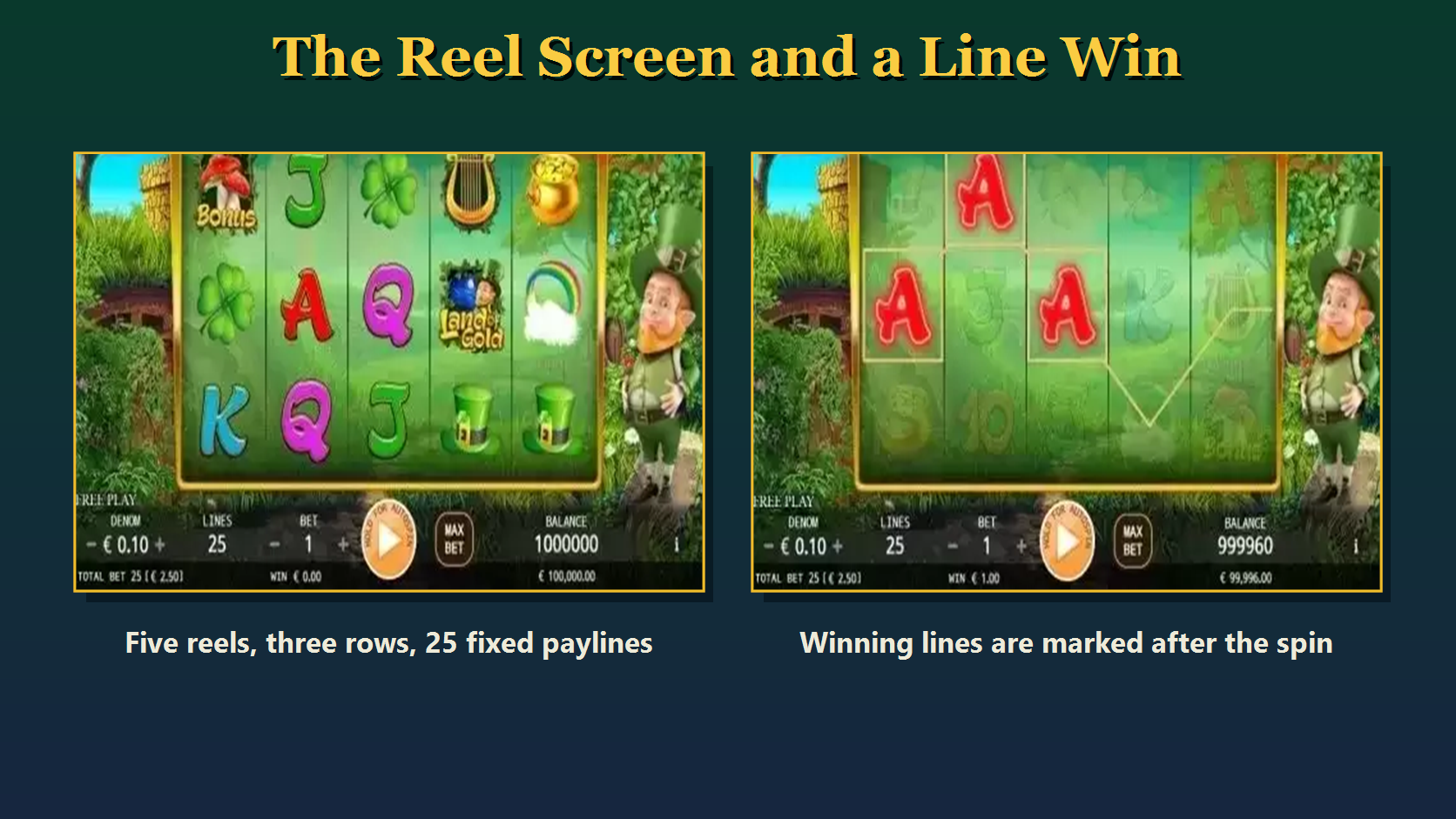
Three Mushrooms Move the Game Away From the Reels
The red mushroom is both Scatter and Bonus trigger. Three or more mushrooms during the base game activate the Fortune Wheel mini-game. Their positions do not need to follow one of the 25 line diagrams.
Scatter wins are multiplied by total bet, unlike ordinary line results. A screen with three mushrooms can therefore contain both the trigger and an immediate Scatter-related payment before the wheel begins.
The archived rules use the phrase three or more. That implies four or five mushrooms are also valid triggers. The available public material does not state that extra mushrooms improve the wheel, add spins, or raise a multiplier, so no such upgrade should be assumed.
Once the trigger is confirmed, the normal reel cabinet darkens and the gold wheel moves to the foreground. The wheel contains sectors for the mystery jackpot, free coins, free games, and combinations pairing free games with multipliers.
The result is random. The wheel is a reveal animation rather than a timing challenge. Pressing at a particular moment or attempting to stop the pointer on a desired colour does not create a reliable edge.
The Fortune Wheel serves two jobs. It determines which bonus type is entered and, for several free-game sectors, determines both the number of spins and the multiplier applied to their wins. This makes the trigger more variable than a fixed award of ten free spins.
Reading the Fortune Wheel Sectors
Archived reviews and the in-game information screen record several possible outcomes. Some wheel sectors award free coins immediately. One sector is marked Jackpot. Others lead to free games with or without a multiplier.
Reported free-game results include 15 or 50 plain free spins. Multiplied combinations include five free games at 4x or 5x, ten free games at 3x, and 50 free games at 2x. The exact sector labels are difficult to read in low-resolution archived captures, but the pattern is clear: fewer spins can carry the larger multiplier, while the longest set uses a lower one.
This creates meaningful differences among bonus results. Five spins at 5x contain only five chances to form a line, but each qualifying payment is multiplied by five. Fifty spins at 2x contain ten times as many reel outcomes, but their multiplier is less than half as large.
Neither structure guarantees the better final return. Five strong screens under 5x can beat 50 weak screens under 2x. Fifty chances can also outperform a short set simply by creating more opportunities for rainbows, Wild substitutions, and multiple-line hits.
The mystery jackpot sector is described as a wheel award rather than a progressive meter shown above the main reels. Public data does not establish that it grows across casinos or networks. It should not be called progressive without confirmation from the active game rules.
Free coin sectors settle as immediate credit prizes. They do not create extra reel spins. A wheel that stops on such a sector returns to the base game after the value is added.
The wheel therefore contains three categories of result: immediate money, a jackpot-labelled prize, and a free-game package. The trigger guarantees access to one category, not a specific amount.
Free Games Keep the Same Grid but Change the Value of Wins
Free games use the same five reels, three rows, 25 fixed lines, regular pictures, logo Wild, and pay directions as the base game. The visible multiplier attached to the wheel result scales wins produced during the awarded set.
A 3x package multiplies each qualifying free-game payment by three. It does not triple the number of free games. A 50-spin package at 2x therefore means 50 reel outcomes with a twofold win multiplier, not 100 spins.
The archived rules state that free games do not retrigger during free games. Mushroom scatters appearing inside the awarded set cannot open another wheel or add another package. This places a hard boundary around the bonus length selected by the original wheel result.
That restriction matters most for the 50-spin sectors. A long set can show several mushroom combinations that would have triggered in the base game, but those appearances do not extend the round. They may still follow any Scatter payment rule described in the local paytable, yet no second Fortune Wheel is opened.
The multiplier also belongs only to the free-game set. Once the final free spin is settled, the game returns to the base cabinet and ordinary line calculations resume.
There is no evidence of sticky Wilds, expanding symbols, symbol upgrades, or a rising multiplier inside the free games. The wheel-selected count and multiplier are the defining changes.
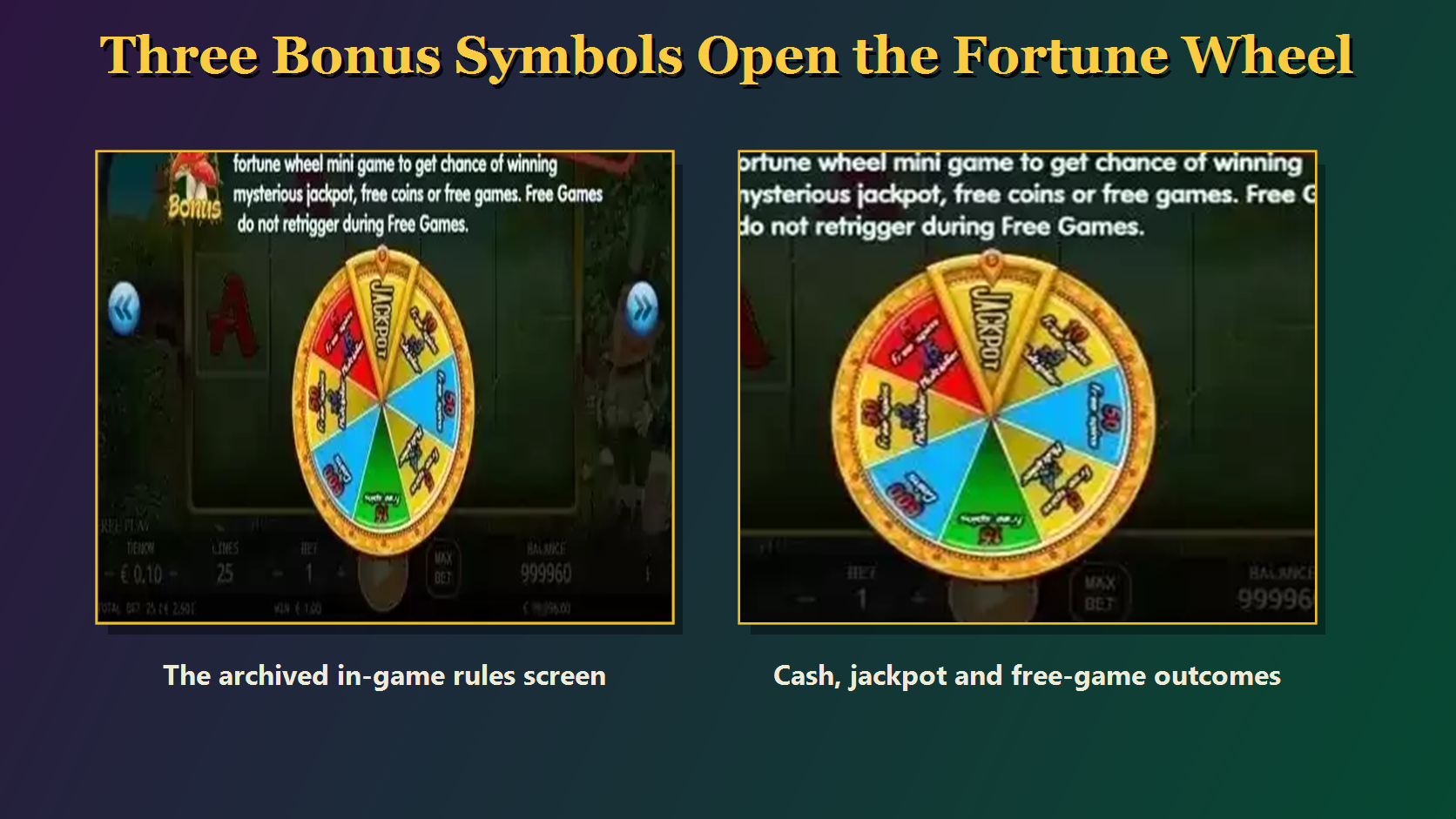
The Wheel Creates a Trade-Off Between Time and Strength
Many free-spin slots use one fixed count, which means trigger value varies mainly through reel results. Land of Gold adds a preliminary source of variance because the wheel can select very different packages.
A short high-multiplier set concentrates risk. There are few opportunities, so one empty sequence can end quickly with a weak total. A strong rainbow or multi-line hit at 5x can compensate just as quickly.
A long low-multiplier set spreads the same bonus over many more reel outcomes. The total has more time to accumulate, but each ordinary line is multiplied less aggressively. The player sees more spins without gaining control over their symbol selection.
Plain free-spin sectors may appear weaker because they lack a multiplier label. Their value depends on the number of spins attached to the sector. Fifty plain spins still carry far more reel opportunities than a short five-spin package.
Comparing packages only by multiplying spin count by multiplier is tempting but incomplete. Five spins at 5x produce a simple exposure index of 25, while 50 spins at 2x produce 100. Slot returns do not scale in such a direct way because hit size, symbol distribution, maximum payout rules, and line overlap matter.
The wheel result should be read as the starting condition of the bonus rather than a prediction of its final cash value. The reels still have to land paying combinations.
RTP at 95.99 Percent
Land of Gold is widely catalogued with a 95.99 percent theoretical RTP. That corresponds to a long-run house margin of 4.01 percent under the listed configuration.
RTP applies to total turnover across a huge statistical sample. It does not mean a 100-credit deposit should end near 95.99 credits, and it does not guarantee that every 100 spins will contain a wheel trigger.
At 10,000 units of turnover, a 4.01 percent theoretical margin corresponds to 401 units. At 100,000 units, it corresponds to 4,010 units. These are long-run expectations, not session forecasts.
The figure is close to the 96 percent reference point used by many online slots. A difference of 0.01 percentage point is negligible for an individual session, although exact RTP still matters when comparing active configurations.
The main uncertainty is version availability. Land of Gold is an older title, and some databases identify its original build as Flash technology. A casino could host a converted build, a wrapper, or a later server version. The RTP shown inside that playable version has priority over catalogue data.
An operator lobby may also list Land of Gold without the KA Gaming suffix. Checking the 25-line cabinet and mushroom wheel is necessary before assuming the 95.99 percent figure applies.
Maximum Win and the 1,500 Rainbow
The database maximum is 7,500 times total stake. The top ordinary paytable line is five rainbows at 1,500 line units. These values describe different parts of the calculation and should not be treated as interchangeable.
A single rainbow line is based on line bet. The maximum result can involve several simultaneous line wins, Wild assistance, Scatter value, a free-game multiplier, or a cap applied after combined awards. Public sources do not publish the full probability model needed to reconstruct the exact 7,500x path.
The 5x free-game sector is an obvious candidate for scaling a strong line. A 1,500-unit rainbow payment multiplied by five reaches 7,500 line units, but total-stake normalization still depends on the 25-line wager. It cannot automatically be called 7,500x total bet without checking the game's calculation.
The safe interpretation is that 7,500x is the recorded highest total-stake result for the KA Gaming build, while 1,500 is the five-rainbow paytable value expressed against line bet. The game history supplies the final cash calculation.
The maximum is also a ceiling, not an event frequency. Medium volatility and a 37.04 percent hit rate do not tell us how often the cap occurs. The majority of hits are necessarily far smaller than 7,500x.
Bet Range and the Max Bet Button
Public records usually place the minimum stake at 0.25 and the maximum at 500. Another archived review describes a maximum of 125. Such differences commonly arise from currency settings, operator limits, or later revisions.
The older interface builds total stake from denomination multiplied by line bet and 25 lines. Raising denomination from 0.10 to 1.00 multiplies the entire 25-line cost by ten. Raising the Bet value also changes the number of units assigned per line.
The Max Bet button can therefore produce a large jump. It may increase both denomination and line stake to their permitted ceiling. The total amount displayed at the bottom left should be read before the next spin is started.
Twenty spins at 2.50 create turnover of 50. Twenty spins at 25 create turnover of 500. The reel layout and trigger rules remain identical, but the cash exposure changes by a factor of ten.
This arithmetic is more useful than a generic instruction to raise stakes after wins or lower them after losses. Past spins do not alter the random selection of the next reel result. The bet controls determine only the cash value attached to that result.
What the Archived Demo Reveals and What It Cannot Prove
The accessible screenshots come from an archived demonstration build. They verify the main visual identity, 25-line count, symbol set, line-win display, Wild rule, Scatter calculation, and Fortune Wheel description.
They also show the old denomination and line-bet controls. The example balance is artificial demo credit, not evidence of a real casino payment.
The public Demo is no longer dependable in a modern browser because several directories associate this build with Flash. An image archive can establish visible rules but cannot test server speed, current currency range, audio stability, or operator-specific history functions.
The stored rule screen states that malfunctions void all pays and plays. It also confirms that only the highest win is paid on each payline, the Wild excludes Scatter, and Scatter awards use total bet.
The screenshots do not reveal the probability of each Fortune Wheel sector. Equal visual segment sizes should not be assumed to mean equal probability unless the game help page says so. A wheel animation can map weighted outcomes onto similarly sized graphics.
They also do not prove a progressive jackpot. The screen says mysterious jackpot, but no shared meter or contribution rate is shown. The word jackpot by itself can refer to a fixed top prize.
Presentation: An Old Cabinet With a Clear Identity
The reel symbols use thick outlines and saturated primary colours. The rainbow and pot of gold are easy to identify, while the green clover, harp, and hat occupy the middle of the pay order. Card ranks fill most ordinary positions.
The leprechaun on the right has a slightly exaggerated head and formal green suit. His placement keeps him out of the reel window, so character animation does not cover the result.
The outdoor background uses hedges, grass, a stone path, and distant hills. The reel glass is pale green and partly transparent. This allows the setting to remain visible without reducing symbol contrast too severely.
The interface shows its age. Text along the lower panel is small, the spin button resembles a physical cabinet control, and the info pages use dense white writing over a darkened copy of the reels. Current mobile slots generally use larger touch targets and more spacious rule screens.
The wheel is the strongest visual change. Gold edging separates the sectors, and red, blue, green, and yellow areas distinguish the possible prize categories. The jackpot sector sits near the top beneath the pointer.
Audio descriptions from archived reviews mention light piano notes and bell sounds. Without a stable modern Demo, exact sound behaviour cannot be verified across current builds. The local mute control remains the practical reference.
Mobile Availability Is the Largest Technical Question
Public sources conflict about device support. Some catalogue records label the title Flash-only with no mobile version. Other casino directories say KA Gaming titles run on mobile and desktop. These statements may refer to different years or converted deployments.
A Flash-only original would not run in current Chrome, Safari, or standard mobile browsers because Flash support ended years ago. A casino showing the title today would need an HTML5 conversion, streaming wrapper, or another compatibility layer.
The existence of a lobby tile does not guarantee that the game launches. A useful check is to open demo mode, confirm that the 25-line interface loads, open the paytable, and complete several spins before depositing for that specific title.
If the screen displays 576 ways or a different bonus system, it is the Playtech game. If it displays an unsupported plug-in warning, the operator has retained an obsolete listing.
The original KA layout is landscape-oriented, which fits a phone held sideways. Control text may become small on a narrow device because the interface was designed before current high-density touch conventions.
A Philippine-Focused Reading
Land of Gold can appear in Philippine-facing casino catalogues under KA Gaming, KA, or a generic Irish category. The exact studio label matters because the Playtech title has different mathematics.
Peso denomination, minimum stake, and maximum stake are controlled by the casino integration. A foreign-currency screenshot showing €0.10 denomination and €2.50 total bet is only an example of how the 25-line calculation works.
GCash, Maya, bank transfer, and other payment methods do not alter the reel mathematics. They belong to the casino account system. The slot controls only its stake, outcome, and recorded game transaction.
If the game freezes after three mushrooms or during the wheel, the operator history should be checked before another spin is attempted. The outcome is determined by the game server and should settle even if the wheel animation fails locally.
A useful support record contains the round ID, time, total stake, opening and closing balance, wheel result, and final credited amount. A screenshot of the pointer alone does not show the completed transaction.
Availability and legal access can change. KA Gaming's corporate site remains online, but its public catalogue page does not expose a searchable Land of Gold rules file. The casino's current approval status, local terms, and help channel therefore need separate verification.
What Holds Up After the Wheel Stops Being New
The 25-line base game is easy to audit. Lines pay from left to right, the logo acts as Wild, mushrooms trigger the wheel, and the cabinet marks winning paths clearly.
The paytable also has a clear hierarchy. Rainbow is the decisive premium icon, followed by pot, clover, harp, and hat. A player does not need to memorize a large set of mystery transformations.
The wheel creates the main source of anticipation because its result can change both bonus length and win strength. Five spins at 5x and 50 spins at 2x create very different pacing from the same trigger.
The limitations come from age and simplicity. Ordinary spins contain no secondary modifier. Free games cannot retrigger. The Wild has no multiplier or expanding behaviour. There is no gamble round, collection meter, or bonus-buy path.
The wheel also introduces outcome inequality before the free games begin. One trigger can return an immediate cash amount, another can award a long multiplied set, and another can land on the jackpot segment. Seeing three mushrooms does not establish the value of the trigger.
Technical uncertainty is harder to ignore. A Flash-era game may be missing from modern lobbies or may run only through a converted version. A conversion must be checked for its own RTP and maximum stake rather than assumed to match the archive.
Final Verdict: The Right Version Is Better Than the Wrong Review
Land of Gold from KA Gaming is a straightforward 25-line cabinet whose identity depends on one variable bonus wheel. The main reels follow conventional left-to-right rules, the logo Wild fills ordinary symbols, and the mushroom Scatter moves the game into a prize selection containing cash, free games, multiplied free games, and a jackpot-labelled result.
Its numbers are respectable for a 2018 release. The recorded RTP is 95.99 percent, medium volatility is consistent with a 37.04 percent hit rate, and the catalogue ceiling reaches 7,500x total stake. The five-rainbow paytable value of 1,500 line units gives the base game a clear premium target.
The bonus design is more interesting than the ordinary reels. A short package with 4x or 5x can create a concentrated result, while a 50-spin package at 2x spreads the chance across a much longer sequence. Free games cannot trigger another wheel, which prevents open-ended chains.
The greatest risk in researching the title is not misunderstanding the Wild. It is opening an article about Playtech's Land of Gold and copying its 576 ways, clover jackpot, or different RTP into the KA Gaming review. The cabinets are not interchangeable.
The greatest practical weakness is technology. Archived records identify a Flash build, and current mobile support is inconsistent across directories. A working HTML5 version should be tested and its local rules checked before any real-money decision.
Judged strictly as a slot, Land of Gold is an older, readable design with a wheel strong enough to carry an otherwise ordinary reel set. Judged as a current casino product, its value depends heavily on finding the correct KA Gaming version, confirming that it runs properly, and checking that the live RTP and 7,500x specification match the historical record.
By Fairy Editorial - 03 Aug 2026

Wizdom Wonders
Wizdom Wonders Review: Six Broken Books and a Multiplier That Learns to Count
Wizdom Wonders asks a different question from most slots. It is not asking how many identical pictures land across a payline. It is asking if the two halves printed on an open spellbook belong together.
Six books sit in two rows of three. Every book has a left page and a right page, and each page carries half of a magical picture. A completed frog, spider, mushroom, potion, rune, or Bonus emblem pays on that single book. A mismatched pair pays nothing. Once a completed picture has been counted, that book closes and reveals one of three elemental spells. The spell removes more books, replacements drop into the empty positions, and another matching check begins.
This sounds like a small alteration, but it changes how the entire screen is read. The six books are not six reels in the conventional sense. They behave more like six self-contained picture puzzles. A win does not travel left to right, and neighbouring books do not need to agree with each other. Each book succeeds or fails on its own two-page combination.
PG Soft released Wizdom Wonders in 2018, and its structure still feels unusual beside newer titles. The official documentation calls it a six-book page-matching slot with respins, multipliers, and a pick bonus. The multiplier begins at 1x, rises after spell-driven replacement rounds, and can reach 5x before the chain ends. Three collected Bonus pictures open a cauldron game with eight initial bubble picks.
The math is less generous than the playful wizard artwork might suggest. PG Soft's official information sheet lists a theoretical RTP of 94.47 percent, medium session volatility, a 32.32 percent hit rate, and a bonus frequency close to one in 126 paid spins. Those figures give the review a firmer foundation than promotional descriptions built only around magic and bubbles.
The Screen Is a Shelf, Not a Reel Set
The first lesson is visual. Three wooden compartments form the upper row and three form the lower row. An open book occupies each compartment. What looks like one symbol position is actually two page positions joined at the spine.
A frog's left half on one page and the frog's right half on the other page complete a frog. A frog half beside a potion half does not count. The rest of the shelf is irrelevant to that individual result. Five other books may fail while one book pays, or several books may complete different pictures on the same starting spin.
This rule removes the usual concept of adjacent reels. There is no need for three frogs across a horizontal line. One complete frog inside one book is sufficient. The same applies to the other regular pictures and to the Bonus emblem. The official information sheet labels the format Page Matching Reels, which is more accurate than the 3x2 shorthand found in many slot databases.
Calling it a 3x2 slot is not entirely wrong because the screen has three columns and two rows. It is incomplete because a standard 3x2 slot would normally have six ordinary symbol cells. Wizdom Wonders has six book cells containing twelve page halves. The matching decision happens inside each cell, not across the external grid.
The wager is tied to all six books. PG Soft's sheet states six books with a bet of six units per spin. Under the original default configuration, the listed minimum is €0.30 and the maximum is €300. Bet size choices are shown as 0.05, 0.5, and 5, combined with levels from 1 through 10. Local currency conversion and later casino builds may display a different range, so the help screen attached to the active version remains the final reference.
The crystal ball below the shelf replaces the familiar circular spin button. Tapping it flips every page pair. The wizard remains above the books beside a glowing cauldron, reacting when symbols complete or elemental spells appear. A multiplier rail marked 1x through 5x runs immediately above the book grid.
That rail matters because every completed symbol during the active sequence is paid at the multiplier currently illuminated. The first check starts at 1x. If a spell removes books and the replacements produce another win, the multiplier advances by one. A long chain can therefore move from 1x through 2x, 3x, 4x, and finally 5x.
The multiplier resets to 1x when no more complete pictures remain and the next paid spin begins. It does not persist across separate wagers. A 5x finish is the final stage of the current chain, not a permanent account-level upgrade.
One Completed Picture Is Enough
The highest ordinary picture is the frog, listed at 30 times the relevant unit value in common paytable records. The spider follows at 15x, then the mushroom at 12x. Potion bottle and laboratory flask results sit at 6x. The eye and purple rune are commonly shown at 3x, while several lower alchemy marks pay 2x. A completed Bonus picture has a small immediate value and is also stored toward the separate cauldron round.
The figures are easier to understand when separated from the six-book total bet. Each book is effectively funded by part of the spin cost. A displayed symbol payment is then multiplied by the active chain value. Since PG Soft shows cash amounts directly on winning books, the local interface is more reliable than trying to convert every paytable number mentally.
Suppose a potion completes during the first page flip. Its payment is calculated at 1x and appears beneath that book. The book then closes, reveals a spell, and the resulting removal may create fresh book positions. If a frog completes after the replacement and the rail has advanced to 2x, the frog is paid at 2x. The earlier potion is not recalculated; it keeps the multiplier that was active when it completed.
Several books may complete at once. Their cash amounts are added to the spin total, all winning books close, and every revealed spell is processed. The order of spell effects can change how much of the shelf is cleared, but the outcome is governed by the game server rather than by a choice from the player.
There is no Wild symbol repairing a broken page pair. A half frog beside half spider remains a mismatch. The absence of a substituting icon keeps the page rule clean, but it also means many near-matches have no value. The visual design makes those near-matches obvious, which can make a losing shelf feel closer to a payment than it mathematically was.
The half-symbol concept also produces a slower read than a conventional line slot. A player first scans six spines, then compares left and right pages, then watches completed books close. Turbo can shorten the flipping motion, but it does not change which halves were selected or how the resulting spells behave.
Fire, Water, and Lightning Control the Replacement Pattern
A completed book does not simply disappear. After its payment has been counted, the cover closes and reveals Fire, Water, or Lightning. These elemental marks determine which positions are removed before the next matching check.
Fire clears books along the vertical axis. On a two-row shelf, that means the Fire book and the position directly above or below it are removed. A single Fire result can therefore refresh an entire column.
Water clears books along the horizontal axis. It removes the books across the affected row, creating three replacement positions. Since half the shelf changes at once, Water has the broadest predictable reach.
Lightning removes the book carrying the Lightning mark plus one randomly selected book. Its second target can sit elsewhere on the shelf, so the shape of the removal is less regular than the Fire column or Water row.
If more than one winning book reveals a spell, their effects are resolved within the same chain. Overlapping removal areas do not create duplicate positions or extra payments by themselves. They determine which books leave and how many new books enter before the next check.
After the spell effects finish, new books fill the empty spaces. Every newly formed book is checked for a complete picture. A replacement that produces no match ends its part of the sequence. A replacement that produces one or more matches pays and starts another spell phase.
This is why the official documentation uses the term respin even though the entire six-book shelf does not always flip again. The game is refreshing positions selected by the elemental effect. It resembles a cascade, but the removal geometry comes from hidden spell marks rather than from the location of winning symbols alone.
The multiplier advances by one after spells act and replacements are added. It cannot rise past 5x. If the chain reaches the final rail position, later matches in that same sequence remain at 5x until no further win is present.
There is a small but important timing distinction. The books pay first, then close, then reveal spells, then the removal takes place, then replacements arrive, and only then does the next matching check occur. The spell itself is not a cash symbol. Its value lies in creating another set of book combinations under a higher multiplier.
The Multiplier Rewards Depth, Not the First Hit
The multiplier begins at 1x because a single completed book on the opening flip is fairly common. The larger returns depend on the sequence surviving long enough to reach the upper rail positions.
A shelf with several opening matches can pay more immediately, yet a single match that uncovers a strong Water or Fire removal may create the better chain. Number of initial wins and chain length are related, but they are not the same thing.
The most valuable path has several stages. First, at least one book completes. Second, the revealed spells remove useful areas of the shelf. Third, the replacements form new completed pictures. Fourth, the same process repeats while the multiplier rises. The player does not choose the pages, spells, or replacement books, so the mechanic remains a chance system despite its puzzle-like surface.
A chain ending at 2x is common enough to explain the system. Reaching 4x or 5x feels more significant because several consecutive replacement checks had to succeed. The rail gives a clean record of that depth. It also prevents confusion about which multiplier is being applied to the current set of book wins.
Every stage still pays only completed pictures. A 5x rail with six mismatched books ends the chain immediately. The high multiplier cannot turn half-symbols into cash, and it cannot carry into the next wager.
This structure creates an interesting contrast with free-spin multipliers. Many slots increase a multiplier across several nominally free rounds. Wizdom Wonders increases it inside one paid spin and resets as soon as the spell chain stops. What looks like several rounds is one wager being resolved through multiple replacement checks.
The practical result is a rhythm of compact openings and occasional long interruptions. Most spins flip pages, identify a small payment or no payment, and return control. A spell chain temporarily takes control away, moves through its removal stages, and adds each payment to the same win meter.
Bonus Symbols Must Be Collected Inside the Same Spin Chain
The cauldron round needs three completed Bonus pictures. A Bonus match is formed like any other paying picture: its left and right page halves must meet inside one book. When it completes, the symbol is paid and one Bonus point is collected in the circular meter above the cauldron.
The three points may arrive on the opening flip or during replacements created by elemental spells. This makes chain depth important for more than the multiplier. Extra book checks create extra chances to complete the second or third Bonus emblem before the paid spin ends.
Once the third Bonus picture has been stored, no further Bonus symbol payments are collected during that spin. The remaining spell sequence is allowed to finish. The cauldron round begins only after no additional book win remains.
This timing stops the bonus screen from interrupting an unfinished multiplier chain. All main-game cash is settled first. The screen then shifts away from the bookshelf and into the bubble selection.
The official sheet lists a Bonus hit rate of 0.79 percent and a frequency of about one in 126 spins. Those two figures agree after rounding. A frequency near one in 126 is not a schedule; two triggers can occur close together, and a much longer gap can also occur.
The distinction between Bonus symbols and scattered halves matters. Seeing three Bonus halves across different books does not trigger anything. Each stored point requires a complete two-page Bonus picture inside one book. The circular meter tracks successful completed pictures, not visible fragments.
Eight Bubbles Begin the Alchemy Round
The bonus starts with eight picks. Bubbles rise from the cauldron, and each tap reveals one of three result types: a cash prize, extra picks, or nothing.
Cash prizes range from 2 times to 30 times the current total bet according to the official rules. The revealed amount is added to the bonus win meter immediately. The bonus artwork may show coins and a bright collection screen, but the useful figure is the accumulated multiple relative to the stake that triggered the round.
An extra-pick result adds either two or three selections. If the counter shows five picks remaining and a three-pick bubble is opened, the counter rises to eight. Extra picks can therefore extend the round beyond its initial eight choices.
An empty bubble consumes one selection without adding money or another pick. Empty results are part of the published outcome set, so eight initial taps do not guarantee eight separate cash awards.
The official launch material advertises a chance to reach up to 300 times the current bet inside the bonus. That statement refers to the pick round, not to a single 30x bubble. Several prize bubbles and additional-pick results are needed for the total to climb far above the value of one selection.
There is no skill test hidden in the cauldron. The bubbles are presented as choices, but the player has no information that identifies which one contains a cash value. Tapping the left side rather than the right side does not create a repeatable edge. The interaction changes how the result is revealed, not the underlying house mathematics.
Once no picks remain, the collected bonus value is transferred to the round result and the main shelf returns. The multiplier rail begins the next paid spin at 1x. A strong bubble total does not raise future page-matching odds.
The bonus is short compared with a ten-spin mode, but it contains more direct input. Every bubble requires a tap, and extra picks can alter the length. This keeps the cauldron from feeling like an automated win counter while preserving the simplicity of a pick-and-reveal game.
The Official Math Tells a More Interesting Story Than the Marketing
PG Soft's information sheet lists a 94.47 percent theoretical RTP. That means 5.53 percent of wagered turnover is retained by the house in the long-run model before any casino promotion is considered. It does not predict the result of a short session.
The sheet also divides the return into 66.28 percent from the main game and 28.19 percent from the bonus. Those components add to 94.47 percent. Nearly three tenths of the theoretical return is therefore tied to the cauldron round even though it appears only about once every 126 spins.
That division explains why the ordinary shelf can feel restrained. A substantial portion of the game's return budget is reserved for a relatively rare event. Someone who stops before seeing a representative number of bonus rounds may experience a return far from the published percentage in either direction.
The reported full hit rate is 32.32 percent. The main-game rate is 31.53 percent, while the Bonus rate is 0.79 percent. A hit in this context means a recorded paying event according to the test definition; it does not necessarily mean a profitable spin after the six-book wager is deducted.
Medium session volatility is PG Soft's own classification. It sits beside a relatively frequent main-game hit rate and a bonus that concentrates a large share of theoretical return. That combination can produce many small completed pictures with occasional larger corrections from a long chain or bubble round.
The same official sheet records maximum exposure of 415 times the stake in a simulation of one billion spins. This wording is not identical to an absolute mathematical maximum. It states the largest exposure found in the studio's simulation sample.
Several current slot directories publish a maximum win of 3,000x or a maximum coin value of 149,400. Those numbers do not match the older official sheet. They may refer to a later build, a different normalization of coin value, or inaccurate catalogue data. Without a newer PG Soft rule file confirming 3,000x, the active in-game paytable should decide the question.
For an article intended to help a player understand the title, the safe description is clear: the official 2019 document records x415 as the largest simulated exposure in one billion spins, while the pick bonus is promoted at up to 300x the current bet. A casino displaying a larger ceiling should show that ceiling in its local rules and transaction system.
Why 94.47 Percent Feels Different From 94.47 Percent on a Line Slot
Two games can share the same theoretical return and distribute it in completely different ways. Wizdom Wonders assigns 28.19 percentage points to the bonus. A conventional line slot might place more of its return in ordinary symbol combinations or a more frequent free-spin round.
The six-book structure also changes what counts as a visually busy result. Several completed low symbols can appear together, creating multiple cash labels and spell effects. The animation may be long while the final result remains below the total stake.
Conversely, one completed high symbol can expose Water, clear a row, lead to two more matches at 2x, and build toward the bonus meter. The opening screen may look modest while its replacement path creates most of the value.
This is why raw hit frequency should not be read as a profit frequency. A 32.32 percent hit rate says something was paid on roughly that share of rounds in the tested model. It does not say roughly one third of spins returned more than their cost.
The official return is also lower than the 96 percent area common among many modern online slots. A difference of 1.53 percentage points between 94.47 and 96.00 sounds small per spin, but it becomes meaningful across high turnover. At 100,000 units wagered, the theoretical house margin is 5,530 units at 94.47 percent compared with 4,000 units at 96 percent.
That comparison remains theoretical. A real session can finish far above or below either expectation. Its purpose is to show that RTP differences apply to total turnover, not merely to the opening deposit.
Bet Size, Bet Level, and the Six-Book Cost
The original rule sheet separates Bet Size from Bet Level. Bet Size determines the underlying unit value, while Bet Level scales that unit. The six books are funded on every paid spin, so the final Bet Amount is the number that matters for cash exposure.
Under the documented defaults, Bet Size choices are 0.05, 0.5, and 5, while Bet Level runs from 1 to 10. The minimum total is €0.30 because six books are active at 0.05 each. The documented maximum is €300.
Some later directories display a maximum of 360. That discrepancy is another reason to read the live help screen rather than copying a lobby card. Currency configuration, studio revision, and operator limits may alter the visible range.
Changing the bet does not buy a different symbol set or a higher multiplier ceiling. The same six books, 1x to 5x rail, elemental spells, and bubble rules remain in place. Cash values scale with the total stake.
If a Philippine lobby shows a ₱6 total bet, each of the six books is effectively carrying one peso under the basic six-unit structure. Fifty paid spins create ₱300 in turnover before returns. At ₱30 per spin, the same count creates ₱1,500 in turnover. Spin count alone does not describe the amount risked.
The maximum-bet button changes Bet Size and Bet Level together. On a compact phone interface, that is a much larger jump than increasing one level. The total displayed next to the crystal ball should be checked after opening or closing the bet menu.
A Vertical Game Presented in Horizontal Review Images
Wizdom Wonders was built around a tall phone screen. PG Soft's official document specifies an optimal 1080x2340 display and a 19.5:9 aspect ratio. The wizard, cauldron, multiplier rail, six books, crystal ball, and controls are stacked from top to bottom.
That portrait design fits the mechanic. Each open book remains large enough for both page halves to be read, and the wizard has space above the shelf without shrinking the controls. The bubble round also works naturally as bubbles rise vertically from the cauldron.
The three review images shown here use landscape editorial layouts because the requested publishing format is 1672x941. The internal phone captures remain unaltered official screens; several portrait frames are placed beside one another so the page-matching sequence and bonus progression can be compared in one horizontal image.
On a real phone, the upper cauldron can become partially obscured by browser bars if the game is not opened in full-screen mode. The six books and total bet should remain visible before a spin is started. Rotating the device may cause the casino wrapper to add empty side space rather than redesign the game's portrait cabinet.
The text on the wooden banner above the books changes during play. It may display a win amount, instructions about Bonus symbols, or a prompt connected to multiplier growth. The cash labels placed directly beneath winning books are more useful when auditing which positions paid.
Sound and Animation Do More Than Decorate the Shelf
The page-flip sound marks the boundary between a paid spin and its first result. Completed books receive a short magical cue, then close with a heavier wooden impact before elemental marks appear.
Fire, Water, and Lightning have different visual signatures. Fire uses red-orange light, Water sends a blue wave through the selected books, and Lightning strikes with a white-blue flash. These distinctions make the removal geometry easier to follow without reading a text label.
The multiplier rail adds a rising cue as the chain moves upward. The sound helps a player notice that replacement wins are now worth more than opening wins. At 5x, the sequence holds the highest rail state until the final mismatch ends the spin.
The bubble round changes to a darker cauldron view. Each selection has a short pause before its content is shown. Prize bubbles use coin effects, extra-pick bubbles raise the counter, and empty bubbles disappear without adding to the meter.
The pacing is theatrical but not excessive by 2018 mobile standards. Long chains can repeat the same book-closing sequence several times, and the bubble round demands manual taps. Turbo shortens main-game reel motion but should be disabled during a first test so the relationship among complete picture, spell type, replacement area, and multiplier rise remains visible.
What a Demo Test Should Actually Check
A useful demo session is not a search for the largest screenshot. It is a check that the rules behave as described.
First, watch a single completed book. Confirm that the cash amount appears before the book closes. Then identify the elemental mark and compare the removed positions with its axis rule.
Second, watch the multiplier rail after replacement books arrive. The next set of completed pictures should use the higher illuminated value. When no more match remains, the next paid spin should return to 1x.
Third, track the Bonus meter. Only a complete two-page Bonus picture should add one point. After the third point, the remaining spell chain should finish before the bubble screen starts.
Fourth, count the initial bubble picks. The round begins with eight. A revealed two-pick or three-pick result should increase the counter by the stated amount, while an empty result should reduce it without adding money.
Fifth, compare the total bet displayed by the interface with the amount removed from the demo balance. The six-book stake should be treated as one paid spin, even when several replacement stages follow.
These checks reveal more about Wizdom Wonders than a short win montage. They show which events are payments, which are removals, which belong to the same wager, and which values reset before the next wager.
Philippine Casino Versions Need Local Verification
PG Soft games appear across many Philippine-facing platforms, but the studio does not control every lobby label, currency conversion, promotion, or withdrawal rule. The active casino controls account balances and transaction history.
A peso stake shown inside Wizdom Wonders should match the amount recorded in the operator history. If a connection drops during a long spell chain or bubble round, the round ID and history result are more important than the final animation seen on the phone.
An operator may also mark the title as unavailable even though older review sites still host screenshots. Some slot catalogues indicate that Wizdom Wonders has been removed from parts of their network. Availability therefore depends on the current casino catalogue and market, not only on the game's original 2018 release.
Deposit methods such as GCash or Maya do not alter the RTP, hit rate, or symbol selection. They affect payment handling at the casino level. Bonus-credit wagering conditions also sit outside the slot rules.
The official information sheet dates from March 2019 and describes version 2.5.R264. A casino running a later revision should expose its own help page. If its maximum win, wager range, or RTP differs, the values attached to that playable build take precedence over an old marketing article.
Where Wizdom Wonders Works and Where It Shows Its Age
The page-matching idea remains easy to recognize. Two halves either complete a picture or they do not. The six-book shelf gives every position an independent purpose, and the elemental spells create replacement patterns that can be understood after one or two examples.
The multiplier is also honest about its state. It begins at 1x, climbs one step after successful spell replacement, stops at 5x, and resets when the chain finishes. There is no hidden meter that must be remembered across sessions.
The bonus complements the theme rather than copying a free-spin template. Three completed alchemy emblems activate a cauldron, and the player pops bubbles for prizes or extra selections. It is a short interaction with a clear end condition.
The weaknesses are equally visible. The 94.47 percent RTP is below many newer releases. A large 28.19 percent share of theoretical return sits in the bonus, so ordinary play may feel underpowered during a long trigger gap. Empty bubbles can also make a rare bonus finish with less impact than its arrival suggests.
The interface predates several conveniences common in newer PG Soft titles. Its bet menu and lower navigation icons are small, the portrait cabinet can feel cramped inside a casino browser frame, and repeated book-closing animations slow a long chain unless Turbo is used.
The maximum-win information found online is inconsistent. A careful review cannot repeat a 3,000x claim as settled fact when PG Soft's archived sheet records x415 as the largest simulated exposure and advertises up to 300x in the bonus. The local rule screen must resolve that difference.
Final Reading: The Puzzle Is Stronger Than the Payout Profile
Wizdom Wonders succeeds because its central rule is both strange and immediately visible. Six books replace paylines. Two page halves replace symbol runs. Fire, Water, and Lightning replace ordinary cascade removal. The result still belongs to chance, but it does not look like another reskinned five-reel cabinet.
Its best moments occur when the mechanism reveals its layers. A completed picture pays, the book closes, Water clears a row, replacements create two new matches, the multiplier moves to 2x, another spell clears more positions, and a third Bonus emblem finally reaches the cauldron. Every stage follows a rule visible on screen.
The bubble round is simpler. Eight picks open the sequence, cash values range from 2x to 30x, two-pick and three-pick bubbles extend it, and empty results consume a choice. The advertised 300x bonus ceiling requires several favourable selections rather than one decisive bubble.
The official numbers keep the verdict grounded. RTP is 94.47 percent. Medium volatility and a 32.32 percent hit rate describe the tested session profile. The Bonus appears near once per 126 spins and accounts for 28.19 percentage points of theoretical return. Maximum simulated exposure in the archived one-billion-spin test is x415.
Those figures stop Wizdom Wonders from being an easy recommendation based only on originality. The mechanic is memorable, but the return percentage is dated and the rare bonus carries a large part of the math. Someone comparing it with a newer PG Soft title should inspect both RTP figures rather than assuming the newer or older game is equivalent.
As a piece of slot design, Wizdom Wonders deserves attention. It turns a bookshelf into six miniature matching puzzles and uses hidden spells to decide how the shelf is rebuilt. As a real-money product, it deserves a careful check of the active help file, especially the RTP, stake limits, version number, and maximum win.
The wizard is not really asking the player to master alchemy. He is asking the player to understand a chain: match the pages, expose the spell, replace the books, raise the multiplier, collect three Bonus pictures, and then test eight bubbles. Once that chain is understood, Wizdom Wonders becomes one of PG Soft's clearest examples of a playful interface built over a precise mathematical loop.
By Fairy Editorial - 02 Aug 2026

Fortune Garuda 500
Fortune Garuda 500 Review: The Fourth Reel Carries the Whole Temple
Fortune Garuda 500 does not hide its plan behind a long free-spin sequence. Nine positions sit in the middle of the screen, five fixed lines cross them, and a narrow reel on the right decides how much a completed line is worth. The first three reels find the win. The fourth reel grades it.
That distinction is the whole game. A plain three-of-a-kind result may look small on the main grid, yet the multiplier framed on the side can turn it into a respectable return. An Ex NUDGE result goes further by pulling a run of multiplier values through the frame, adding them together, and applying the total to the same paid spin. Fortune Garuda 500 is therefore less about waiting for a separate bonus round and more about watching one normal spin acquire a second life.
JILI wraps the system in a gold temple setting built around Garuda, the mythic bird figure found across Hindu and Buddhist traditions. The screen is lavish without becoming difficult to read. Letter symbols occupy most ordinary spins, gemstone tiles sit above them in the pay order, and the gold Garuda Wild is clear even on a small phone. The right edge remains visually separate from the 3x3 grid, which matters because the player must read two results at once.
The title carries a published maximum win of 25,000 times the stake. JILI lists the volatility as low to medium on its product page, while some independent catalogues label it low. Those labels describe a broad math profile, not a promise that a short session will feel gentle. High multipliers, long nudge sequences, and the 8x Extra Bet can create abrupt swings even when the standard mode is classified near the lower end of the scale.
A Small Grid With a Fourth-Reel Problem
The base layout uses three reels and three rows. Five fixed win lines run through that 3x3 block, and combinations are read from the first reel toward the third. A standard paid result needs matching symbols on consecutive reels along one of those lines. Only the best result on a line is counted, so overlapping interpretations of the same symbols do not create multiple line prizes.
At first sight, this resembles an old three-reel cabinet translated to a phone. The resemblance ends when the fourth reel starts moving. That special strip is not an ordinary symbol column and does not form part of the five-line pattern. It carries multiplier discs and the Ex NUDGE emblem. Its centre frame is the active position after a spin settles.
If the main grid has no win, the side result has nothing to multiply. A 100x or 500x disc can be visible on the strip and still mean zero because the first condition was not met. This is one of the most important details to understand before judging the game. The fourth reel is an amplifier, not an independent prize wheel.
When the main grid does contain a paid line, the value in the centre frame becomes relevant. A regular multiplier changes the line award according to the game calculation. Published rule summaries describe the standard formula as line payout multiplied by the special-reel value and divided across the five fixed lines. The in-game paytable should be treated as the final reference for the exact credit display in a particular currency or operator build.
That last qualification matters because JILI titles are distributed through many casino platforms, and a lobby may show pesos, credits, or a local token balance. The visual bet number alone does not always reveal the underlying coin value. A player who wants to check the math should use a clean winning spin, note the stake, note the base symbol combination, note the multiplier in the centre frame, and compare the final win against the local help screen.
The compact grid changes how wins look. Stacked letters can cover two or three positions, and a full reel of the same symbol can intersect more than one line. The reels therefore appear busy even though only nine base positions exist. This visual density is useful on mobile, but it can also make a modest multi-line return look larger than it is until the numeric counter finishes.
What the Symbols Are Really Doing
The regular ladder is short. J, Q, K, and A form the lower group. Red, blue, and green gemstones form the stronger group. The ordinary Garuda Wild substitutes for regular paying symbols and sits at the top of the base pay order. An Ex NUDGE Wild also substitutes, but its real purpose is tied to the side reel.
Published paytable summaries place three Wilds at 25 times the stake before the relevant side-reel treatment. The gemstone trio values are commonly listed at 10x, 7.5x, and 6x, followed by card-symbol returns ranging from 5x down to 1x. These figures explain an otherwise odd visual pattern: the base grid is not designed to carry the largest moments by itself. Its strongest ordinary line still needs the fourth reel to approach the numbers advertised on the loading page.
Stacks help the five-line structure. If a letter fills most of reel two, the chance that it meets the same letter on reels one and three across several paths becomes easier to see. A Wild stack can bridge several lines in the same way. Yet a multi-line screen is not automatically a profit. Each line value is modest, and the stake paid for the round still has to be recovered.
The Ex NUDGE Wild deserves separate attention. It may appear on any of the three main reels, works as a substitute, and can trigger its collection action when the spin has a win. Published rule descriptions state that it does not need to sit on the winning line; its presence on the grid plus a paid result is the relevant pairing. That makes it more powerful than a Wild whose only job is completing a combination.
The number shown on an Ex NUDGE Wild is not a cash multiplier applied once. It represents how many downward steps the special reel will make. Each framed multiplier encountered during those steps is collected. The collected values are added, not multiplied together. If a short sequence captures 2x, 3x, and 5x, the combined figure is 10x rather than 30x.
This addition rule prevents the mechanic from becoming mathematically absurd, but long counts can still build a large total. The visual rhythm is deliberately repetitive: step, frame, collect, step again. On a high count, the suspense comes from the accumulating sum and from the possibility of stronger discs entering the centre, not from new symbols appearing on the main grid.
The Special Reel Is the Actual Main Character
The right-hand strip carries values from 1x through 500x. Public rules list 1x, 2x, 3x, 5x, 10x, 15x, 20x, 25x, 50x, 100x, and 500x among the possible multiplier results. The exact set visible in ordinary play and each Extra Bet tier changes because low values are removed in the paid settings.
A standard multiplier is easy to read. The centre frame lands on a disc, the main-grid return is adjusted, and the win counter resolves. Ex NUDGE changes the procedure. The special-reel emblem initiates repeated downward movements, collecting each multiplier that passes through the active frame. Ex NUDGE Wild starts from the main grid but produces a comparable collection on the side.
Both actions depend on a winning base spin. That dependency keeps many rounds short. The player may see an Ex NUDGE icon, a tempting multiplier above the frame, or Garuda moving at the side, but no payment is due unless the grid satisfies the line condition. Fortune Garuda 500 is good at showing potential before it confirms value, so reading the final counter is more reliable than reading the animation.
The maximum nudge count can reach 500 under the stronger configurations. This does not mean 500 free spins. It means up to 500 movements of the special reel inside the resolution of one paid round. The distinction is critical. The stake is tied to the initiating round, the multiplier discs are accumulated during that round, and the process ends when the collection is complete or the payout cap is reached.
Long sequences may be accelerated by the interface, and a casino build can compress part of the count. That is why a displayed Ex NUDGE number should not be interpreted as a promise of the same number of separately controllable spins. It is a collection count. The game can process several steps quickly, especially under Turbo settings, while the final sum records the captured values.
The special reel also gives ordinary wins more texture. A three-symbol line followed by 1x feels almost flat. The same line followed by 20x becomes the moment the player remembers. Since both outcomes begin with a similar grid, the emotional difference is concentrated in a narrow column on the right. JILI has effectively moved most of the variance away from symbol matching and into post-match grading.
Gift of Garuda Rewrites a Settled Spin
Gift of Garuda can arrive at random during normal play. It is not a scatter round and does not take the screen to a new location. Garuda intervenes in the existing result through one or more modifiers connected to the grid or special reel.
One version selects several multiplier values or Ex NUDGE and raises their chance of appearing on the special strip. The selection is displayed before the final side result, letting the player see which outcomes have been favoured. This is still a probability change rather than a guaranteed capture of the largest marked value.
Another version chooses a stronger multiplier or Ex NUDGE and may replace the result that originally settled in the centre frame. A related version upgrades the framed multiplier directly. The practical difference between these animations is small from the player side: a weak side result is given a route toward a stronger one.
A further modifier respins a base reel while guaranteeing a higher winning combination. This is the clearest reminder that the two parts of the screen are linked. Improving the main grid raises the amount waiting to be multiplied; improving only the side reel raises the factor applied to the same base amount. A strong outcome needs both halves to cooperate.
Gift of Garuda may also select a multiplier visible above or below the centre frame and move a higher one into the active position. Because the candidate is already on screen, this version is easier to follow than a hidden random upgrade. The player can see the rejected centre result and the better disc that takes its place.
The mechanic solves a pacing issue found in many compact slots. A 3x3 grid with five lines can become repetitive very quickly. Garuda gives occasional interruptions without forcing a separate bonus loading sequence. The round remains readable, and the change has an immediate relationship to the result already on screen.
It also creates a common misunderstanding. A dramatic Garuda animation does not guarantee a net gain. The modifier may improve a 1x result to 3x, yet the base line can still be too small to cover the total stake. Improvement is measured against the original outcome, not automatically against the cost of the spin.
Extra Bet Changes the Multiplier Pool, Not the Past
Two Extra Bet settings sit behind the EX control. The first costs 1.5 times the standard stake. The second costs 8 times the standard stake. They do more than increase the denomination; they alter which low multipliers remain available and expand the possible Ex NUDGE counts.
At 1.5x, the 1x and 2x discs are removed from the special reel and Gift of Garuda pool according to published rules. The remaining set starts higher, and Ex NUDGE or Ex NUDGE Wild may reach counts up to 500. The player pays an additional 50 percent for that revised distribution.
At 8x, the pool becomes much more severe. Values from 1x through 10x are removed, leaving 15x, 20x, 25x, 50x, 100x, and 500x in the published description. Ex NUDGE and Ex NUDGE Wild counts are raised by a factor of five and may also reach 500. The word may is doing substantial work here. The higher charge buys a different set of probabilities; it does not buy a hit.
An example makes the cost easier to grasp. Suppose the base stake shown by the game is 10 credits. Standard play costs 10. Extra Bet 1 costs 15. Extra Bet 2 costs 80. Ten spins therefore cost 100, 150, or 800 credits before any returns are counted. The third option is not a slightly stronger version of the first. It is a different budget pace.
The 8x mode can make the screen look kinder because weak side multipliers have been stripped out. That visual impression ignores all losing base grids. A removed 1x disc has no value on a round where the three main reels fail to form a line, and the eightfold charge is still paid. The revised special reel matters only after the first gate has opened.
This is also why switching Extra Bet on after a run of losses has no mathematical basis. Previous results do not improve the next grid, and the game does not owe a Garuda modifier. The toggle changes future wager cost and future outcome distribution. It cannot repair past spins.
The 1.5x tier is easier to study in a demo because the cost difference remains visible without racing through the balance. The 8x tier is the headline mode, but it can distort a first impression. Large framed values appear more often by design while the cost per attempt has risen far more sharply than the jump from standard play to 1.5x.
The 97.10 Percent Figure Needs Context
Independent game catalogues commonly publish an RTP of 97.10 percent for Fortune Garuda 500. JILI's short product page does not place that figure beside the other headline specifications, so it should be checked against the help file loaded by the actual casino before money is used. Some studios distribute more than one math configuration, and operator implementations may vary.
An RTP figure is a long-run theoretical ratio across an enormous sample of wagers. It does not mean a 100-credit session should end near 97.10 credits. It also does not mean every 1,000 spins will behave alike. A single Ex NUDGE chain can dominate the return of one session, while another session may contain many plain 1x and 2x resolutions.
If 97.10 percent is the active configuration, the mathematical house margin is 2.90 percent before considering outside promotions or wagering conditions. Multiplying the stake by the number of rounds gives turnover; multiplying turnover by 2.90 percent gives the theoretical long-run loss attached to that turnover. This is an expectation across a very large sample, not a forecast for tonight.
Extra Bet complicates casual comparisons. A person may count 100 spins in standard mode and 100 spins at 8x as equal samples. They are not equal in turnover. The second block risks eight times as many credits if the displayed base amount stays unchanged. RTP is applied to wager volume, so spin count alone hides the true exposure.
Volatility labels are also inconsistent across public pages. JILI marks low to medium. Several catalogues mark low, while some casino articles call it high because the side-reel mechanic can generate sharp peaks. JILI's own label is the best headline reference, yet the 8x Extra Bet can still feel severe at session scale. A classification describes the underlying distribution, while personal experience is shaped by stake size, session length, and which mode was selected.
The maximum of 25,000x is a cap, not a target frequency. Published rule summaries state that play ends and the accumulated return is paid when the cap is reached. The 500x disc and 500 nudge count are inputs to the mechanic; neither guarantees 25,000x. A base grid still has to win, and the calculation remains subject to the cap.
Reading One Spin Without Being Fooled by the Animation
A clean way to audit a round is to separate it into four questions.
First, did the 3x3 grid form one or more of the five fixed line patterns? If not, the side reel cannot rescue the round through an ordinary multiplier.
Second, which regular symbols or Wild substitutions created the paid line? This determines the base line value before the special-reel treatment.
Third, what settled in the active centre frame? A multiplier resolves directly. Ex NUDGE begins a collection. An Ex NUDGE Wild on the main grid can also begin a collection when the round contains a win.
Fourth, which wager mode was active? Standard, 1.5x, and 8x use different costs and different side-reel pools. Comparing the final cash amount without checking the stake can make an 8x result appear far stronger than it was relative to cost.
These four questions strip away most of the visual noise. Coins, flashes, Garuda gestures, and enlarged win labels are presentation layers. The useful record is the main-grid line, active special result, total wager, and final paid amount.
Turbo changes the speed but not the published rules. In ordinary speed, each nudge step is easier to inspect. In faster modes, long collections pass rapidly and the final counter becomes more important. Anyone learning the system should leave the animation at normal speed until the relationship between the centre frame and total win is familiar.
Autoplay deserves similar care. The compact grid can process rounds quickly, and the absence of a long free-spin mode means fewer natural pauses. If Extra Bet is active, each automatic round inherits the higher charge. A setting that looked affordable for manual taps may consume the displayed balance at a very different pace when automated.
Why There Is No Conventional Free-Spin Chapter
Fortune Garuda 500 does not build its identity around three scatters, ten free spins, or a bonus-buy button. Its extended sequence is the nudge collection attached to one winning base round. That design cuts away the usual wait for a separate mode and concentrates the top values on the fourth reel.
The absence of free spins is neither automatically good nor bad. It shortens the rules path. A player does not need to remember a second paytable, sticky-symbol state, or growing multiplier across ten rounds. The trade-off is that sessions have less structural variety. Most of the time, the screen returns to the same nine positions after the result counter closes.
Gift of Garuda partly fills that gap by changing a settled round. Ex NUDGE fills it more strongly by extending one result into many reel steps. The difference is psychological as much as mechanical. A conventional bonus gives several new bets at no new charge after a trigger. A nudge sequence feels like a bonus because it lasts, but all of its value belongs to the initiating spin.
This distinction also helps explain user complaints about a large displayed nudge number. The count is not a batch of manually viewed free rounds. It refers to multiplier grabs processed by the special reel. Casino speed settings, animation compression, and the game's counter display can make the number of visible steps look different from a player's expectation. The proper check is the history record and final accumulated multiplier, not an assumption that each unit equals a separate spin.
Presentation: Gold With a Functional Purpose
The art direction uses sandstone frames, jewel inlays, deep violet sky, and large areas of polished gold. Garuda stands to the right of the cabinet, visually connecting the character to the special reel rather than blocking the central symbols. The main grid uses a duller stone background, allowing the multiplier discs to remain the brightest moving objects.
This hierarchy is smart. The main symbols need to be identified quickly, but the side result is where the round changes scale. Red illumination outlines the special reel during active sequences, while the centre frame stays fixed as values move through it. Even without reading the help page, the player can infer that the framed item is the one being counted.
The letter symbols use metallic edges and small gemstones. They are not imaginative, but they are legible. The higher gemstone tiles are more decorative and easy to separate by hue. Wild and Ex NUDGE Wild use Garuda faces with different labels, so the special function is not left to a tiny corner icon.
The soundtrack leans on temple percussion and orchestral swells. Ordinary spins remain restrained, while Garuda interventions and large multiplier captures add heavier hits. Long nudge runs repeat their collection cue, which communicates progress but can become tiring. The mute control is easy to reach if the sequence outlasts its novelty.
Big Win overlays occupy most of the screen and briefly obscure the exact symbols that created the payment. This is common in mobile slots, yet it makes the history button more useful. A large label is not a substitute for checking the wager multiple. In the official promotional screen, a Big Win of 8,804.30 is shown against a bet of 100, which is about 88.04 times the stake, substantial but far below the 25,000x ceiling.
How It Holds Up on a Horizontal Phone
The landscape layout is built for a phone held sideways. The 3x3 grid takes the centre-left area, the special reel forms a narrow column beside it, and Garuda occupies the far right. Bet, balance, win, spin, stop, settings, and Extra Bet controls sit along the lower edge.
This arrangement keeps the five-line cabinet large enough to read without hiding the special strip. A portrait crop would damage the concept because the fourth reel and Garuda character need horizontal space. On a smaller handset, the values inside the side discs can still be read, although transaction text and tiny version numbers at the bottom are naturally much smaller.
The spin button uses a large circular target, with stop and speed controls beside it. The EX switch sits on the opposite side to reduce accidental activation. That separation is important because the 8x choice changes cost drastically. A confirmation layer should still be read each time; colour alone is not a reliable check that the intended tier is active.
Connection quality matters during long nudge resolutions. The game result is determined by the server, not by how smoothly every frame is drawn on the device. If the screen freezes after a paid spin, reopening the title and checking transaction history is safer than repeatedly pressing controls. A missing animation does not necessarily mean a missing result.
JILI states broad language support, and the linked product material is designed for many currencies. Filipino users may see peso values, but the available stake range depends on the casino. Public directories show ranges such as 0.20 to 1,000 in generic currency units, while some local lobbies use different minimums. The number displayed inside the active game is the relevant one.
A Philippine-Focused Reading of the Bet Controls
Fortune Garuda 500 fits the short-session pattern common on Philippine mobile casino lobbies: quick horizontal loading, a familiar plus-and-minus wager control, and no lengthy bonus tutorial. That accessibility makes the Extra Bet cost easy to underestimate.
If the base display reads ₱10, the three modes cost ₱10, ₱15, and ₱80 per round. At twenty rounds, turnover becomes ₱200, ₱300, or ₱1,600. The same visible base number therefore leads to very different cash exposure. Checking the final total beside the spin control is more useful than remembering only the base denomination.
GCash, Maya, bank transfer, or another payment rail does not change slot mathematics. Deposit speed and game RTP are separate matters. A casino promotion can also attach wagering requirements that make credited bonus funds behave differently from withdrawable cash. Those terms belong to the operator, not to Fortune Garuda 500 itself.
Local access rules should be checked before play because operator status and permitted markets can change. The game studio controls the software; the casino controls account verification, deposits, withdrawals, transaction records, and complaint handling. A dispute about an interrupted nudge sequence should be sent to the casino with the round ID shown at the bottom of the game screen.
That transaction number is worth preserving. A screenshot of the Ex NUDGE count alone does not show the final settlement. A useful record includes the round ID, time, stake mode, starting and ending balance, displayed collected multiplier, and result in the operator history. Those details give support staff something that can be audited.
The Strong Parts and the Friction Points
Fortune Garuda 500's best decision is the separation of selection and amplification. The main reels answer a simple yes-or-no question about paylines. The side reel then determines scale. A new player can understand the first layer immediately and learn the nudge system after seeing it once.
The five-line 3x3 format also works well on a small display. Symbols stay large, Wild stacks are obvious, and the special reel never gets buried beneath a crowded six-reel board. Gift of Garuda adds variation without opening a detached bonus room.
The published 97.10 percent RTP is attractive if it matches the active help screen, and the 25,000x cap gives the compact cabinet a high ceiling. Those two numbers should not be blended into a promise of frequent large payments. Return percentage and maximum win describe different parts of the math.
The largest friction point is repetition. There is no conventional free-spin mode, no persistent collection meter between spins, and no second visual setting. People who want a long bonus with changing rules may find the loop thin after the nudge mechanic is understood.
The Extra Bet labels also demand more care than their small control suggests. The 1.5x tier is a measured increase; the 8x tier is an eightfold leap. Removing low multiplier discs makes the reel look stronger, but it does not remove losing base grids. The interface could state the final cash stake even more prominently during every spin.
Public data quality is another nuisance. JILI's product page correctly describes a 3x3 grid with five win lines, yet a separate metadata field on the same page shows Paylines 1. The gameplay screen and detailed rule summaries support five fixed lines, so the solitary 1 appears to be a page-entry error. Release dates also vary between catalogue listings and the official rollout material. The studio page places the game in April 2026, while associated official news gives March 31, 2026 for global release.
Final Assessment: A Multiplier Game Wearing a Three-Reel Mask
Fortune Garuda 500 looks like a tiny line slot, but its real subject is multiplier accumulation. The main grid performs the minimum work needed to qualify a result. The special reel, Ex NUDGE, Ex NUDGE Wild, and Gift of Garuda decide how far that result travels.
The system is strongest when a modest line meets a long collection. Each captured disc adds a visible piece to the total, so the player can follow the growth rather than receiving an unexplained final number. Gift of Garuda is less dramatic but useful, especially when it replaces a weak centre multiplier or improves the base combination before calculation.
Standard mode keeps the game's scale understandable. Extra Bet 1 raises the floor of the side-reel pool at a moderate additional cost. Extra Bet 2 turns the same interface into a far more expensive test, and the stronger multiplier set should never distract from the eightfold wager.
The lack of free spins is the clearest dividing line. Anyone expecting scatters and a ten-round bonus will not find them here. Anyone interested in a compact fourth-reel mechanism gets a focused interpretation with unusually large nudge counts and a clearly stated 25,000x ceiling.
The fairest verdict is that Fortune Garuda 500 is mechanically sharper than its gold-heavy surface suggests. It understands which part of the screen matters, keeps that part visible, and resolves its biggest moments within one paid round. Its weaknesses are equally plain: repeated base spins, inconsistent public metadata, and an 8x control that changes session cost much faster than the compact cabinet implies.
Before real-money play, the local help file should be checked for RTP, stake range, five-line layout, Extra Bet prices, and payout cap. The official product material establishes the core design, but the operator build is the final authority for the version attached to an account. Fortune Garuda 500 is easiest to judge once the fourth reel is treated as the game and the three reels beside it are treated as the admission ticket.
By Fairy Editorial - 01 Aug 2026
Dream Catcher
Dream Catcher Evolution Review: The Wheel That Made Live Casino a Game Show
Dream Catcher asks one question and refuses to hide it behind a maze of side games. Which numbered segment will stop under the pointer?
There are no cards to total, no reels to read, and no dealer decision that changes the result. A presenter spins a giant vertical wheel divided into 54 equal sections. Six numbered outcomes carry prizes of 1, 2, 5, 10, 20, or 40 to 1. Two multiplier sections can hold every wager in place and send the wheel around again.
That spare design is historically important. Evolution launched Dream Catcher in February 2017 as the first title in its Live Lucky Wheel category. Later releases such as Monopoly Live and Crazy Time added bonus games, augmented-reality stages, and more elaborate payout routes. Dream Catcher is the foundation beneath them: a live host, a physical wheel, a short betting window, and a result anyone can understand before the first round ends.
Its simplicity does not make the mathematics uniform. The six numbers occupy different amounts of wheel space, so every betting position has its own hit rate and theoretical return. Evolution lists an RTP range from 89.88 percent to 95.65 percent, not one percentage that applies equally to the whole betting layout. That single fact separates a useful review from a promotional summary.
A Wheel Whose Geometry Is the Paytable
The wheel contains 54 sections separated by metal pins. Twenty-three sections show 1. Fifteen show 2. Seven show 5. Four show 10. Two show 20. One shows 40. The remaining sections are the silver 2x multiplier and gold 7x multiplier, one of each.
Those counts explain the entire base game. Number 1 appears often because it pays only 1 to 1. Number 40 has a much larger prize but occupies a single section. The game does not need hidden reel strips or a virtual symbol map; most of the probability structure is visible on the studio wheel.
On an individual physical spin, 1 occupies 23 of 54 sections, or about 42.59 percent. Number 2 occupies 15 of 54, around 27.78 percent. The shares then fall sharply: 5 covers about 12.96 percent, 10 about 7.41 percent, 20 about 3.70 percent, and 40 about 1.85 percent.
Each multiplier also occupies 1 of 54 sections. The chance of landing either multiplier on a physical spin is therefore 2 out of 54, or about 3.70 percent. A multiplier is not a numbered result. It pauses settlement, keeps existing wagers on the layout, and requires another spin.
Because multiplier spins repeat until a numbered section appears, the final numbered outcome has a slightly different distribution from a single physical spin. Once the two multiplier sections are removed from the denominator, the terminating number is drawn from 52 numbered sections. Number 1 then represents 23 of 52 final numbered outcomes, number 2 represents 15 of 52, and number 40 represents 1 of 52.
That distinction matters when reviewing a session log. A round may contain two or three physical spins but only one final numbered result. The multiplier spins belong to the same unresolved round rather than creating separate wins or losses.
What Happens From Bet Open to Settlement
A countdown marks the betting phase. The six positions appear on the interface as coloured panels labelled 1, 2, 5, 10, 20, and 40. Chips may be placed on one position or spread across several, subject to the table's minimum, maximum, and aggregate limits.
Once the timer closes, no more wagers can be added. The host spins the wheel, the camera follows its movement, and a fixed flapper at the top clicks over the pins as the wheel loses speed. The section held beneath that flapper becomes the result.
If a numbered section wins, bets on that number receive the printed odds and the original stake returns. A PHP 100 wager on 5 produces PHP 500 profit plus the PHP 100 stake when 5 lands. Bets on the other five numbers lose.
The distinction between profit and total amount credited should remain clear. A 5-to-1 result does not mean the account receives only five times the stake including the original wager. It means five times the stake as profit, with the successful stake returned alongside it. The total credit is six times the bet before any multiplier is considered.
A bet on 1 therefore produces PHP 100 profit from a PHP 100 wager and returns the original PHP 100, for a PHP 200 credit. A successful PHP 100 bet on 40 produces PHP 4,000 profit plus the returned stake, for PHP 4,100 credited.
The visual size of a number on the betting panel has no connection to its frequency. The six panels use comparable screen space because the interface needs six clear targets. Their actual probabilities come from the number of matching sections around the wheel.
The 2x and 7x Sections Do Not Pay by Themselves
Landing on silver 2x or gold 7x does not settle a bet placed on one of the six numbers. No separate wager is placed directly on the multiplier sections. They modify the prize attached to the eventual numbered outcome.
When a multiplier lands, every active number bet remains on the table. The betting window stays closed, so no one can add money after seeing the boost. The presenter spins again. If the next result is a number, the payout odds on the winning position are multiplied by the carried value.
Suppose PHP 100 is placed on 5. The first spin lands on 2x, and the next lands on 5. The normal 5-to-1 prize becomes 10 to 1. The profit is PHP 1,000, and the original PHP 100 wager also returns.
Now suppose the sequence is 2x, then 7x, then 5. Consecutive multipliers are multiplied together, producing 14x. The 5-to-1 odds become 70 to 1. A PHP 100 wager earns PHP 7,000 profit plus the returned stake.
They are not added into 9x. This is one of the most common errors in Dream Catcher explanations. A chain of 7x followed by another 7x becomes 49x. Three consecutive 7x sections become 343x before the final number is applied.
The chain can contain either multiplier in any order. A sequence of 7x, 2x, 2x, and then 10 creates a combined multiplier of 28x. The normal 10-to-1 prize becomes 280 to 1.
Every multiplier spin keeps the round unresolved. Recent-results panels may display each physical stop, but the account history should group the chain under one game round. Evaluating each spin as an independent stake would overcount both the amount wagered and the number of settled outcomes.
The Gold Section Changes Every Panel at Once
A multiplier applies to the payout odds of the eventual winning number. It does not affect only one selected panel. If wagers are spread across several numbers, the multiplier boosts the numbered wager that succeeds at settlement.
After a 7x result, the interface can show the adjusted prizes directly on the six positions. Number 1 becomes 7 to 1, number 2 becomes 14 to 1, number 5 becomes 35 to 1, number 10 becomes 70 to 1, number 20 becomes 140 to 1, and number 40 becomes 280 to 1.
Those values are conditional. Only one numbered section finally stops beneath the pointer, so only that matching position receives a prize. Seeing 280x printed over the 40 panel does not mean every participant has gained access to a 280x payment. A stake must already have been placed on 40 before betting closed, and 40 must then land.
The most dramatic displayed figure may still be attached to the least frequent numbered section. After 7x, the 280-to-1 prize on 40 occupies a bright panel at the bottom of the screen, but the wheel still contains only one 40 section. The boost changes the payment, not the physical amount of 40s around the wheel.
Multiplier chains create the game's longest pauses between wager and resolution. A standard round may end after one spin. A 2x or 7x extends it, and another multiplier extends it again. The host keeps spinning until a numbered section finally settles the round or the configured cap applies.
RTP Belongs to the Bet Position
Evolution's official material lists an optimal theoretical return of 95.65 percent and a full range from 89.88 percent to 95.65 percent. The range exists because the six numbers do not share the same relationship between segment count and payout.
Number 10 is commonly identified as the position associated with the 95.65 percent optimal figure under the published configuration. Number 40 sits at the low end of the official range. The other number bets fall between those limits.
It is therefore inaccurate to describe Dream Catcher as a 95.65 percent game without qualification. That figure is the best theoretical return available among the individual betting positions, not a universal rate attached to every chip placed on the screen.
A theoretical return describes a vast number of rounds under the stated limits and rules. It does not mean PHP 95.65 comes back from each PHP 100 wagered. A short session may contain several 1 results, a rare 40, a multiplier chain, or a long stretch in which a selected number never appears.
The corresponding house edge also changes by position. A 95.65 percent RTP implies a 4.35 percent theoretical edge. An 89.88 percent RTP implies a 10.12 percent edge. That is a substantial pricing difference inside one betting layout.
Spreading a wager over several numbers blends the returns according to the money allocated to each position. It does not automatically inherit the highest RTP. If half the stake uses a higher-return panel and half uses a lower-return panel, the combined theoretical rate lies between them, adjusted for the exact allocations and any table rules.
The official range already accounts for multiplier mechanics and the configured maximums. Calculations that treat the multiplier chain as unlimited can produce a higher theoretical number, especially because rare repeated 7x events have a large influence on an uncapped mathematical expectation. Dream Catcher limits the accumulated multiplier to 20,000x and also applies a default maximum win of €500,000 or the equivalent amount in another currency.
Covering More Numbers Changes the Shape, Not the Price
The interface permits simultaneous bets on several positions. This reduces the chance that every chip loses on the final numbered result, but the total amount at risk rises with every added wager. Coverage should therefore be measured against total stake rather than judged only by the frequency of seeing one panel win.
Consider PHP 10 placed on each of the six numbers. The total stake is PHP 60. If 1 lands without a multiplier, the successful position returns PHP 20: PHP 10 profit and the PHP 10 stake. The other five bets lose PHP 50. The round finishes PHP 40 down despite producing a winning animation.
If 2 lands, the successful PHP 10 stake earns PHP 20 profit and returns PHP 10. The PHP 30 credit still sits below the PHP 60 total stake, creating a PHP 30 net loss.
A result of 5 produces PHP 50 profit plus the returned PHP 10 stake. The total credit equals the PHP 60 originally placed, so the round breaks even before a multiplier. Number 10 produces PHP 110 credited from the successful panel and loses the other PHP 50, leaving a PHP 50 net gain. The higher numbers create larger gains, but they occupy far fewer sections.
This explains why the Bet on All control is a convenience button rather than a mathematical advantage. It places the selected chip on all six panels at once. It saves taps and makes a numbered win almost certain after any multiplier chain resolves, but low-number results can still return less than the combined stake.
The multiplier changes those calculations. With PHP 10 on all six numbers, a 7x followed by 1 turns the 1-to-1 profit into 7 to 1. The winning panel returns PHP 80, while the other five bets lose PHP 50, creating a PHP 20 net gain. A single boost can therefore convert a low number from a net loss under full coverage into a positive round.
That does not make full coverage superior to a single-position bet. It creates a different result distribution by exchanging larger total cost for more numbered coverage. The theoretical return remains the weighted result of the six chosen positions.
The same principle applies to unequal allocations. A large chip on 1 and smaller chips on 10, 20, and 40 may produce frequent partial recovery alongside rare large gains. The screen may look balanced, but the exposure is determined by cash assigned to each panel, not the number of panels containing a chip.
Recent Results Are a Record, Not a Forecast
A result road on the right side of the interface displays recent wheel stops. The colours and numbers help users reconstruct the last several rounds and see multiplier chains. This record is useful for auditing; it has no power over the next spin.
If 1 has appeared six times in a row, its wheel share does not shrink on the seventh spin. The physical wheel returns to the same set of 54 sections. A long absence of 40 does not make the single 40 section larger or cause it to become due.
Humans are quick to read short sequences as patterns. Alternating colours may look deliberate. Several low numbers may create an expectation that a high number must follow. Three recent 2 results may tempt someone to avoid 2 because it has already appeared too often. None of those impressions changes the section counts.
The history panel becomes genuinely useful after a multiplier. It can confirm that the sequence was 2x, 7x, and then 5, allowing the combined 14x factor to be checked against the credited result. It also helps distinguish physical spins from settled rounds when reviewing a session.
A proper log should contain two columns of thought even if no table is used. Record each wheel stop in sequence, then group multiplier stops with the numbered result that closes the round. Counting every stop as a fresh paid wager produces a false turnover figure.
The Host Controls Pace, Not the Outcome
Dream Catcher is presented from a dedicated studio rather than generated as a slot animation. A host opens betting, speaks to the camera, spins the wheel, and announces the section beneath the flapper. Several camera angles show the wheel at full size and move closer as it slows.
The large physical prop gives the game much of its character. The clicking pins create a rising sense of proximity as the wheel loses momentum. A high-value section may approach the pointer, pass underneath it, or stop one pin away. That sequence is easier to follow than a digital number appearing instantly.
The presenter does not select the winning section. The spin, wheel momentum, pins, and flapper produce the physical result under the game's certified setup. A softer or harder visible spin may change how long the wheel turns, but it does not create a usable prediction method from a remote video feed.
Camera delay is another reason manual timing cannot affect a placed wager. Betting closes before the spin resolves. Clicking after the countdown ends cannot move a chip onto the section approaching the pointer. The accepted wager state is locked at the server before the result.
The host's strongest practical influence is rhythm. Conversation can make the betting interval feel shorter, especially on mobile. Prepared chip values and the Repeat control reduce the number of actions needed before the timer reaches zero.
Studio production remains restrained compared with Evolution's later game shows. The wheel dominates the set. Gold bulbs, purple latticework, coloured wedges, and a presenter fill the scene without a separate bonus room or animated character stage. The design dates from an earlier phase of the category, yet the visual hierarchy is still clear.
A Multiplier Chain Is Rarer Than a Multiplier
Either multiplier occupies 2 of the 54 sections combined, so a physical spin has about a 3.70 percent chance of extending the round. Two multiplier results in succession require the wheel to hit that two-section group twice before a number appears. Under the equal-section model, that raw sequence probability is roughly 0.137 percent from the start of a round.
The exact identities within the chain matter. A 2x followed by 2x creates 4x. A 2x followed by 7x creates 14x. Two 7x results create 49x. Each specific multiplier section occupies only 1 of 54 positions on each spin.
Three or more consecutive multiplier results become much rarer, but their products grow rapidly. This heavy right tail is why unlimited theoretical calculations can be misleading. Very unlikely chains carry enormous mathematical weight once repeated 7x values are multiplied together.
Evolution stops that escalation at a 20,000x accumulated multiplier. The default maximum cash win adds a second boundary. If the calculated award exceeds the permitted cap, the credited amount is limited according to the game and operator rules.
The two limits are not identical. A low stake may reach a 20,000x multiplier without reaching the cash maximum. A large stake may encounter the cash ceiling before the multiplier ceiling becomes relevant. Table limits and currency conversion decide which boundary matters first.
Dream Catcher promotional material sometimes describes prizes multiplied up to 20,000 times. That figure refers to the multiplier chain cap. It should not be confused with the ordinary 40-to-1 number prize or treated as a routine maximum return from one common event.
Mobile Play Compresses the Same Studio
The game runs on desktop, tablet, and phone. Mobile does not replace the live wheel with an RNG result. The same studio video and round outcome are streamed into a smaller interface.
Portrait mode places the video above the betting controls, which makes the six number panels easier to tap but reduces the apparent size of the wheel. Landscape mode gives the studio more room and resembles the desktop composition. The better choice depends on the immediate task: portrait for clean chip placement, landscape for watching the wheel and reading the pointer.
On a narrow screen, verify the total stake after placing chips across several panels. Small chips can overlap visually, and Repeat may restore the entire previous layout rather than one selected position. The amount displayed under Total Bet is the reliable final check before betting closes.
The video-quality control affects stream resolution, not wheel probability. Lower quality can reduce data use or stabilise a weak connection, but compressed motion makes the final few pins harder to see. The server result remains the same even when the picture briefly drops frames.
If the stream freezes near settlement, the account history should be used instead of guessing. A completed round is settled by the server, and reconnecting does not generate a replacement result simply because the viewer missed the pointer.
Chat adds the social layer expected from a live studio. It can make waiting between rounds less sterile, though it also adds scrolling movement around an already busy mobile layout. Collapsing chat leaves more room for the wheel, betting panels, and result road.
Live Dream Catcher and First Person Dream Catcher
Evolution also distributes First Person Dream Catcher, an RNG-based 3D edition. It uses the same six number positions, 2x and 7x multiplier logic, and familiar wheel design. The main difference is who controls the pace and how the result is produced.
In the live version, the presenter runs a shared schedule for everyone at the table. Betting windows, spins, and settlements happen at the studio's pace. A user joining midway waits for the next open period.
In First Person, the user presses Spin and may choose from speed settings such as Fast, Normal, and Relaxed. The wheel is rendered in 3D and the result comes from the game system rather than a physical studio wheel. A Go Live control can move the session into the live table.
Neither format changes the basic wager into a slot. The six number panels remain direct predictions of the wheel result. The choice is mainly between shared live presentation and private on-demand pacing.
The live version has stronger social presence and visible mechanical motion. First Person removes presenter downtime and allows faster repeated rounds. Fast control also increases turnover speed, so equal time periods can contain very different total stakes even when the bet per round is unchanged.
For a review, results from the two formats should not be mixed casually. A log from First Person describes an RNG product, while a log from live Dream Catcher describes the studio wheel. Rules and payouts may match, but the execution environment and round timing do not.
What Dream Catcher Lacks Next to Newer Game Shows
Dream Catcher has no separate bonus game. The 2x and 7x sections extend and multiply the current number round, but they do not open a pachinko board, animated city, card-picking stage, or second wheel.
Crazy Time surrounds its main wheel with several bonus routes and a Top Slot multiplier. Monopoly Live adds a board-game sequence. Other Evolution titles combine live wheels with digital layers, character sequences, and several kinds of boosted outcomes.
Dream Catcher stays with the original money-wheel idea. That makes it easier to audit. Every normal result is visible on the wheel, the segment counts are published, and the multiplier calculation can be reconstructed with basic arithmetic.
The price of that clarity is repetition. After several rounds, the structure does not reveal a new mode. The visual peak is a multiplier chain followed by a high number. Anyone expecting a long bonus sequence may find the game thin beside its successors.
Its slower studio pace also becomes more noticeable because there is only one main event. Later shows fill more of the broadcast with reveals and bonus stages. Dream Catcher alternates between betting, spinning, and settlement with little deviation.
This restraint is also why it remains approachable. A new user does not need to understand four bonus symbols, random Top Slot values, or several risk levels. The wheel shows the available outcomes, and the betting panels mirror them.
How to Audit a Demo or Low-Stake Session
A short observation cannot verify RTP, but it can test rule understanding and interface behaviour. Begin by recording the table limits, official RTP range, chip denominations, and any operator-level maximum win.
Track settled rounds separately from physical spins. Write each multiplier into the same sequence as the number that follows it. A line such as 7x, 2x, 10 represents one paid round, a 14x combined multiplier, and a 140-to-1 prize on a successful 10 bet.
Record total stake across all number panels before each betting window closes. If PHP 20 is placed on 1 and PHP 10 on 10, the round stake is PHP 30. A win on 1 credits PHP 40 from that position, but the PHP 10 wager on 10 is lost, leaving PHP 10 net profit. The gross win message alone does not show that net result.
Separate credited amount from profit. A PHP 10 bet on 5 returns PHP 60 when successful without a multiplier: PHP 50 profit plus the PHP 10 stake. Recording only the PHP 50 odds award makes the account credit look wrong; recording PHP 60 as pure profit makes performance look too strong.
The result road can be copied for fifty or one hundred physical stops to confirm the visible segment mix, but small samples will move widely around theoretical frequencies. One 40 in 20 spins does not prove that 40 appears 5 percent of the time. No 40 in 100 spins does not prove the section is inactive.
Multiplier frequency should also be measured by physical spins, not settled rounds. If 100 rounds contain 104 wheel spins because four rounds included a multiplier, the observed multiplier rate is four out of 104 spins rather than four out of 100.
For connection testing, note any freeze, resolution change, rejected late wager, or delayed balance update. These observations describe stream and interface quality. They should not be mixed with claims about wheel mathematics.
The Parts That Still Work
The published wheel layout makes probability unusually visible. A user can see that 1 appears many times and 40 only once without opening a complex paytable. The betting interface copies that simple structure.
Multiplier arithmetic is also clean. Values multiply across consecutive bonus stops and then multiply the printed odds of the terminating number. The adjusted panels show the calculation before settlement.
The live wheel has physical presence that an RNG animation cannot fully imitate. Pins, flapper noise, changing momentum, and the host's reaction turn one result into a short broadcast event.
The official RTP range gives informed users enough information to distinguish one number position from another. The crucial requirement is to read the range correctly rather than repeat the optimal 95.65 percent figure as if it covered every wager.
The Parts That Age Poorly
There is almost no mechanical variation beyond multiplier chains. A long session repeats the same betting and spinning cycle. The game predates the elaborate bonus architecture now associated with live casino shows.
The 89.88 percent lower end is expensive compared with many modern casino games. Selecting the largest printed prize also selects one of the least favourable theoretical positions under the official range.
Multi-number betting can create misleading win messages. A highlighted successful panel may still leave the round negative after the other positions are counted. The interface shows gross payouts more prominently than net change.
The 20,000x headline depends on extreme multiplier chaining and remains subject to a cash cap. It should be read as a boundary, not a representative target.
Recent-result displays invite pattern hunting even though past stops do not alter the wheel geometry. Their best role is verification, not prediction.
Final Spin
Dream Catcher is not a simplified version of Crazy Time. It is the earlier blueprint from which Evolution's live game-show category grew. A 54-section wheel, six numbered bets, two multipliers, and a live presenter carry the entire product.
Its rules can be learned in a minute, but accurate evaluation requires more care. Number counts differ, RTP changes by betting position, multiple bets increase total exposure, and multiplier chains belong to one unresolved round. The 2x and 7x sections multiply together, while the accumulated value stops at 20,000x and remains subject to the default €500,000 maximum win.
The game is at its best when transparency matters more than spectacle. Wheel geometry is visible, payouts match the printed numbers, and a multiplier calculation can be checked directly on screen. It is weakest when repeated studio pacing and the absence of bonus stages begin to feel dated.
Dream Catcher still earns its place in Evolution's catalogue because the central object does all the work. The wheel is the theme, the random mechanism, the paytable, and the show. Later titles built larger worlds around the same circle. This one lets the circle speak for itself.
By Fairy Editorial - 31 Jul 2026